


Automotive plastic materials should be selected from the part’s complete job description: load, temperature, chemicals, weathering, flame behavior, electrical needs, appearance, dimensional stability, joining, production process, and cost. Choosing “ABS,” “nylon,” or “polycarbonate” before those conditions are defined turns a material name into a guess.
This article organizes common polymer families by the problems they solve and shows how to move from a broad shortlist to testable, production-relevant requirements.
Material selection path
Give the Material a Job Description
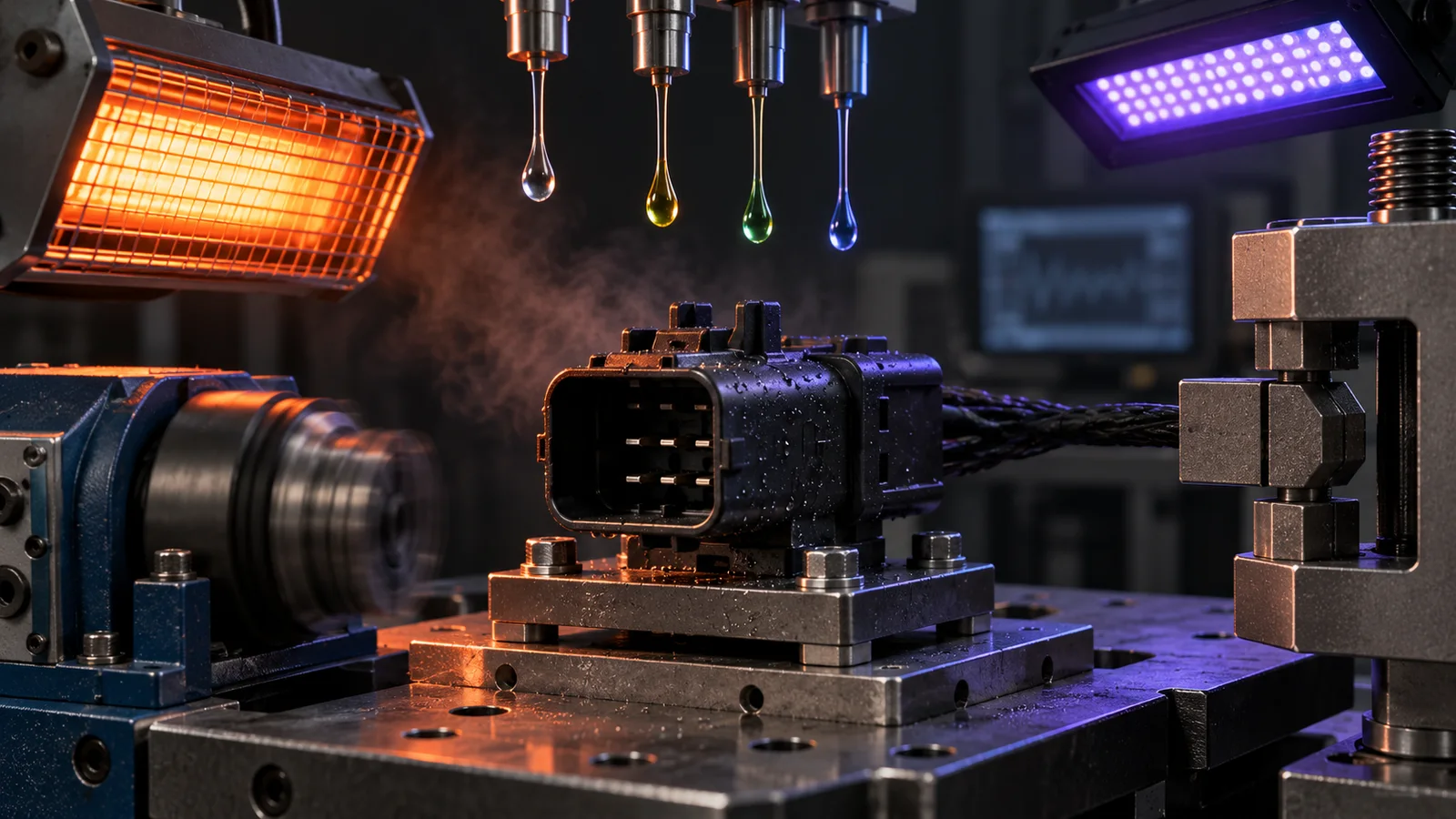
List operating temperature rather than only room-temperature strength. Identify continuous and short-term peaks, thermal cycling, heat sources, and whether the component is constrained during heating. A stiff polymer can still produce poor gap and flush if its thermal expansion and creep are ignored.
Name the fluids, cleaners, oils, fuels, salts, cosmetics, skin contact, humidity, and ultraviolet exposure that may occur. “Chemical resistant” is too broad because polymer response depends on the chemical, concentration, temperature, stress state, and exposure time. Environmental stress cracking often appears when a chemical and molded-in stress act together.
Define the mechanical event: static load, vibration, repeated clip deflection, fastener clamp, impact, bearing load, pressure, or sealing compression. Also define the acceptable outcome after aging. A latch that still operates but loses half its retention force may not meet the product requirement.
The material branch should link back to the parent automotive manufacturing page while preserving its own intent: helping engineers compare polymers, not repeating every vehicle manufacturing process.
Common Polymer Families Solve Different Problems
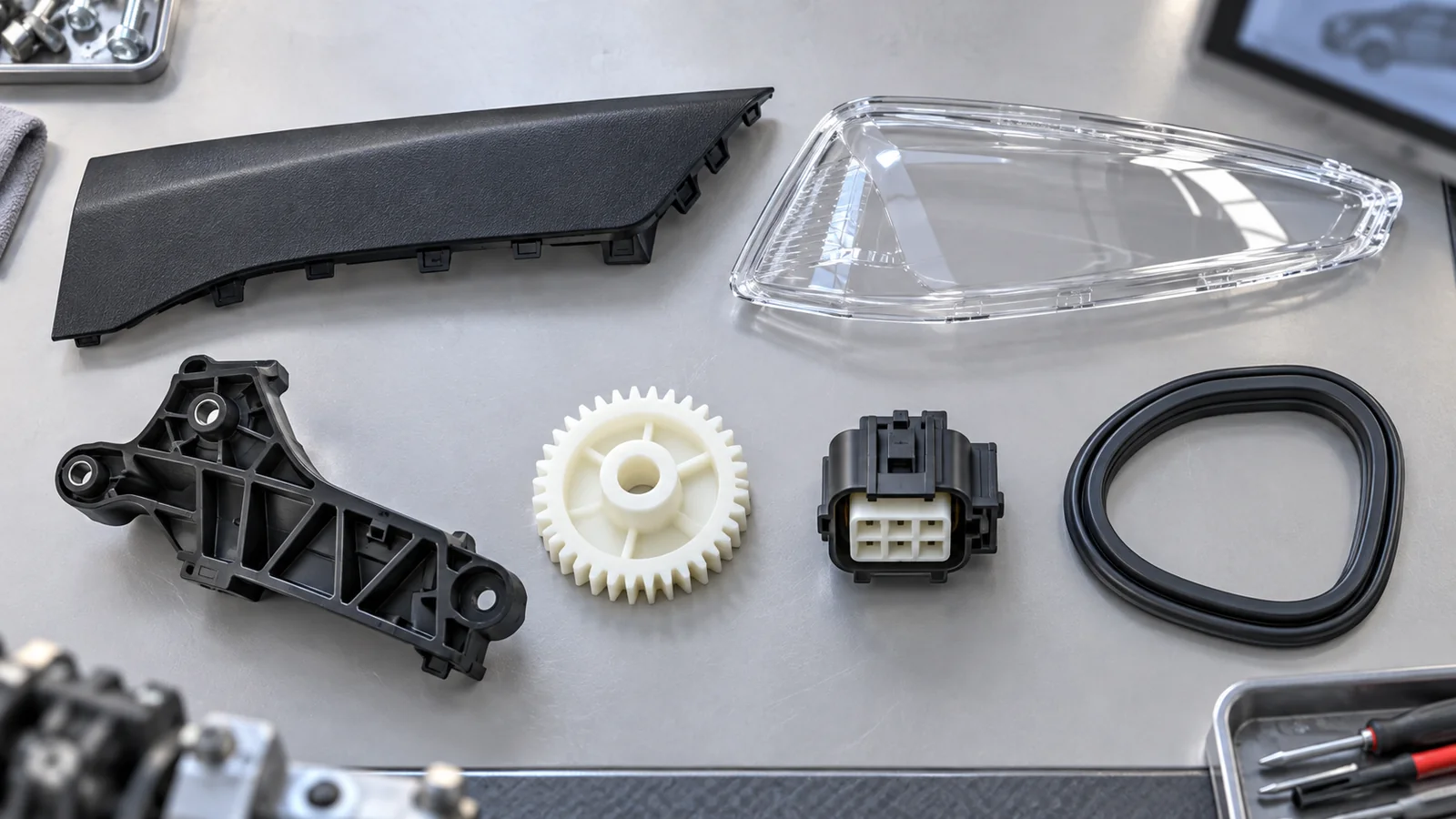
| Famiglia | Often selected for | Review carefully |
|---|---|---|
| PP and modified PP | Low density, chemical resistance, living features, trim | Surface energy, stiffness, paint and thermal expansion |
| ABS and PC/ABS | Interior housings, bezels, appearance and impact balance | Heat, UV, chemical exposure and emissions grade |
| PA6/PA66 | Under-hood strength, clips, brackets and reinforced parts | Moisture conditioning, warpage and dimensional change |
| POM | Low friction, gears, guides and precision mechanisms | Bonding, paint, flame requirements and chemical compatibility |
| PC and PMMA | Transparent covers, lenses and lighting features | Scratch, stress cracking, optical quality and coating |
| PBT/PET | Electrical housings, connectors and dimensional stability | Hydrolysis, weld lines, drying and impact modification |
| TPE/TPU | Seals, grips, flexible covers and damping | Compression set, bonding, abrasion and temperature |
These are families, not final specifications. Grade-level additives, reinforcement, impact modification, UV stabilization, flame retardance, color package, recycled content, and supplier formulation can change processing and performance. Approval should occur at the grade level or through a controlled equivalency process.
Vehicle Location Is a Powerful First Filter
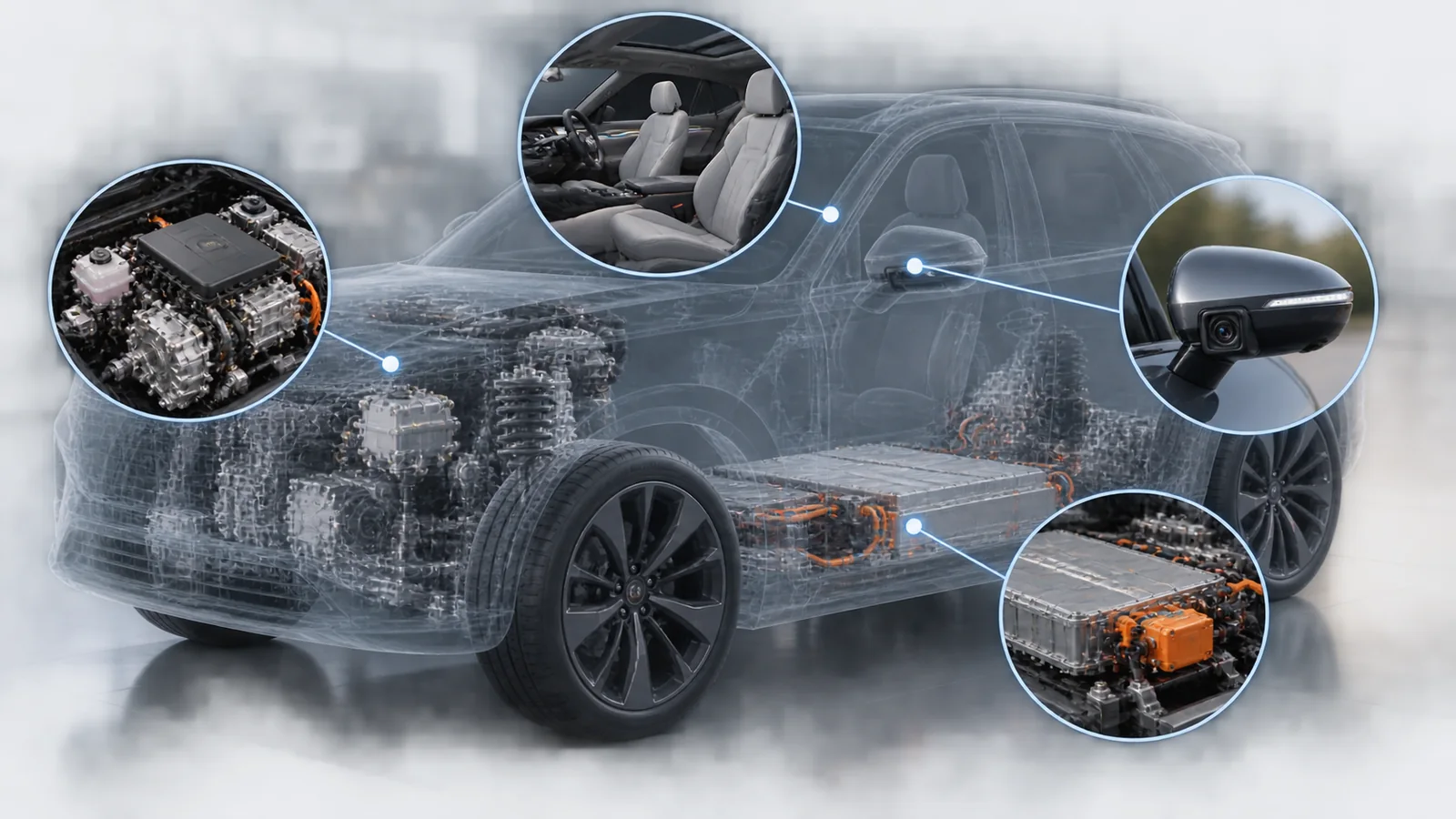
Passenger compartment
Interior materials may need controlled odor, fogging, emissions, color stability, scratch behavior, low gloss, tactile quality, and heat aging under solar load. A material that passes a simple tensile test can still fail perceived-quality requirements after cleaners, skin oils, and repeated touch.
Exterior
Exterior polymers face ultraviolet radiation, water, salt, temperature cycling, stone impact, car-wash chemicals, and visible color change. Paint or coating can extend performance, but the substrate, pretreatment, coating flexibility, and edge geometry must work as a system.
Under hood and thermal zones
Heat, fluids, pressure, vibration, and long-term creep dominate. Heat-stabilized reinforced polyamides, polyesters, PPS, PEEK, and other engineering polymers may enter the shortlist depending on the exact zone. Peak temperature alone is not enough; duration and load at temperature control the decision.
Electrical and high-voltage systems
Insulation, tracking resistance, flame behavior, thermal management, color identification, dimensional stability, and connector retention become important. Material changes can affect creepage geometry, sealing, ultrasonic welding, and terminal retention, so electrical and mechanical validation should remain linked.
Processing and Reinforcement Change the Final Part
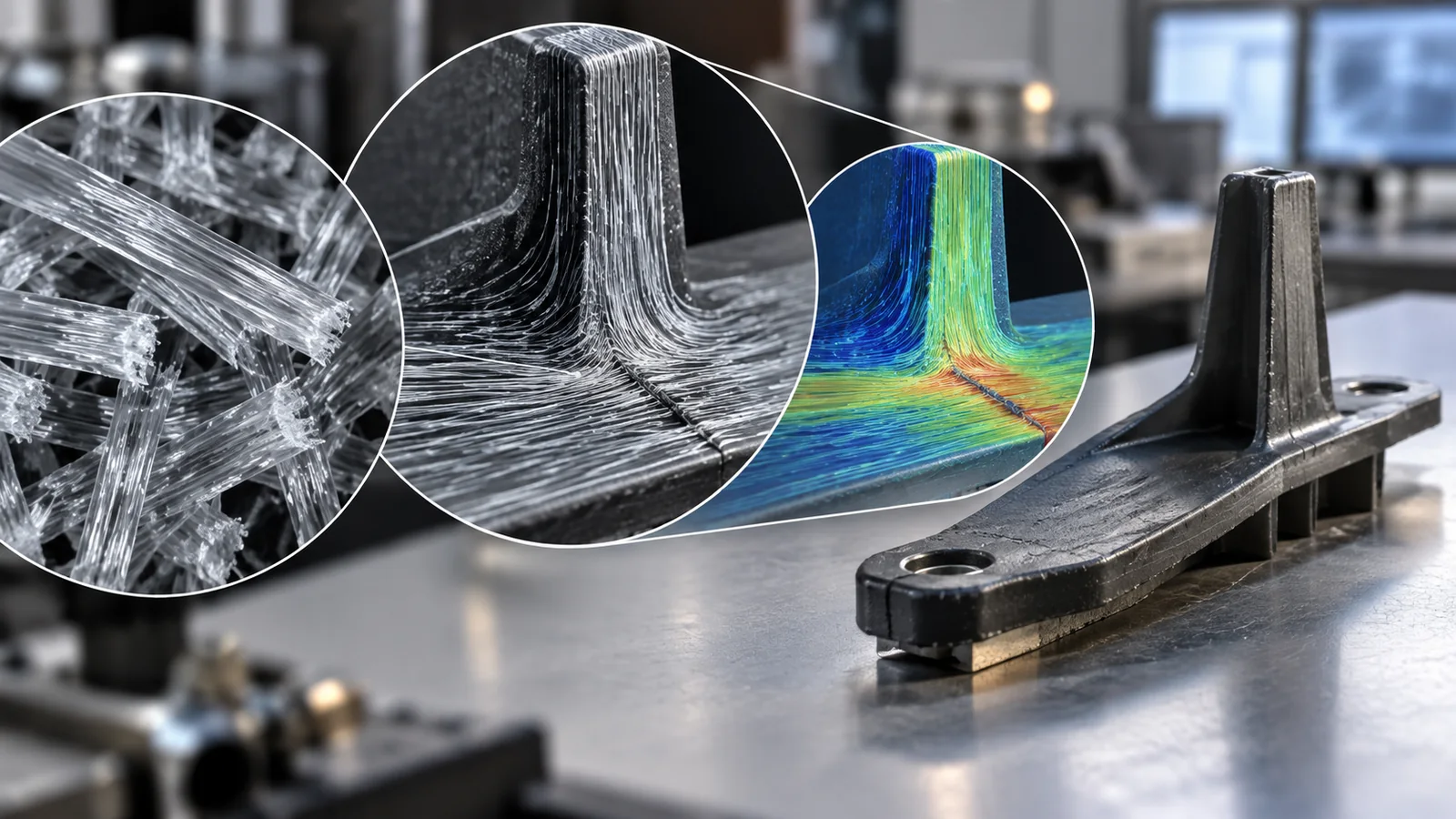
Glass or carbon fiber can increase stiffness and reduce some thermal movement, but it introduces orientation-dependent shrinkage, surface texture, tool wear, and weld-line sensitivity. Mineral fillers may improve dimensional stability or stiffness while changing density and impact behavior. The percentage alone does not describe the result; fiber length, orientation, and molding conditions matter.
Moisture-sensitive polymers require controlled drying. Excess moisture can reduce molecular weight and performance even when the part looks acceptable. Mold temperature, melt temperature, injection speed, packing, cooling, and gate position affect dimensions and internal stress. The automotive injection molding process therefore belongs in material selection, not after it.
Joining must also be screened early. Adhesive bonding, ultrasonic welding, heat staking, laser welding, snap fits, and threaded inserts each interact with polymer chemistry, fillers, surface energy, geometry, and moisture. A material that excels in bulk properties may create an expensive secondary-operation problem.
Validate From Coupon to Assembly
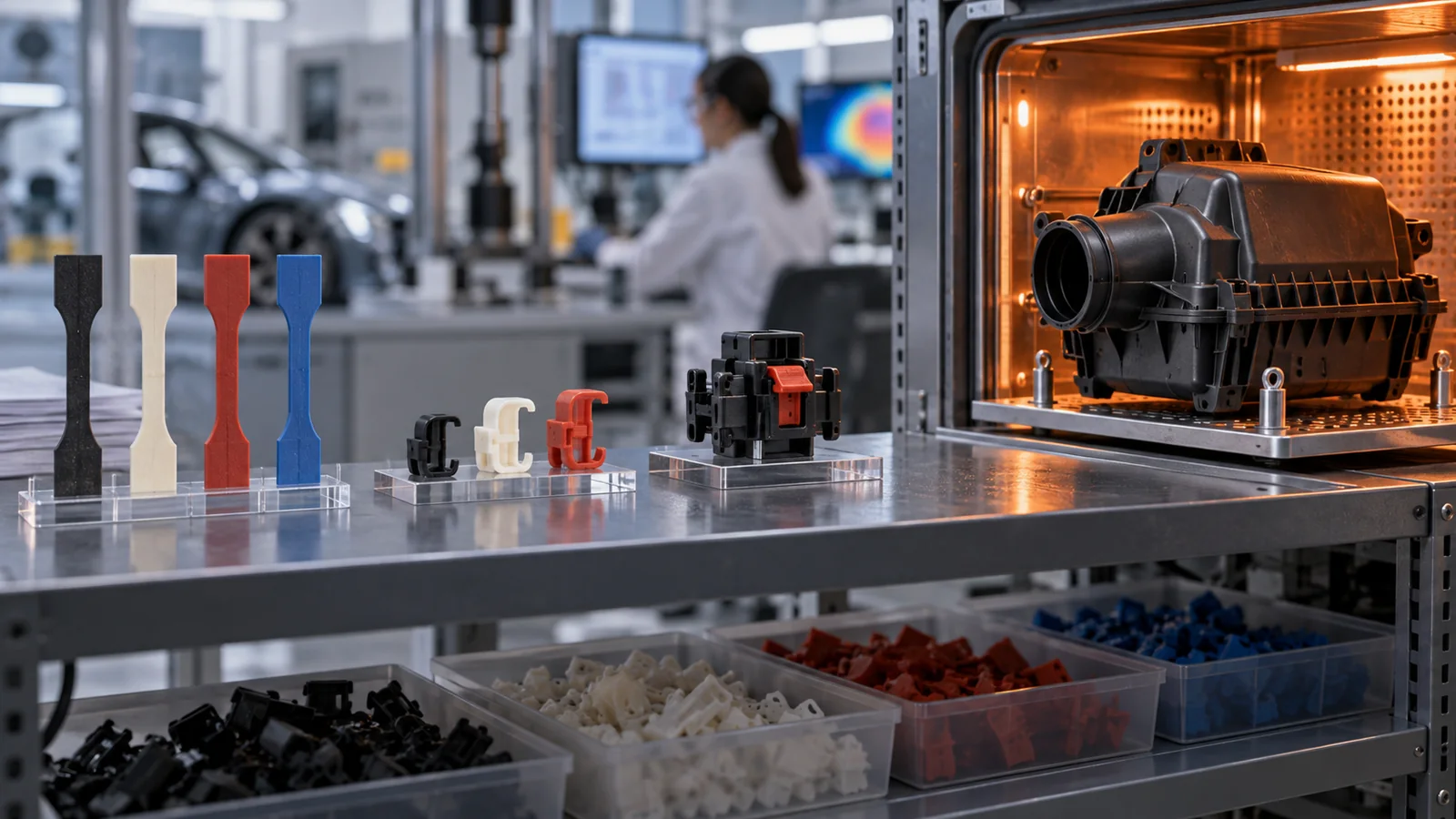
Supplier data sheets are useful for screening, but test methods, specimen thickness, conditioning, color, and processing may differ from the real component. Start with published data, then build evidence through material coupons, representative features, subcomponents, and production-intent assemblies.
- Screen: eliminate materials that miss non-negotiable temperature, chemical, electrical, or regulatory requirements.
- Compare: test shortlisted grades under a shared conditioning and measurement plan.
- Represent: include molded weld lines, ribs, bosses, clips, inserts, and finish where they influence performance.
- Age: apply heat, humidity, chemicals, UV, cycling, and load in combinations that represent use.
- Confirm: repeat critical tests with production tooling, process windows, color, additives, and assembly conditions.
Early prototypes may use substitute materials for geometry learning. Mark those substitutions clearly and connect them to automotive rapid prototyping stages so a successful surrogate test is not mistaken for production material approval.
Write a Specification That Can Survive Purchasing
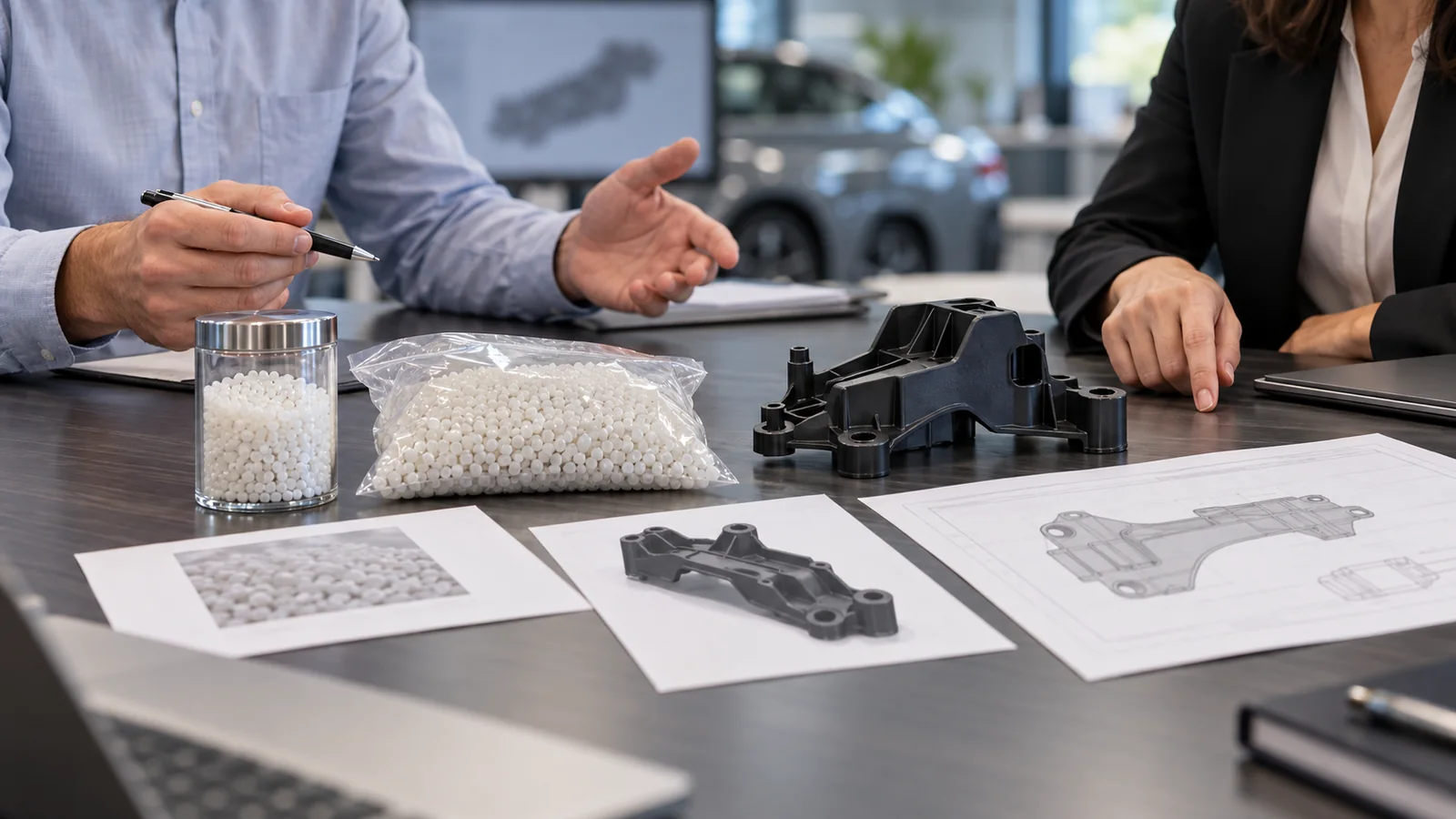
A usable specification identifies an approved grade or a performance-based equivalency route. Include critical mechanical, thermal, environmental, electrical, cosmetic, processing, and compliance requirements. State conditioning and test method where the result depends on them.
Control color and additive packages because pigment, flame retardant, impact modifier, lubricant, and recycled content can alter performance or processing. Define change-notification expectations so a supplier substitution does not enter production as an invisible commercial decision.
Jucheng Precision can connect material selection with machining, printing, tooling, molding, finishing, inspection, and assembly. The value of that connection is practical: material recommendations can be challenged against geometry and process before the program invests in production tooling.
Frequently Asked Questions
What is the most common plastic used in automotive parts?
Polypropylene is widely used because of its low density, chemical resistance, cost, and ability to be modified for trim and functional components. However, “most common” does not mean suitable for every location; temperature, stiffness, appearance, joining, and safety requirements may point elsewhere.
Why do nylon automotive parts change dimensions?
Many polyamides absorb moisture, which changes dimensions and mechanical behavior. Fiber orientation, molding shrinkage, temperature, and conditioning also contribute. Drawings and validation plans should define the relevant moisture state rather than assuming one dry-room dimension represents vehicle service.
Can recycled plastic be used for automotive components?
Yes, when feedstock control, contamination, property variation, appearance, odor, emissions, traceability, and durability meet the component requirements. Recycled content should be validated at the intended percentage and process, not treated as an administrative substitution.
Should a drawing specify a polymer family or an exact grade?
Critical applications usually need an approved grade or a controlled equivalent with measurable requirements. A family-level callout may be adequate during early development, but it leaves too much variation for production approval unless performance and change controls are added.

