
Axson PX 223/HT - Materiale ABS per colata sottovuoto
Axson PX 223/HT is a high-impact polyurethane resin for vacuum casting, simulating tough ABS or ABS/PC blends. It excels where impact resistance, ductility, and moderate heat tolerance are critical (e.g., snap-fits, enclosures, automotive clips). While less rigid than PX 215, its superior toughness and higher HDT make it ideal for demanding functional prototypes and end-use parts across automotive, consumer goods, and industrial sectors. Limitations include UV sensitivity, silicone mold constraints, and lower stiffness than some engineering plastics.
Axson PX 223/HT
Caratteristiche di base
Tipo di materiale: Sistema di resina poliuretanica (PU) termoindurente bicomponente (2K).
Simulazione Target: Engineered to mimic high-impact ABS or ABS/PC blends.
Proprietà chiave:
Simulazione Target: Engineered to mimic high-impact ABS or ABS/PC blends.
Proprietà chiave:
- Impact Strength: Significantly higher than PX 215 (Notched Izod typically ~50-80 J/m).
- Flexural Modulus: Lower than PX 215 (less rigid), offering better toughness and ductility.
- Tensile Strength: Slightly lower than PX 215 (~35-45 MPa).
- Elongation at Break: Higher than PX 215 (~15-30%).
- Heat Deflection Temperature (HDT): ~65-75°C (149-167°F) at 0.45 MPa / 66 psi; higher than PX 215.
- Viscosity: Low viscosity mix (A+B), excellent for degassing and flow.
- Cure Time: Fast demold times (similar to PX 215, ~45-90 minutes).
- Mix Ratio: Typically 100A : 90B by weight (Always consult the TDS).
- Shrinkage: Low (~0.15-0.2%).
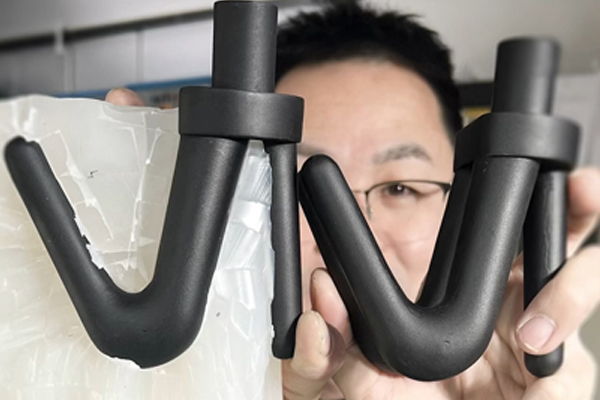
Parametri tecnici principali
| PROPRIETÀ FISICHE | ||||
| PARTE A | PART B | MISCELAZIONE | ||
| Composizione | ISOCIANATO | POLIOLO | ||
| Mixing ratio by weight at 25°C | 100 | 80 | ||
| Aspetto | liquido | liquido | liquido | |
| Colore | incolore | black | black | |
| Viscosità a 25°C (mPa·s) | BROOKFIELD LVT | 1.100 | 700 | 700 |
| Density of parts before mixing at 25°C Density of cured mixing at 23°C | ISO 1675 :1975 ISO 2781 :1988 | 1.17 - | 1.12 - | - 1.14 |
| Pot life at 25°C on 90g (min.) | - | 6 - 7 | ||
PROCESSING (Vacuum casting machine)
• Vacuum casting into silicone molds.
• Both parts have to be processed at a temperature above +18°C.
• Important : Rehomogenize part B before each weighing.
• Degas each part before use.
• Mix for 45 seconds approx.
• Cast in a mold pre-heated at 40°C minimum.
• Allow to cure 45 to 75 minutes at 70°C before demoulding
• Carry out the following thermal treatment : 1 hr at 100°C + 2 hr at 110°C or more if possible.
NOTA : After demoulding it is not necessary to use a conformer to maintain the part in the oven during the post curing. Nevertheless it is advisable to ensure that the geometry or the mass of the part does not present any deformation risk.
PRECAUZIONI DI MANEGGIO
Durante la manipolazione di questi prodotti, osservare le normali precauzioni di salute e sicurezza:
• ensure good ventilation
• wear gloves and safety glasses
Per ulteriori informazioni, consultare la scheda dati di sicurezza del prodotto.
| MECHANICAL PROPERTIES at 23°C | |||
| Modulo di elasticità a flessione | ISO 178 :2001 | MPa | 2.300 |
| Resistenza a flessione | ISO 178 :2001 | MPa | 80 |
| Resistenza a trazione | ISO 527 : 1993 | MPa | 60 |
| Allungamento a rottura in trazione | ISO 527 :1993 | % | 11 |
| Charpy impact resistance | ISO 179/2D :1994 | kJ/m2 | > 60 |
| Durezza - a 23°C - at 120°C | ISO 868 :1985 | Shore D1 | 80 > 65 |
| PROPRIETÀ TERMICHE E SPECIFICHE | |||
| Glass transition temperature | T.M.A.-Mettler | °C | > 120 |
| Coefficient of linear thermal expansion (CLTE) [+15, +120]°C | T.M.A.-Mettler | ppm/K | 115 |
| Ritiro lineare | - | mm/m | 4 |
| Spessore massimo di colata | - | mm | 5 - 10 |
CONDIZIONI DI CONSERVAZIONE
Shelf life of both parts is 12 months in a dry place and in their original unopened containers at a temperature between 15 and 25°C. Any open can must be tightly closed under dry nitrogen blanket.
Scenari e campi di applicazione
Uso primario: Functional prototypes and end-use parts requiring high impact resistance and moderate heat resistance.
Settori e applicazioni chiave:
Settori e applicazioni chiave:
- Automotive: Interior trim clips, snap-fit housings, connectors, under-hood components (non-critical), fluid reservoir prototypes, handles.
- Consumer Electronics: Durable housings for power tools, handheld devices, sports equipment, protective cases, buttons, latches.
- Industrial Equipment: Covers, housings, enclosures, jigs, fixtures requiring impact resistance, levers, handles.
- Consumer Goods: Toys, sporting goods components, ergonomic grips, housings for appliances.
- General Product Design: Parts subject to drops, impacts, or flexing; snap-fits; prototypes needing better toughness than standard ABS simulants.
Adattabilità al Processo di Fusione Sottovuoto:
Ottima Adattabilità: Specifically formulated for vacuum casting.
Adattamenti Chiave:
Adattamenti Chiave:
- Low Viscosity: Ensures easy mixing, thorough degassing, and complete filling of complex molds.
- Vacuum Degassing: Degasses efficiently for bubble-free casts.
- Fast Cure: Enables quick demolding and high productivity per silicone mold.
- Silicone Mold Compatibility: Works well with standard RTV silicone molds.
- Mold Life: Similar to PX 215 (15-25 high-quality parts per mold). Slightly higher exotherm might marginally reduce mold life compared to lower-impact resins.
Vantaggi:
- Superior Impact Resistance: Outstanding toughness for a castable PU resin, excellent for snap-fits and parts prone to impact.
- Good Heat Resistance: Higher HDT than standard ABS-simulating resins (like PX 215).
- Good Chemical Resistance: Resistant to fuels, oils, and many chemicals typical in automotive/industrial settings.
- Fast Processing: Quick demold times enable rapid iteration and production.
- Riproduzione di Alti Dettagli: Excellent flow captures fine details.
- Buona Finitura Superficiale: Smooth surfaces suitable for painting or finishing.
- Verniciabile e Incollabile: Accepts paints, adhesives, and secondary ops well.
- Cost-Effective for Tough Prototypes: Ideal for low-medium volumes needing high impact strength.
Limitazioni:
- Lower Rigidity: Less stiff than PX 215 or true engineering ABS/PC.
- Heat Resistance Limit: Still unsuitable for sustained high-temp applications (>80°C / 176°F).
- Sensibilità ai raggi UV: Will yellow and degrade under UV exposure without protection.
- Sensibilità all'umidità: Requires proper storage and handling.
- Vincolo di durata dello stampo: Limited parts per silicone mold.
- Non è Plastica di Produzione: Lacks long-term durability/stability of injection-molded thermoplastics.
Produttori
ELANTAS PDG (ALTANA Group): Manufactured and distributed by ELANTAS PDG (Prototyping, Design, and Modeling), part of the ALTANA Group (acquired Axson Technologies in 2018). Distributed globally through partners (e.g., Freeman Supply).
Materiali Alternativi Comuni:
Within ELANTAS PDG (Axson):
- PX 215: Standard ABS simulant (higher stiffness, lower impact/HDT).
- FC52 / FC53: Simulates Polycarbonate (PC) - higher HDT and impact than PX 223/HT, but often more brittle and higher cost.
- PX 271: Newer resin often positioned as a high-performance ABS/PC simulant; check specific datasheet vs PX 223/HT.
- Smooth-On Task 15: Popular US alternative for high-impact, ABS/PC-like parts.
- Smooth-On Tusk™XC (formerly Task 10): Very high impact resistance.
- Polytek Poly 74-20 / 74-30: Known for toughness and impact resistance.
- Huntsman RenShape® SL 7820 (epoxy tooling board - machined): For molds, not direct casting alternative.
- VarioCast VK64 / AX92 (Germany): Common European tough PU resins.
- Higher HDT/Stiffness: ELANTAS FC52/FC53 (PC sim), PX 521 epoxy (for tooling/masters).
- More Flexible/PP-like: ELANTAS PX 256, Smooth-On Task 12, Polytek Poly 74-45.
- Standard ABS Sim: ELANTAS PX 215, Smooth-On Task 9, Polytek Poly 74-29.
Scopri di più sui materiali di tipo ABS
- ABS Hei-Cast PU8150 per materiale per colata sottovuoto
- ABS Hei-Cast PU8160 per materiale per colata sottovuoto
- ABS Axson UP4280 per materiale per colata sottovuoto
- Materiale ABS Axson PX100 per colata sottovuoto
- Axson PX215 - Materiale ABS per colata sottovuoto
- Axson PX527 - Materiale ABS per colata sottovuoto
- Axson PX 225 / PX 225L - Materiale per colata sottovuoto ABS

Richiedi il tuo DFM e Preventivo – Carica i tuoi Disegni
ㆍInserisci i tuoi requisiti e carica il tuo file 2D e 3D, ti forniremo il preventivo e il DFM entro 24 ore.ㆍTipi di file: STEP, STP, IGES, IGS, SLDPRT, 3DM, SAT, X_T, DWG, DXF, STL, PDF, ZIP e altri. Dimensione file: < 128 MB Dimensione pezzo: < 1500*1500*1500 mm
ㆍPrivacy: Rispettiamo la tua privacy. Qui puoi trovare un esempio di accordo di non divulgazione. Inviando questo modulo, accetti i nostri termini e condizioni e la politica sulla privacy.
ㆍPrivacy: Rispettiamo la tua privacy. Qui puoi trovare un esempio di accordo di non divulgazione. Inviando questo modulo, accetti i nostri termini e condizioni e la politica sulla privacy.
