


L'inerzia è la tassa invisibile sulla produttività industriale moderna. Ogni millisecondo che un braccio robotico trascorre decelerando, o aspettando che vibrazioni ad alta frequenza si stabilizzino sulla sua punta, è una perdita nella redditività della fabbrica. Per decenni, il settore dell'automazione è rimasto intrappolato in un ciclo di sovraingegnerizzazione, affidandosi a pinze in alluminio pesanti e squadrate e telai in acciaio saldato che stressavano i servo-motori e limitavano la capacità di "forza G" del mandrino. Questo peso meccanico ha raggiunto il punto di rottura. Mentre ci spingiamo verso l'era dei robot collaborativi (cobot) e della smistamento ultra-veloce, l'agilità dell'hardware deve finalmente eguagliare la velocità del software. Questa è l'origine strategica di Prototipazione per l'Automazione Robotica. È una transizione dal semplice assemblaggio all'integrazione strutturale, che permette agli ingegneri di sviluppare end-effector scheletrici che sono 70% più leggeri rispetto alle loro controparti metalliche tradizionali senza sacrificare un solo Newton di forza di serraggio.
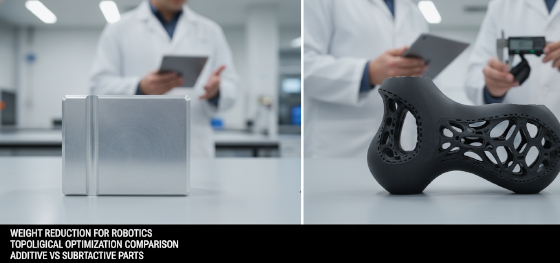
JUCHENG opera come un santuario tecnico per le principali aziende di automazione del mondo, dalle startup di robotica medica ai produttori automobilistici di primo livello. Riconosciamo che un componente robotico non è solo una staffa; è un atleta ad alta accelerazione che deve sopravvivere a milioni di cicli senza affaticamento microscopico o deriva dimensionale. Unendo la forza grezza delle poliammidi rinforzate con fibra di carbonio con la certezza a livello di micron della finitura CNC a 5 assi, forniamo una roadmap unificata per l'innovazione funzionale. La nostra struttura, dettagliata nel nostro hub di Produzione per l'Automazione Robotica, è ottimizzata per rimuovere il "Compromesso Geometrico" che di solito rovina il movimento ad alta velocità. Questa guida va oltre i semplici mockup visivi per esplorare la fisica della massa cinetica, la logica dei circuiti pneumatici interni e perché l'approccio integrato di JUCHENG ai materiali ad alta durabilità garantisce che i vostri sistemi automatizzati operino al massimo assoluto delle loro prestazioni teoriche.
L'efficienza nel mondo automatizzato è conquistata da chi riesce ad aumentare la capacità di carico senza aumentare il consumo energetico. Non state solo acquistando una pinza in plastica; state acquistando la capacità di muovervi più velocemente con meno usura meccanica. Che stiate costruendo un innovativo smistatore per magazzino o un robot chirurgico sub-micronico, la logica della stampa e la precisione della fresatura sono i vostri maggiori vantaggi competitivi. Analizziamo i pilastri tecnici delle soluzioni additive robotiche e vediamo come la lungimiranza tecnica possa fissare l'integrità del vostro prossimo breakthrough automatizzato nella realtà fisica.
Sovranità Cinetica: Combattere il Momento d'Inerzia

La forza lineare è semplice da calcolare, ma il "Momento d'Inerzia" è ciò che distrugge un braccio robotico. Nel rigoroso mondo della Prototipazione per l'Automazione Robotica, ci concentriamo sulla fisica delle estremità. Ogni grammo di peso aggiunto all'end-effector robotico agisce come un carico moltiplicato contro gli ingranaggi interni e i servoazionamenti dei giunti principali del braccio. Se la vostra pinza è 500 grammi sovrappeso, il vostro robot non è solo più lento—è fisicamente più caldo. I motori devono assorbire più corrente per iniziare il movimento e esercitare più coppia contraria per fermarlo, portando a "Vibrazioni di Assestamento" in cui il braccio oscilla per diversi millisecondi prima di trovare il suo bersaglio. Per un'operazione di prelievo ad alta velocità in un magazzino e-commerce, questi millisecondi persi si traducono in migliaia di prelievi mancati al giorno.
JUCHENG risolve questo attraverso l'ingegnerizzazione dei "Vuoti Digitali". Abbandoniamo la mentalità del blocco pieno. Utilizzando le tecnologie Multi Jet Fusion (MJF) e SLS, produciamo componenti strutturali che utilizzano reticoli giroidi interni. Queste architetture scheletriche forniscono l'esatto modulo di flessione richiesto per il sollevamento pesante ma con 60% in meno di massa materiale. Questa riduzione di peso cinetico abbassa l""Impulso di Forza" sui giunti del braccio, consentendo curve di accelerazione aggressive che l'hardware tradizionale non può sopportare. Per i nostri clienti dell'assemblaggio automobilistico, questo rappresenta la "Sovranità Cinetica"—la capacità di eseguire cicli 15% più velocemente mentre si estende contemporaneamente la vita utile degli attuatori robotici. Non stampiamo solo parti; ingegnerizziamo la rimozione della massa, assicurando che i vostri sistemi automatizzati siano reattivi quanto il codice che li guida.
Labirinti Integrati: Progettazione di Circuiti Pneumatici Interni
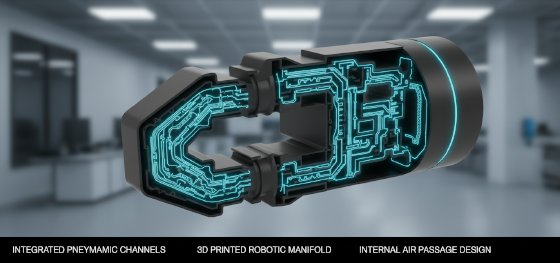
Le tradizionali "mani" robotiche sono spesso un caotico groviglio di tubi esterni, raccordi in ottone e fascette. Questi "Cordoni Ombelicali" non sono solo antiestetici; sono passività operative. In un movimento ad alta velocità a 6 assi, un tubo pneumatico esterno può impigliarsi in un attrezzo, sfregare contro un telaio o sviluppare una perdita a causa della flessione costante. Questo porta a tempi di fermo imprevedibili. Una Prototipazione per l'Automazione Robotica di successo richiede l'eliminazione di questi punti di guasto esterni. In Jucheng Precision, sfruttiamo la libertà geometrica della produzione additiva per "nascondere l'impianto idraulico" all'interno dello scheletro del pezzo.
Progettiamo e produciamo pinze robotiche con canali d'aria interni integrati—labirinti curvi e organici scolpiti nelle stesse pareti del nylon strutturale. Questa "Integrazione Fluidica" elimina la necessità di ingombranti raccordi esterni e riduce il rischio di impigliamento a zero. Questi percorsi interni sono matematicamente ottimizzati per prevenire cadute di pressione, consentendo un innesto quasi istantaneo del vuoto. Per garantire che questi vuoti interni siano perfettamente ermetici, JUCHENG utilizza polveri di Nylon 12 ad alta densità e levigatura a vapore automatizzata. Questo trattamento chimico scioglie i pori microscopici del materiale, creando una pelle sigillata e ad alta pressione che funziona come un collettore in alluminio lavorato ma a una frazione del peso. Trasformando la pinza in un "Utensile Intelligente" monolitico, semplifichiamo il vostro assemblaggio e blocchiamo la logica fluidica interna più complessa in una struttura compatta e senza manutenzione che sopravvive ai più estenuanti cicli produttivi 24 ore su 24, 7 giorni su 7.
Material Fortification: Why Carbon-Fiber Infusion Rules the Floor
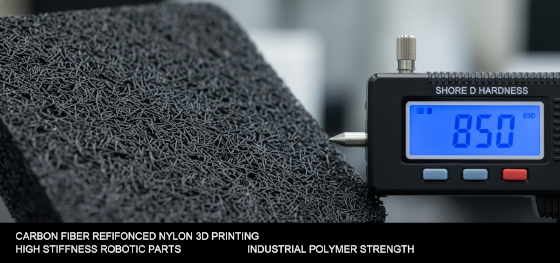
Standard polymers often fail in the abrasive, chemical-heavy environment of the factory floor. They "creep" under constant load, warp near high-heat welding cells, or develop stress-cracks from the high-frequency vibrations of a CNC spindle. This is the durability gap that JUCHENG bridges through "Material Fortification." For structural robotic mounts and high-torque sensor brackets, we utilize Carbon-Fiber reinforced polyamides (Nylon-CF). This composite is the backbone of modern Prototipazione per l'Automazione Robotica, offering a tensile modulus that challenges soft aluminum alloys while retaining the vibration-damping characteristics of a high-end polymer.
The addition of microscopic carbon fibers provides a "Mechanical Spine" that prevents the dimensional drift common in lower-grade plastics. It ensures that a high-definition vision system mount stays perfectly calibrated to its datum even after months of high-G impacts. We also specialize in high-performance materials like PEEK 3D Printing for robotic components that must operate in sterilized medical labs or near industrial ovens. By selecting materials based on their molecular resistance to creep and fatigue, we ensure your 3D printed robotic hardware isn't a temporary prototype—it is a production-ready asset. Our engineering team audits your load-case and chemical environment to determine if you need the raw impact strength of Nylon 11 or the extreme rigidity of a carbon composite, ensuring your automation vision is built on a foundation of structural permanence.
Sensory Shelters: Engineering Custom Mounts for High-Def Optics
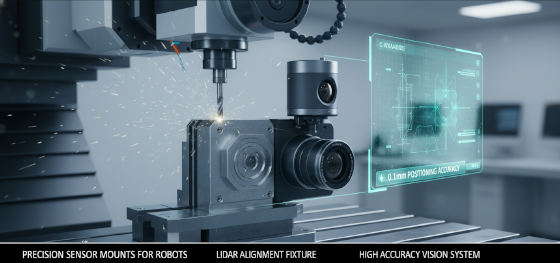
Optical integrity is a fragile asset in the vibration-heavy environment of a manufacturing cell. As robots evolve to perform high-precision inspection and autonomous navigation, the sensors they carry—high-resolution cameras, LiDAR units, and ultrasonic transducers—become the most valuable components on the arm. A mounting bracket that flexes by a single millimeter or vibrates at the wrong frequency can cause "Optical Blur," rendering an expensive AI vision system useless. Prototipazione per l'Automazione Robotica for sensory equipment is not just about holding a part; it is about creating a stabilized sanctuary for photons and data.
Jucheng Precision utilizes a "Damping-First" design philosophy for sensor mounts. We recognize that while metal mounts are rigid, they often transmit high-frequency harmonics directly from the motors to the lens. By utilizing MJF or SLS nylon, we exploit the material's natural polymer damping characteristics to absorb these micro-vibrations. However, where absolute axis alignment is required, we move toward a hybrid metal-plastic mount. We utilize our 5-axis CNC machines to carve the primary optical datums into 6061 aluminum, providing a rock-solid reference point for the camera's sensor. We then overmold or assemble this metal core into a 3D-printed housing that handles the complex cable routing and environmental protection. This multi-material strategy ensures your vision systems stay perfectly calibrated even during aggressive 4G acceleration moves, providing the "Sensory Sovereignty" needed for modern applicazioni industriali della stampa 3D in the autonomous vehicle and high-speed sorting sectors.
Rapid EOAT Iteration: From CAD to Clamping in 48 Hours
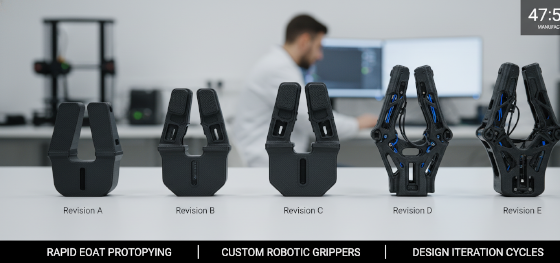
Design cycles in the robotics sector have outgrown the eight-week lead time of traditional tool-making. In a world of agile hardware, the ability to iterate on a "Grip Logic" determines the speed of market entry. If a robot drops a part during a test run, waiting a month for a new set of aluminum fingers to be milled is a project-killing delay. Prototipazione per l'Automazione Robotica transforms this bottleneck into a high-speed digital loop. Because additive manufacturing requires zero physical dies or fixtures, JUCHENG can produce a new iteration of an End-of-Arm Tool (EOAT) in a matter of days.
We utilize this velocity to help our clients perform "Kinematic Stress Tests" early in the development cycle. Our facility is equipped to handle "Revision Sprints," where an engineer can upload a CAD file on a Monday and hold a functional, carbon-fiber reinforced gripper by Wednesday. This speed allow for a "Fail-Fast" methodology—testing aggressive geometries, thin-walled vacuum cups, and complex interlocking hinges under real loads. If a design fails, the cost of the iteration is measured in dollars, not thousands. This iterative sovereignty is what allows JUCHENG to support startups and global OEMs alike. We bridge the gap between digital theory and visceral hardware, ensuring your robotic fingers possess the exact "tactile honesty" needed to secure your specific payload without damaging sensitive surfaces.
Hybrid Metamorphosis: CNC Finishing for Mission-Critical Interfaces
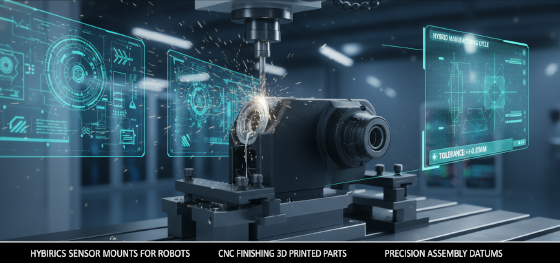
Complexity is a technical superpower, but it shouldn't come at the cost of precision. 3D printing provides the geometric freedom to create internal labyrinths and topologically optimized frames, but it often fails at the "Critical Interface." A 3D printer cannot consistently deliver an H7 bearing bore or a mirror-finish seal surface to a +/- 0.01mm tolerance. Jucheng Precision eliminates this "Accuracy Gap" through our hybrid manufacturing workflow. We don't just "print and ship"; we treat the 3D printer as a high-tech foundry that produces an "Advanced Preform."
Every high-performance robotic component we manufacture undergoes a "Metamorphosis" after the additive build is complete. We print your complex designs with an extra 1.5mm of "Machining Stock" on all critical assembly datums. Once the part has been thermally stabilized through a vacuum-annealing cycle, it moves to our 5-axis CNC floor. Our high-speed mills carve away the near-net texture, revealing the surgical accuracy needed for bearing seats, precision-tapped threads, and high-pressure fluid ports. This integrated approach is why JUCHENG is the preferred partner for medical surgical robots and high-speed delta-robots. We eliminate the accountability gap between additive bureaus and machine shops, providing a single, verified engineered solution that possesses the lightweight freedom of additive and the sub-micron certainty of CNC. We ensure your robotic assemblies fit perfectly the first time, every time, regardless of how complex the geometry has become.
JUCHENG’s Reliability Standard: Validation via CMM and IATF 16949
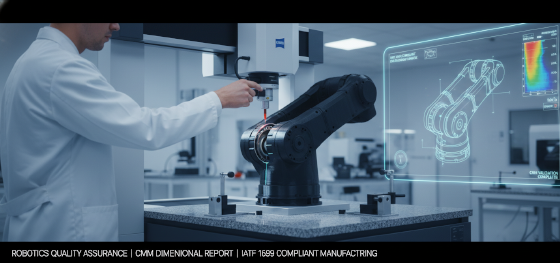
Trust is the final, essential component in a successful prototype. Choosing a partner for high-stakes Prototipazione per l'Automazione Robotica is a decision of technical liability. Most shops treat 3D printing as a visual craft; Jucheng Precision operates a facility where additive manufacturing is a documented engineering discipline. We have centered our quality ecosystem around the most demanding global standards, holding both ISO 9001 and IATF 16949 certifications. This means our process control is not a suggestion—it is a system.
Our quality protocol includes a full "Structural Audit" of your robotic components. We utilize high-resolution Coordinate Measuring Machines (CMM) and 3D laser scanners to generate digital heatmaps of dimensional compliance. We don't just check the outside; we use ultrasonic testing and X-ray analysis for mission-critical metal prints to verify that there are zero internal voids or hidden fusion defects. For our automotive and medical clients, we provide full material lot-traceability and documented process validation. When you receive a shipment from JUCHENG, you aren't just getting metal and plastic; you are getting the verified certainty that your hardware is ready for 24/7 industrial service. We bridge the gap between a design and a survivor. Our expertise in high-fidelity materiali per stampa 3D ensures that your vision is delivered with the absolute visual and structural integrity needed to win in the automation race.
Technical Verdict: Why Integration Defines the Next Era of Robotics
The success of a modern automation project is decided by the management of complexity. In a market where components must be lighter, faster, and more integrated, the traditional model of fragmented manufacturing is an expensive bottleneck. Selecting Jucheng Precision for your Prototipazione per l'Automazione Robotica needs is a strategic move toward industrial stability. We remove the uncertainty of material choice and the friction of multiple setups, ensuring that the machinist, the additive technician, and the quality auditor are all reading from the same engineering playbook.
We invite you to challenge our engineering team with your most ambitious designs. Whether you are building an innovative heart-lung machine bypass pump or a high-speed satellite deployment mechanism, JUCHENG provides the technical rigor and the manufacturing capacity to deliver. Our mastery of the processo di stampa 3D, combined with our world-class CNC floor, allows us to optimize your parts for both performance and price. Don't let your innovation be limited by the weight of legacy manufacturing. Experience the clarity and the capability that integrated robotic prototyping can bring to your next breakthrough. Visit our specialized hub for Robotics Automation Manufacturing to see our full technical scope. Contact Jucheng Precision today for a comprehensive technical DFM review and let our engineers help you build a bigger, better, and more profitable physical reality.

