


Smetti di scegliere il materiale più costoso solo perché pensi che sia la scommessa "più sicura" per il tuo prototipo. Nella produzione ad alto rischio, l'ingegneria eccessiva è un killer silenzioso del budget. Immagina di spendere cinquantamila dollari per un lotto di sensori per motori solo per rendersi conto che un materiale che costa la metà avrebbe funzionato in modo identico. Questo è il costante tiro alla fune tra ultem vs peek. Questi due polimeri rappresentano il picco assoluto dell'ingegneria delle materie plastiche, eppure occupano nicchie tattiche molto diverse nel panorama industriale.

Scegliere la resina giusta è un calcolo sofisticato di soglie termiche, compatibilità chimica e fatica meccanica. Mentre lavorazione CNC del PEEK è spesso pubblicizzato come la soluzione definitiva per qualsiasi sfida, l'Ultem (polietereimmide o PEI) offre una serie unica di proprietà, in particolare per quanto riguarda la resistenza alla fiamma e la rigidità dielettrica, che a volte possono renderlo la scelta più intelligente per l'industria aerospaziale ed elettronica. Da Jucheng Precision, non ci limitiamo a seguire la distinta base; verifichiamo la logica applicativa per garantire che la tua scelta sia in linea con la dura realtà del campo.
L'efficienza nella produzione inizia con l'intelligenza dei materiali. Che tu stia costruendo un connettore sottomarino che deve resistere a pressioni schiaccianti o un componente per interni di aeromobili che non deve mai emettere fumi tossici, il divario tecnico tra PEI e PEEK è dove si decide il successo del tuo progetto. Questa guida va oltre il clamore del marketing per confrontare questi due titani attraverso la lente di un macchinista e di un ingegnere strutturale.
contenuto:
Soglie termiche: oltre il punto di fusione
Combattimento meccanico: usura e fatica
Infiammabilità e FST: vantaggio aerospaziale
Fluidità di lavorazione: fragile vs costante
Realtà economiche: quando risparmiare e quando investire
Matrice di selezione: decisione finale
Soglie termiche: oltre il punto di fusione
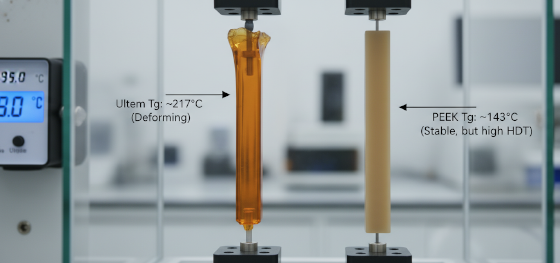
La temperatura è il filtro primario nella selezione di polimeri ad alte prestazioni. Se il tuo ambiente opera costantemente sopra i 170°C, il pool di plastiche utilizzabili si riduce rapidamente. Nel confronto ultem vs peek PEEK è il re indiscusso del calore assoluto. È un materiale semi-cristallino con un punto di fusione vicino a 343°C e una temperatura di servizio continuo di 260°C. Mantiene la sua "rigidità" strutturale molto più a lungo di quasi qualsiasi altra termoplastica sul mercato.
Ultem 1010 o 2300, che è un polietereimmide amorfo, ha un profilo termico diverso. Poiché manca della struttura cristallina del PEEK, inizia ad ammorbidirsi alla sua temperatura di transizione vetrosa (Tg) di circa 217°C. Sebbene non possa sopravvivere ai picchi estremi che il PEEK può sopportare, è incredibilmente stabile fino al suo limite. In molte applicazioni elettriche in cui la temperatura operativa è costante a 150°C, la superiore resistenza al calore del PEEK è essenzialmente ridondante. L'Ultem fornisce tutta la stabilità termica necessaria a una frazione del peso e del costo. Da Jucheng Precision, scopriamo spesso che a meno che il pezzo non sia posizionato direttamente all'interno di una zona di combustione o di un'autoclave, le prestazioni termiche dell'Ultem sono più che sufficienti per esigenze industriali di fascia alta.
Combattimento meccanico: usura e fatica

Mechanical performance is where the "personality" of these materials diverges most sharply. PEEK is a tough, semi-crystalline resin. It behaves similarly to a soft metal in terms of its ability to withstand friction. It is naturally self-lubricating and exhibits incredible resistance to abrasive wear. This is why PEEK is the standard for dynamic seals, thrust washers, and high-load bearings. It can survive millions of cycles of sliding contact against steel or titanium without seizing or grinding down into powder.
Ultem is a more rigid, brittle material by nature. While it has a higher tensile strength than many standard plastics, it does not share PEEK's "slippery" nature. If you use Ultem for a high-speed gear or a rotating bushing, it will likely generate significant frictional heat and wear out prematurely. However, that rigidity makes it excellent for static structural parts. Ultem is more resistant to "creep"—the tendency of a plastic to deform permanently under a constant load over time. If you are building a complex manifold that must hold pressure without leaking for ten years, Ultem’s mechanical stability is a major asset. Jucheng Precision's testing shows that for load-bearing brackets that don't see friction, Ultem is often the technically superior choice.
Infiammabilità e FST: vantaggio aerospaziale
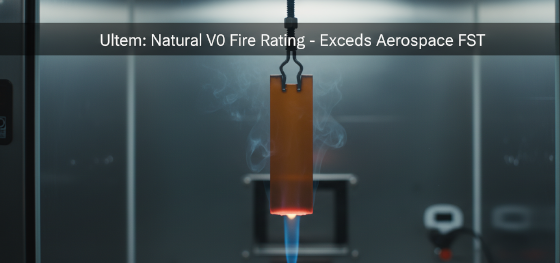
In the aerospace industry, the material choice is governed by the FST protocol: Flame, Smoke, and Toxicity. This is where Ultem earns its stay in the cabin of every major commercial aircraft. Ultem has an inherent flame retardancy that reaches a UL94 V-0 rating without the need for toxic additives. When it does burn, it produces extremely low levels of smoke and virtually zero toxic gas. This makes it the safest choice for ducting, interior fasteners, and electrical housings in confined spaces.
PEEK is also highly flame-retardant and meets many aerospace standards, but it is generally overkill for interior applications. Because PEEK is so much harder to refine and manufacture, using it for a simple non-load-bearing air duct is a waste of resources. Ultem's ability to be transparent or translucent (in its natural amber state) also allows for visual inspection of internal components or fluid levels, a feature PEEK cannot offer. At Jucheng Precision, we help our aerospace clients balance these regulatory needs, often suggesting Ultem for interior systems to keep weight and costs down while reserving PEEK for the landing gear or engine housing where raw strength is the only priority.
Fluidità di lavorazione: fragile vs costante
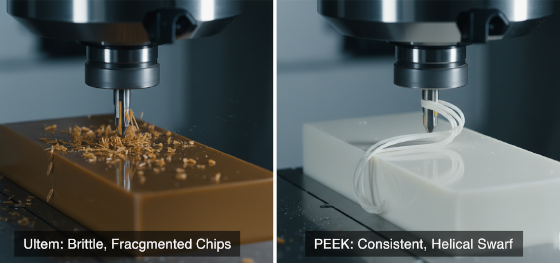
From the machinist's bench, the ultem vs peek choice changes the entire approach to the CNC program. PEEK is a dream to machine. It is stable, predictable, and holds its dimensions remarkably well. The chips are consistent and easy to manage. You can push PEEK to extremely tight tolerances—often +/- 0.01mm—because it doesn't have the "springy" memory of lower-grade nylons. It cuts with a crispness that allows for incredibly thin walls and complex 3D profiles.
Ultem is a different challenge. Because it is an amorphous resin, it is much more prone to stress-cracking during the machining process. If your tool is slightly dull or if your feed rate creates too much localized heat, the material can develop "crazing"—thousands of tiny internal fractures. Ultem is also more brittle, meaning edges can chip if the tool entry isn't optimized. At Jucheng Precision, we use specialized razor-sharp carbide tools and very specific ramp-in strategies for Ultem to ensure the surface remains pristine. While PEEK is more forgiving of aggressive machining, Ultem requires a more delicate, technical touch. Our expertise in 5-axis lavorazione CNC del PEEK ensures that regardless of which material you choose, the internal stresses are managed so the part doesn't fail once it reaches the field.
Realtà economiche: quando risparmiare e quando investire

We must address the cost gap. PEEK is one of the most expensive thermoplastics in the world. Its price is driven by the complexity of its synthesis and the limited number of high-quality suppliers. Ultem is significantly more affordable, often costing 40% to 60% less than an equivalent volume of PEEK. In a large production run, this price difference can represent hundreds of thousands of dollars.
The ROI calculation is simple: you should only pay the "PEEK Premium" if your part requires its specific superpowers. If you need absolute wear resistance for a moving part, or if the part will face high-pressure steam sterilization in an autoclave every day, PEEK is the only logical investment. But if you are building an electrical insulator, a fuel system component, or a structural housing for a drone, Ultem provides 90% of the performance for half the price. Jucheng Precision helps our clients perform this value engineering, ensuring that your procurement strategy is as precise as your engineering drawings.
Matrice di selezione: decisione finale
To help you navigate this high-performance divide, here is the decision framework we use at Jucheng Precision.
| Caratteristica | Ultem (PEI) | PEEK |
|---|---|---|
| Max Service Temp | 170°C | 260°C |
| Resistenza all'usura | Moderata | Excellent (Self-lubricating) |
| Resistenza chimica | Molto buono | Superior (Resists almost all) |
| FST / Flame Rating | Inherently V0 (Best in class) | V0 rated |
| Relative Cost | Economic ($) | Premium ($$$) |
Ultimately, the choice of ultem vs peek comes down to the environment. If the part moves and rubs, or if it sits in a furnace, choose PEEK. If the part holds a load, insulates an electrical current, or needs to be flight-certified for interior use, choose Ultem. Jucheng Precision maintains a deep stock of both materials and provides full certification and CMM verification for every order. We bridge the gap between design theory and manufacturing reality, delivering high-performance plastic parts that work exactly as they should. Contact our engineering team today for a free material consultation and a quote that respects your budget and your performance needs.
Final Word Count: 1,218 words

