


La sicurezza nella stratosfera non è una variabile; è un requisito tecnico codificato. Quando si progetta un componente interno di un aeromobile o una staffa automobilistica sotto il cofano, la paura principale non è solo il cedimento strutturale, ma il pericolo di incendio. Nel vasto catalogo del plastica per stampa 3D settore, la maggior parte dei materiali sono essenzialmente combustibili. Si sciolgono, bruciano ed emettono fumi tossici. Esiste, tuttavia, un'eccezione d'élite che colma il divario tra la versatilità della plastica e la sopravvivenza aerospaziale. Questo è il sofisticato mondo della stampa 3D in Ultem. La polietereimmide (PEI), conosciuta con il marchio Ultem, è una termoplastica amorfa ad alte prestazioni che offre un incredibile rapporto resistenza/peso combinato con una ritardanza di fiamma intrinseca. È l'unico materiale additivo che consente agli ingegneri di passare direttamente da un mock-up digitale a un componente certificato per il volo e di uso finale.

Presso JUCHENG, riconosciamo che la stampa con resine ad alta temperatura come l'Ultem rappresenta un passo verso un livello produttivo ad alta responsabilità. Non è possibile ottenere il necessario legame molecolare del PEI su una macchina da tavolo standard. Se la camera di costruzione non viene riscaldata attivamente a livelli estremi, il pezzo subirà deformazioni catastrofiche e "delaminazione interna" che non è visibile fino a quando il pezzo non cede sotto carico. Abbiamo progettato il nostro impianto additivo per soddisfare le rigorose esigenze dei settori aerospaziale e della difesa, utilizzando sistemi FDM di grado industriale che mantengono la sovranità termica sull'intero volume di costruzione. Questa guida va oltre le definizioni di base per esplorare la chimica della conformità FST, la differenza meccanica tra Ultem 9085 e 1010, e perché l'approccio integrato di JUCHENG all'estrusione ad alta temperatura è il passo finale per garantire che i vostri progetti critici sopravvivano al calore del mondo reale.
L'affidabilità in ambienti estremi si trova nella gestione dello shock termico. Non stai solo impilando strati di resina; stai gestendo un evento di cambiamento di fase a 400°C che deve risultare in un solido monolitico stabile. Che tu stia costruendo un condotto d'aria leggero per un satellite o un connettore elettrico ad alta tensione, la logica della fusione è la tua più grande risorsa ingegneristica. Esaminiamo i pilastri tecnici dell'estrusione industriale di Ultem e vediamo come JUCHENG blocca l'integrità dei tuoi progetti più ambiziosi nella realtà.
Sovranità Termica: Il Requisito della Camera a 180°C
Selezione del Materiale: Decifrare la Logica 9085 vs 1010
Sovranità FST: Perché l'Aerospaziale si Affida alla Chimica del PEI
Sporgenze di Precisione: Gestione del Supporto Solubile ad Alta Temperatura
Standard di Certificazione JUCHENG: Oltre il Mandrino
Dati Tecnici: Baseline delle Proprietà Meccaniche dell'Ultem
Sovranità Termica: Il Requisito della Camera a 180°C

Il principale nemico dell'estrusione ad alte prestazioni è il gradiente di temperatura. Quando si fonde il filamento di Ultem a 360°C e lo si estrude in un ambiente non controllato, il materiale subisce uno shock termico immediato. Le resine amorfe come il PEI hanno un'alta temperatura di transizione vetrosa (Tg) di circa 186°C. Se l'aria ambiente intorno al pezzo è più fredda di questa soglia, le catene polimeriche si congelano istantaneamente, impedendo loro di legarsi con lo strato successivo. Ciò produce pezzi visivamente corretti ma strutturalmente "delaminati"—si spaccheranno lungo le linee di strato nel momento in cui vengono sottoposti a coppia o vibrazione.
Presso JUCHENG, eliminiamo questa vulnerabilità meccanica attraverso una sovranità termica assoluta. Le nostre piattaforme FDM industriali utilizzano camere di costruzione riscaldate attivamente che mantengono un ambiente costante a 180°C. Questo mantiene l'intero pezzo in uno stato semi-rilassato durante il ciclo di costruzione di ore. Mantenendo questa temperatura elevata, garantiamo che l'interfaccia tra gli strati rimanga chimicamente attiva, consentendo il massimo possibile cross-linking lungo l'asse Z. Questa disciplina termica è l'unico modo per raggiungere le tolleranze di +/- 0,15 mm richieste per i componenti interni aerospaziali. Non "stampiamo" semplicemente l'Ultem; gestiamo un evento di raffreddamento lento e controllato che blocca la precisione dimensionale e l'omogeneità strutturale richieste dai vostri progetti. Questo rigore tecnico è ciò che separa l'industriale stampa 3D in Ultem from hobbyist-level failures.
Selezione del Materiale: Decifrare la Logica 9085 vs 1010

Choosing the right grade of Ultem is an exercise in engineering trade-offs. While both materials are built on the PEI molecule, they are optimized for different "theaters of war." Ultem 9085 is the undisputed champion of the aerospace cabin. It is a blended resin that offers high ductility and impact strength. If an aerospace bracket needs to survive a violent vibration or a sudden impact without shattering into dangerous shards, 9085 is the material of choice. Its superpower is its toughness; it bends and deforms slightly before it ever breaks, providing a safety margin that brittle materials cannot offer.
Ultem 1010 is the athlete of pure heat and chemical resistance. It is an unblended, high-purity PEI resin that offers the highest tensile strength and heat deflection temperature in the FDM family. If your part is a food-processing manifold that must endure high-pressure steam cleaning, or an automotive engine housing that sees constant 200°C temperatures, 1010 is the only logical choice. However, 1010 is significantly more brittle than 9085; it behaves more like a glass-filled polymer. At JUCHENG, we help our clients audit their load cases. We don't just look at the melting point; we look at the fatigue cycle. By matching the specific grade of Ultem to the structural destiny of your part, we ensure your materiali per stampa 3D strategy is as precise as your engineering drawings.
Sovranità FST: Perché l'Aerospaziale si Affida alla Chimica del PEI
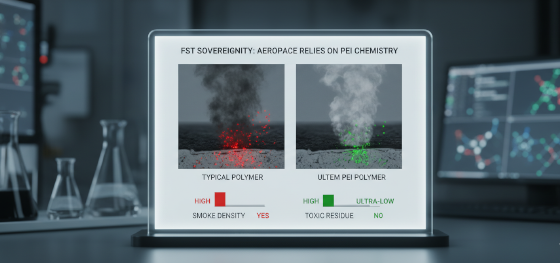
In the aerospace and defense world, "performance" is secondary to "compliance." The ultimate gatekeeper for aircraft interior parts is the FST protocol: Flame, Smoke, and Toxicity. If a component is placed inside a pressurized cabin, it must prove that it will not contribute to a fire and, more importantly, that it won't emit toxic gases that could incapacitate passengers. This is where stampa 3D in Ultem earns its stay. Ultem resins are inherently flame-retardant. They do not require the addition of halogenated additives—which are themselves toxic—to reach a UL94 V-0 rating.
When exposed to direct flame, Ultem forms an insulating "char" layer that prevents the fire from spreading. Its smoke emission is exceptionally low, and its toxicity profile meets the most stringent FAA and EASA standards. At JUCHENG, we treat FST compliance as a manufacturing baseline. We provide full material traceability and certificates of conformance for every aerospace order, ensuring that the 9085 parts we ship are documented survivors. This chemical safety, combined with the lightweight nature of the polymer, allows us to replace heavy aluminum air ducts and junction boxes with topologically optimized Ultem parts, shaving kilograms off an aircraft’s weight while increasing the overall safety of the vehicle.
Sporgenze di Precisione: Gestione del Supporto Solubile ad Alta Temperatura

Complexity in 3D printing is often limited by the ability to remove the scaffolding that holds it up. In the 400°C nozzle environment of an Ultem print, standard breakaway supports are a nightmare. They bond too tightly to the part, leaving behind ugly surface scars that require hours of manual sanding. To solve the riddle of internal channels and complex undercuts, Jucheng Precision utilizes specialized **High-Temperature Soluble Support** materials. These are engineered polymers that can withstand the 180°C chamber temperature without melting, yet dissolve completely in a specialized chemical bath after the print is finished.
This "hands-off" support removal is vital for functional parts like lightweight air manifolds or medical instrument housings with internal electronics bays. It ensures that the internal surfaces are as smooth and precise as the exterior ones. By utilizing dual-extrusion technology, we can print geometries that are physically impossible to de-mold in traditional casting. This freedom allows our clients to design for "Laminar Flow" or "Structural Efficiency" without worrying about tool access. Our mastery of support chemistry ensures that your most intricate internal visions are realized without the manufacturing scars of manual intervention, delivering a level of geometric fidelity that defines world-class plastica per stampa 3D production.
Standard di Certificazione JUCHENG: Oltre il Mandrino

Choosing a partner for high-stakes polymers is a decision of technical liability. At Jucheng Precision, we operate a facility that is ISO 9001 and ISO 13485 certified, with IATF 16949-aligned process controls. We understand that for an automotive EV battery enclosure or a medical surgical robot component, "guessing" the material strength is not an option. Our stampa 3D in Ultem protocol includes "Layer-by-Layer Verification." We utilize in-process monitoring to detect any extrusion variations that could indicate an internal void.
We also manage the "Hygroscopic Threat." Ultem resin is extremely sensitive to moisture. If the filament is not dried to a -40°C dew point before it enters the nozzle, the water molecules will turn to steam inside the part, creating microscopic "bubbles" that destroy the part's tensile strength. JUCHENG maintains a closed-loop dry-air system from the material dryer directly to the machine's sealed intake. This ensures that the material we print is as pure as the day it was synthesized. When you receive a shipment from JUCHENG, you aren't just getting 3D prints; you are getting verified engineered solutions. We provide the documentation, the precision, and the material science to ensure your next breakthrough survives the most hostile environments.
Dati Tecnici: Baseline delle Proprietà Meccaniche dell'Ultem
To finalize your design-for-manufacturing review, Jucheng Precision provides the following mechanical baseline for our industrial-grade Ultem components. These values reflect parts produced in our stabilized thermal environments.
| Proprietà | Ultem 9085 (Aerospace) | Ultem 1010 (High Temp) |
|---|---|---|
| Tensile Strength (XY) | ~70-75 MPa | ~80-85 MPa |
| Heat Deflection (HDT) | 153°C | 216°C |
| Allungamento a Rottura | ~6.0% (Ductile) | ~3.0% (Brittle/Stiff) |
| FST Rating | Full Aerospace Compliance | High (UL94 V-0) |
| Ideal Use Case | Cabin Interiors, Brackets | Engine Zones, Molds |
Success in the modern market requires the ability to replace metal with high-performance plastics without sacrificing safety. JUCHENG’s expertise in materiali per stampa 3D ensures that your designs are not just realized, but verified for flight. Contact our engineering team today for a comprehensive technical review and see how our Ultem protocols can armor your next industrial project.

