


La durabilità è una metrica ingannevole quando si guarda solo alla superficie. Nel panorama in evoluzione di materiali per stampa 3D, il cambiamento più critico non è stato nelle macchine stesse, ma nella transizione dei polimeri da modelli visivi a componenti funzionali. Questa è l'era industriale delle plastica per stampa 3D polveri. A differenza delle resine fragili dello SLA o della debolezza stratificata dell'FDM, le poliammidi in polvere processate tramite fusione laser o a infrarossi offrono la "spina dorsale" strutturale necessaria per componenti che devono sopravvivere sul campo. Quando un ingegnere automobilistico progetta un complesso collettore di cavi o un'azienda di robotica ha bisogno di mille gripper funzionali, non cercano filamenti—cercano l'integrità molecolare che solo la fusione su letto di polvere può fornire.
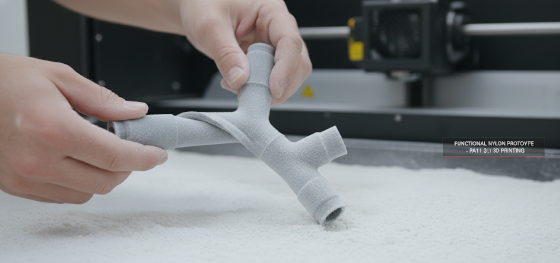
Presso JUCHENG, abbiamo costruito la nostra strategia di produzione additiva attorno all'affidabilità assoluta dei nylon di grado ingegneristico. Comprendiamo che un componente ha successo solo nella misura in cui può resistere a fatica ciclica ed esposizione chimica. Allontanandoci dalla prototipazione standard e concentrandoci su tecnologie come HP Multi Jet Fusion (MJF), forniamo ai nostri clienti un ponte verso la produzione di massa che bypassa l'alto costo degli stampi a iniezione. Questa guida esplora il divario tecnico tra PA11 e PA12, la logica del rinforzo composito e perché l'esperienza di JUCHENG nella sinterizzazione ad alta densità è il passaggio finale obbligatorio per trasformare un modello 3D in un asset pronto per la produzione.
L'affidabilità nella produzione di plastica si trova nella gestione del confine termico. Non stai solo fondendo polvere; stai orchestrando un evento di fusione che definisce l'anima meccanica del componente. Che tu stia costruendo un telaio innovativo per drone o un complesso set di maschere industriali, la logica della polvere è il tuo più grande alleato. Esaminiamo i pilastri tecnici delle plastiche industriali e vediamo come ridefiniscono la sopravvivenza dei tuoi progetti più ambiziosi.
Potenza della Poliammide: Ingegnerizzare le Prestazioni di PA11 e PA12
Fortificazione Composita: Logica del Rinforzo in Vetro e Carbonio
Dominio MJF: Perché Multi Jet Fusion Domina la Produzione in Lotto
Espansione Elastomerica: Il Ruolo delle Polveri TPU
Standard Integrato JUCHENG: Dalla Sinterizzazione alla Finitura di Precisione
Potenza della Poliammide: Ingegnerizzare le Prestazioni di PA11 e PA12
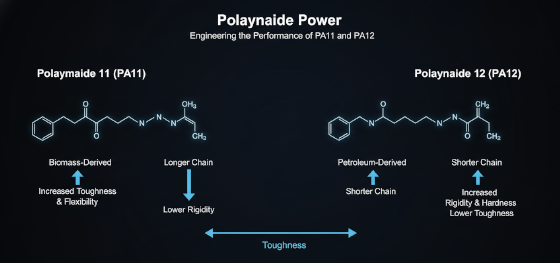
Nella gerarchia della stampa 3D industriale, il Nylon (Poliammide) è il re indiscusso. Tuttavia, scegliere la giusta "varietà" di nylon è dove i progetti di ingegneria si vincono o si perdono. Nylon 12 (PA12) è il cavallo di battaglia globale. La sua struttura molecolare è caratterizzata da una matrice cristallina bilanciata che offre elevata resistenza, eccellente stabilità a lungo termine e resistenza chimica a oli e carburanti. Presso Jucheng Precision, utilizziamo PA12 per la maggior parte dei nostri prototipi funzionali perché è il materiale più prevedibile nel mondo dei letti di polvere. Assorbe pochissima umidità rispetto ai nylon di grado inferiore, garantendo che le tue dimensioni rimangano "fedeli" dal nostro laboratorio di ispezione alla tua linea di assemblaggio.
Per applicazioni che richiedono il limite assoluto di resistenza all'impatto, ci orientiamo verso Nylon 11 (PA11). Mentre PA12 è rigido e affidabile, PA11 è duttile e resiliente. Derivato dall'olio di ricino di origine vegetale, PA11 possiede un valore di allungamento a rottura più elevato, il che significa che può piegarsi e assorbire energia dove PA12 potrebbe rompersi. Questo è il materiale per cerniere vive, attrezzature sportive e componenti aerospaziali che devono resistere ad ambienti ad alta vibrazione senza sviluppare cricche da stress. Comprendendo il "respiro" meccanico di questi due polimeri, JUCHENG ti aiuta a navigare il compromesso tra rigidità e duttilità. Non forniamo solo plastica; forniamo l'ingegneria di livello metallurgico necessaria per garantire che i tuoi componenti polimerici funzionino come un sistema strutturale, non solo come un modello visivo.
Fortificazione Composita: Logica del Rinforzo in Vetro e Carbonio
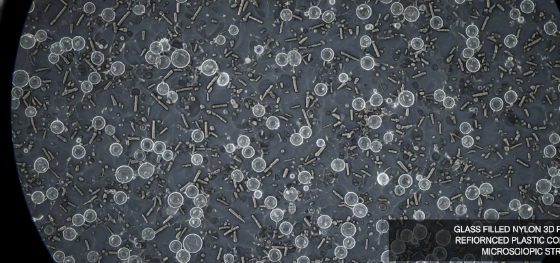
Sometimes, raw nylon isn't enough. When a design requires the stiffness of a cast metal but the weight of a plastic, we move into the realm of "Composite Powders." JUCHENG utilizes Glass-Filled Nylon (PA12-GF) to provide a massive boost in structural rigidity. By infusing the nylon matrix with 30% to 40% microscopic glass beads, we create a material that refuses to bow under pressure. This is essential for large-format enclosures or high-temp industrial housings where dimensional creep must be avoided at all costs. The glass beads act as an internal stabilizer, significantly increasing the material's heat deflection temperature (HDT).
For the ultimate in performance, we offer Carbon-Fiber Reinforced Nylon. In this composite, short carbon fibers provide a skeletal reinforcement that increases the tensile modulus to levels that challenge lightweight aluminum alloys. This is the choice for Formula 1 air ducts and high-end cycling components. However, machining or finishing these composites is a technical high-wire act. The fibers are abrasive and can lead to surface "fuzz" if the fusion isn't perfect. JUCHENG’s mastery of the materiali per stampa 3D landscape ensures that these fibers are perfectly encapsulated within the resin matrix. We manage the thermal gradients of the build chamber to prevent delamination between the fibers and the binder, delivering a part that is structurally homogeneous and visually consistent. We turn a difficult composite into a reliable engineering solution.
Dominio MJF: Perché Multi Jet Fusion Domina la Produzione in Lotto
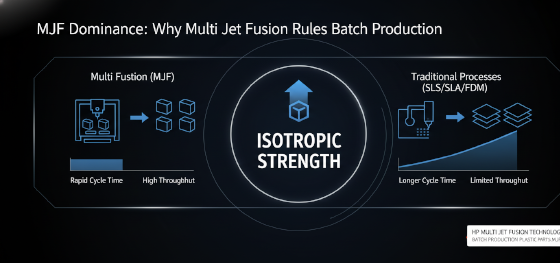
If speed and strength are your primary constraints, the technical answer is Multi Jet Fusion (MJF). Developed by HP, this technology has redefined the economics of plastica per stampa 3D. While traditional Selective Laser Sintering (SLS) uses a laser to trace each part, MJF uses a detailing and fusing agent applied via an inkjet array, followed by a sweep of infrared lamps. This "full-layer" fusion means the part complexity has zero impact on build time. Whether we are printing one gear or one hundred, the cycle time is the same. This makes MJF the high-speed champion for batches of 50 to 1,000 pieces.
The real power of JUCHENG’s MJF line is its Isotropic properties. Because the infrared fusion is so intense and uniform, the bonds between the layers are as strong as the material within the layer. In an MJF part, the Z-axis (vertical) strength is almost identical to the X and Y axes. This mechanical predictability is vital for functional validation. You can design complex fluid manifolds or structural mounts with the confidence that they won't shear apart under pressure. Furthermore, MJF parts are naturally denser and less porous than SLS parts, making them superior for applications requiring airtight or watertight seals. We treat our MJF department as a "Tooling-Free" injection molding facility, providing our clients with a scalable production method that responds to the speed of the market, not the lead time of a steel tool.
Espansione Elastomerica: Il Ruolo delle Polveri TPU
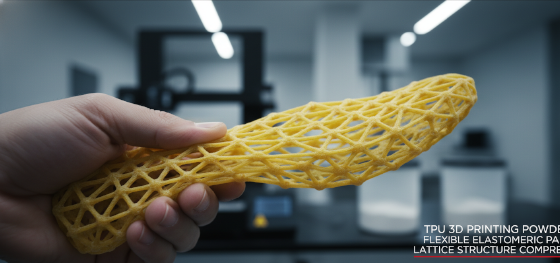
Engineering isn't always about rigidity. Sometimes, success is found in the ability to yield. This is the domain of Thermoplastic Polyurethane (TPU). As a powder-bed material, TPU is a miracle of elastomeric engineering. It combines the toughness of plastic with the flexibility of rubber. We utilize TPU to produce seals, gaskets, ergonomic grips, and complex vibration dampers that would traditionally require expensive overmolding. Because it is printed in a powder bed, we can create complex lattice structures that allow for "Variable Density"—making one part of a cushion soft and another part firm.
At Jucheng Precision, we specialize in high-resolution Flexible 3D Printing. We understand that the porous nature of 3D printed TPU can be an issue for hygiene or fluid containment. To solve this, we offer integrated chemical sealing and vapor smoothing to create a "skin" on the TPU parts, making them liquid-resistant and easy to clean. Whether you are building a custom-fit prosthetic liner or a series of shock-absorbers for a high-speed assembly line, JUCHENG’s TPU protocols provide the tactile and functional performance of production-grade rubber without the molding cost. We help you select the exact Shore hardness needed to satisfy your ergonomic or mechanical requirements, ensuring your flexible designs are both durable and responsive.
Standard Integrato JUCHENG: Dalla Sinterizzazione alla Finitura di Precisione
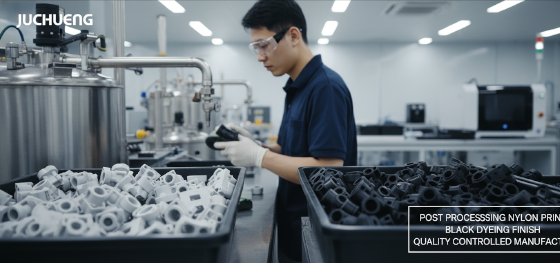
A raw part straight out of the powder is only half-finished. In the industrial world, aesthetics are a functional requirement. A part that looks "rough" is often perceived as "low quality" by the end user. At Jucheng Precision, we have invested in a comprehensive post-processing hub to transform raw plastica per stampa 3D into consumer-ready products. Our workflow includes automated bead-blasting to homogenize the surface and high-temp chemical dyeing to achieve a deep, permanent black finish that won't chip or fade.
Our quality protocol includes full CMM verification of critical dimensions and material lot tracking to ensure every batch meets the ISO 9001 standard. We don't just "hit go" on a printer; we manage a technical lifecycle that includes DFM reviews, thermal stabilization, and final aesthetic refinement. Whether you are building an aerospace sensor housing or a production run of a thousand custom consumer cases, JUCHENG has the technical rigor and the manufacturing capacity to deliver. We don't just make parts; we engineer reliability through the science of industrial polymers. Contact our engineering team today for a comprehensive technical review and see how our plastic additive protocols can armor and elevate your next manufacturing breakthrough.

