


Le cicatrici sono la storia non scritta di una costruzione 3D. Nell'arena professionale di post-elaborazione della stampa 3D, il momento in cui un componente emerge dalla macchina non è il traguardo—è l'inizio di un intervento chirurgico ad alto rischio. Che si tratti di una rete di perni in resina o di un blocco solido di ancoraggi in titanio, rimozione delle strutture di supporto è la fase invisibile che determina l'utilità finale del tuo hardware. Un'estrazione mal eseguita può trasformare un alloggiamento aerospaziale da cinquemila dollari in un pezzo di scarto strutturato. È un processo che richiede un equilibrio tra forza bruta e delicatezza microscopica, assicurando che la fondazione strutturale che ha permesso al pezzo di crescere non diventi il difetto che ne distrugge le prestazioni.
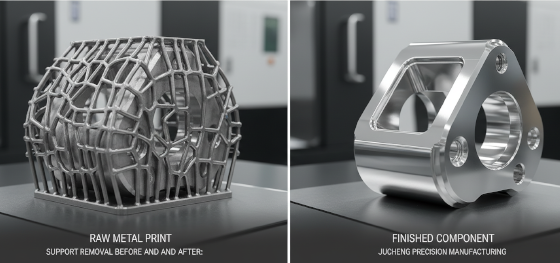
Jucheng Precision ha riprogettato il laboratorio di post-lavorazione per operare con il rigore tecnico di una camera bianca. Comprendiamo che per un impianto medico o una guida luce automobilistica, gli "artefatti di supporto"—quei piccoli rilievi e segni di vaiolatura lasciati indietro—sono più che problemi estetici; sono potenziali punti di fatica e guasti ottici. Integrando tecnologie di rimozione specializzate come l'elettroerosione a filo ad alta frequenza e bagni di dissoluzione chimica nel nostro reparto produttivo, eliminiamo la variabilità della mano umana. Questa guida va oltre le basi dello "spezzare la plastica" per esplorare le realtà termodinamiche e meccaniche dell'estrazione dei supporti in tutto lo spettro industriale, assicurando che i tuoi progetti passino dalla piastra di costruzione al campo con zero impronte di fabbricazione.
La redditività nella produzione additiva è spesso nascosta nelle ore di lavoro della sala di finitura. Puoi stampare un pezzo in ore, ma se ci vogliono due giorni per pulirlo, il tuo ROI è morto. Analizziamo le leggi fisiche dell'estrazione del materiale e vediamo come i protocolli di finitura integrati di JUCHENG proteggano l'anima strutturale dei tuoi componenti di prossima generazione.
Rimozione della Resina: L'Atto Chirurgico dei Protocolli SLA e DLP
Rompere il Legame Polimerico: Opzioni Staccabili FDM vs. Solubili
Il Guanto di Metallo: Perché il Supporto DMLS è una Sfida Strutturale
Cicatrici e Artefatti: Gestire il Punto di Contatto Meccanico
Integrazione Ibrida: Usare il CNC per Eliminare le Impronte dei Supporti
Validazione: Garantire l'Integrità Superficiale e il Blocco Dimensionale
Rimozione della Resina: L'Atto Chirurgico dei Protocolli SLA e DLP
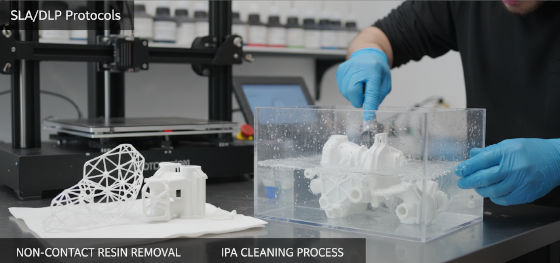
Nel regno dei fotopolimeri polimerizzati con la luce, rimozione delle strutture di supporto è una corsa contro la finestra dello "stato verde". Quando un pezzo completa la sua costruzione in una vasca SLA, non è ancora completamente polimerizzato. In questo stato semi-solido, i supporti sono progettati per essere sottili e facilmente recidibili. Tuttavia, i punti di contatto sono spesso di pochi micron di diametro. Se un tecnico usa troppa forza, può "cratare" la pelle del pezzo, lasciando un foro che nessuna quantità di levigatura può riparare.
I tecnici JUCHENG utilizzano un protocollo di "Estrazione Pre-Polimerizzazione". Rimuoviamo i supporti mentre la resina è ancora malleabile, usando micro-tronchesi specializzate progettate per gioiellieri. Questo minimizza il trasferimento di energia nel corpo principale del pezzo. Dopo la rimozione, il pezzo subisce un bagno ultrasonico in IPA per dissolvere il liquido residuo, e poi passa a una camera di polimerizzazione UV. Questa sequenza è vitale per la chiarezza ottica; se polimerizzi il pezzo con i supporti ancora attaccati, i punti di contatto si "cuoceranno" nella superficie, creando difetti visivi permanenti. Trattando la rimozione della resina come una procedura chirurgica piuttosto che come un compito di pulizia, assicuriamo che le tue lenti trasparenti e gli alloggiamenti ad alto dettaglio mantengano un'integrità superficiale pronta per display automobilistici o medici di alta gamma.
Rompere il Legame Polimerico: Opzioni Staccabili FDM vs. Solubili
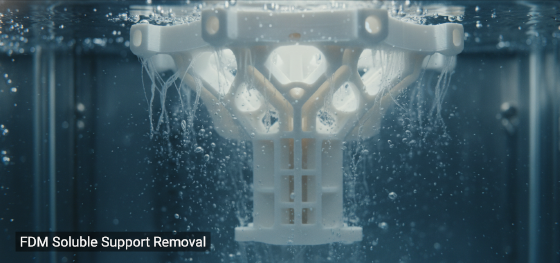
FDM technology presents a dual-pathway for managing overhanging mass. The first is "Breakaway Support"—using the same material as the part but with a lower density infill. This is the fastest method, but it leaves the most aggressive artifacts. When you rip a PEEK or Ultem support away from a part, the "weld" between the scaffold and the skin must be physically broken. At JUCHENG, we utilize proprietary tool-path offsets to create a "Weakened Interface Layer," allowing the supports to snap off cleanly without the need for heavy prying.
The second, and more advanced, pathway is "Soluble Support." By utilizing a dual-nozzle system, we can print the part in an industrial polymer like ASA and the scaffolding in a water-soluble or chemical-soluble resin. Support structure removal in this context is a passive event. The part is placed in a heated circulation tank where the solvent attacks the support material while leaving the part untouched. This is the only reliable way to clean internal labyrinths or intricate fluid manifolds that no mechanical tool can reach. We manage the chemical concentration and temperature of these baths with extreme rigor, ensuring that the part’s skin is never compromised by the dissolution process. This "Hands-Off" approach is the definitive solution for functional post-elaborazione della stampa 3D, delivering internal cavities that are as clean as they were in the CAD model.
Il Guanto di Metallo: Perché il Supporto DMLS è una Sfida Strutturale
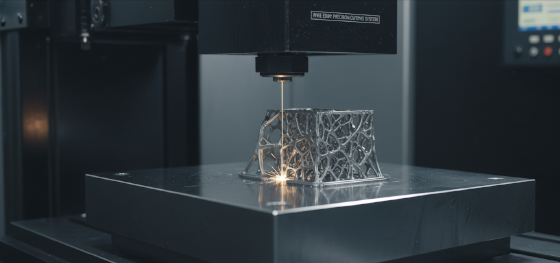
The most violent phase of 3D printing is found in the metal powder bed. In DMLS (Direct Metal Laser Sintering), the supports are not just propping up the part—they are acting as massive heat sinks that anchor the part to a thick steel build plate. These supports are 100% dense metal. Removing them is not a matter of a hand-tool; it is a matter of industrial equipment. Support structure removal for titanium or stainless steel is a technical gauntlet that separates job shops from integrated manufacturing centers.
At Jucheng Precision, we solve the metal extraction riddle through the integration of Wire EDM Machining. We utilize a high-precision molybdenum wire to saw the part off the build plate with zero mechanical stress. This prevents the "spring-back" warping that occurs when a part is hacked off with a manual band-saw. For the intricate supports inside a manifold, we utilize specialized internal grinding tools and 5-axis milling to "bore out" the metal scaffolding. We treat the removal of metal supports as a primary machining operation, ensuring that the thermal integrity of the alloy is maintained and the dimensional tolerances are locked in before the part enters the final inspection lab.
Cicatrici e Artefatti: Gestire il Punto di Contatto Meccanico
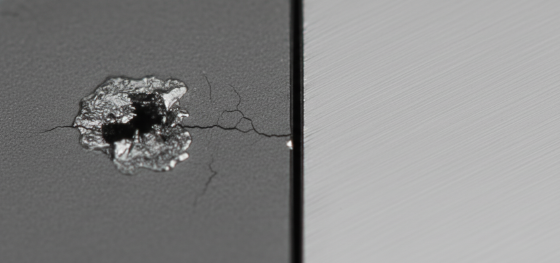
Every support point leaves a "witness mark." In high-fidelity manufacturing, managing these marks is where the artistry of the technician meets the precision of the machine. If a nub is left too high, the part won't fit; if it's sanded too low, the part is undersized. JUCHENG implements a "Staged Refinement" protocol. We don't just sand the surface; we re-engineer it.
First, we use automated bead-blasting to homogenize the surface texture, making the support zones less visible. For parts requiring aesthetic perfection, we move to a five-stage mechanical sanding process, progressing from 400 to 2000 grit. This eliminates the "artifact ghosting" that often plagues 3D printed parts. For industrial components, we utilize vibratory finishing to "break" the sharp edges where the supports were removed, ensuring every part is safe to the touch. By managing the contact point as a micron-scale feature, we deliver components that look and feel like they were cast or molded, providing the professional finish your brand identity requires.
Integrazione Ibrida: Usare il CNC per Eliminare le Impronte dei Supporti
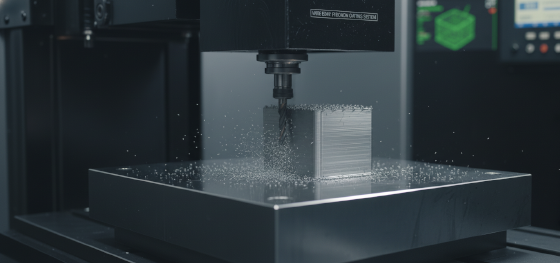
The ultimate strategy for eliminating support artifacts is the "Hybrid approach." Why sand a surface by hand for an hour when a 5-axis mill can refine it in five minutes? Jucheng Precision has optimized its progetto di stampa 3D logic to include "Post-Machining Allowances." We intentionally print an extra 1.0mm of material over the support zones of critical mating surfaces.
After the primary rimozione delle strutture di supporto, the part moves directly to our CNC department. We utilize our 5-axis centers to mill away the support footprints entirely, revealing a mirror-smooth surface with H7-level tolerances. This synergy between additive complexity and subtractive certainty is the definitive solution for aerospace flanges, medical mating plates, and high-performance automotive housings. We don't just "clean" the part; we machine it into a final engineered state. This integration removes the most expensive and variable part of the 3D printing cycle—the manual labor—replacing it with the predictable, documented accuracy of CNC technology.
Validazione: Garantire l'Integrità Superficiale e il Blocco Dimensionale
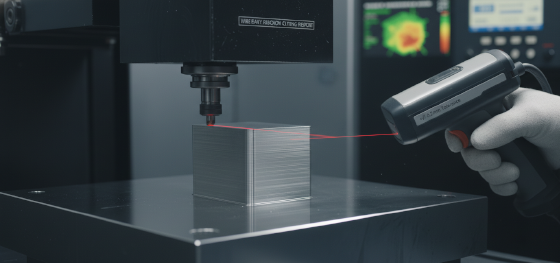
The final hallmark of a professional manufacturing partner is the audit of the extraction. You cannot manage what you do not verify. JUCHENG’s quality protocol includes a full "Surface Integrity Audit" after the supports are removed. We use non-contact 3D scanners to compare the finished part against the original STEP file, ensuring that the removal process hasn't induced any localized bowing or stress warping.
We also utilize surface roughness testers (Ra) to verify that the sanding or milling has reached the required finish level. For medical implants, we perform microscopic inspection at 40x magnification to ensure that zero support fragments or metallic dust remain in the crevices. This transparency is the cornerstone of our service to the global robotics and defense sectors. When you receive a shipment from JUCHENG, you aren't just getting 3D prints; you are getting verified engineered solutions that have been surgically refined for performance. We bridge the gap between a raw build and a functional masterpiece. Contact Jucheng Precision today for a technical DFM review and see how our support extraction protocols can stabilize and elevate your next manufacturing breakthrough.

