


L'affidabilità nella produzione additiva è raramente raggiunta solo dalla stampante; nasce dall'integrità molecolare del letto di polimero. Nel panorama in rapida evoluzione dell'industria della plastica per stampa 3D , una famiglia di materiali ha superato il confine tra "mockup visivo" e "parte funzionale finale". Questo è il regno della stampa 3D in nylon. Le poliammidi rappresentano il cavallo di battaglia industriale del 21° secolo, offrendo una combinazione di elevata resistenza alla trazione, resistenza chimica e duttilità necessaria per sopravvivere a sollecitazioni meccaniche reali. Mentre i sistemi a resina inseguono l'estetica, le tecnologie di fusione a polvere a base di nylon come SLS e MJF stanno ingegnerizzando la "spina dorsale" strutturale della robotica moderna, dei vani motore automobilistici e della strumentazione medica.
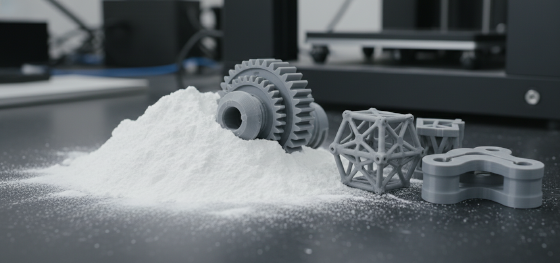
At JUCHENG, we recognize that an engineer’s primary fear is the "layer weakness" inherent in traditional 3D printing. We have centered our facility around technologies that mitigate this risk. Powder bed processes can produce strong nylon parts, but strength, elongation and fatigue resistance may vary with build direction and the exact grade. This guide moves beyond the standard sales pitches to explore the thermodynamic grit of powder bed fusion, the chemical divide between PA11 and PA12, and why JUCHENG’s focus on high-density MJF production is the definitive answer for those looking to bridge the gap between initial prototyping and full-scale injection molding.
La coerenza nella produzione di plastica è una lotta contro la distribuzione del calore e la gestione dell'umidità. Non stai solo impilando strati; stai gestendo un evento di cambiamento di fase che definisce l'anima meccanica del pezzo. Che tu stia costruendo un telaio innovativo per drone o una serie di complessi collettori fluidi, la logica della polvere è il tuo più grande alleato. Esaminiamo i pilastri tecnici del nylon industriale e vediamo come ridefinisce la sopravvivenza dei tuoi progetti 3D più ambiziosi.
Il Divario Tecnologico: Sinterizzazione vs. Fusione
Resilienza Chimica: Navigare le Prestazioni di PA11 e PA12
Fortificazione Rinforzata: Infusione di Vetro e Carbonio
Dati Tecnici: Tabella delle Prestazioni Meccaniche
Il Verdetto di JUCHENG: Prototipazione vs. Lavorazione CNC
Il Divario Tecnologico: Sinterizzazione vs. Fusione
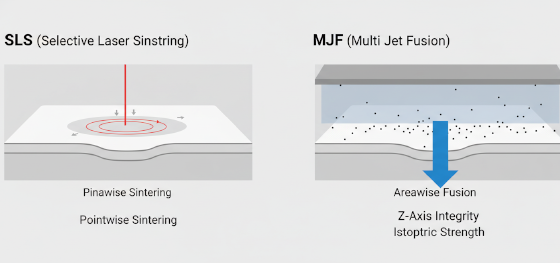
Per padroneggiare stampa 3D in nylon, devi prima comprendere i due titani del letto di polvere: Selective Laser Sintering (SLS) e Multi Jet Fusion (MJF). Mentre entrambi utilizzano un letto di polvere di nylon, i loro percorsi termodinamici verso un solido sono fondamentalmente diversi. SLS utilizza un singolo laser CO2 ad alta precisione per "tracciare" la geometria di un pezzo, sinterizzando le particelle di polvere insieme nel punto di contatto. Questo metodo è il cavallo di battaglia originale del settore, in grado di produrre parti senza strutture di supporto, consentendo la creazione di geometrie complesse e interconnesse fisicamente impossibili da realizzare tramite fresatura.
MJF, sviluppato da HP, rappresenta la prossima evoluzione nella materiali per stampa 3D processing. Instead of a laser point, it utilizes an inkjet array to apply a "fusing agent" across the entire surface of the bed, followed by an intense infrared lamp pass that melts the material in a single sweep. At JUCHENG, we use MJF for some small-batch jobs (50 to 500 units). Do not infer equal strength in every direction or a pressure rating from the process name. For housings or manifolds, confirm the grade and build direction, and verify representative finished parts under the relevant loads and leak-test conditions.
Resilienza Chimica: Navigare le Prestazioni di PA11 e PA12
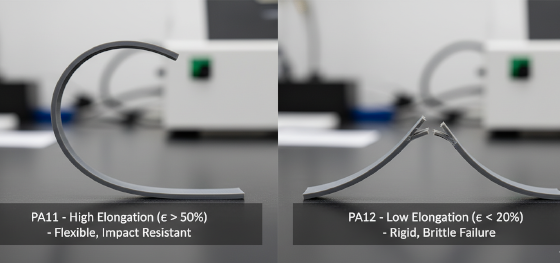
The naming convention of polyamides—11 and 12—is not arbitrary; the number refers to the carbon count in the repeating unit of these nylon types. Select by grade and measured properties, not the number alone. Nylon 12 (PA12) is the most common material in our facility. PA12 is often used for housings and fittings, but moisture and temperature can still affect dimensions and mechanical behavior. Verify bearing seats and snap-fits on representative parts conditioned for the intended service environment.
Some PA11 grades offer higher elongation than some PA12 grades, but compare the exact grade, build direction and condition. Elongation at break is not a measure of hinge life. For hinges or clips, validate representative parts through the specified cycle count, deflection and service conditions.
Fortificazione Rinforzata: Infusione di Vetro e Carbonio
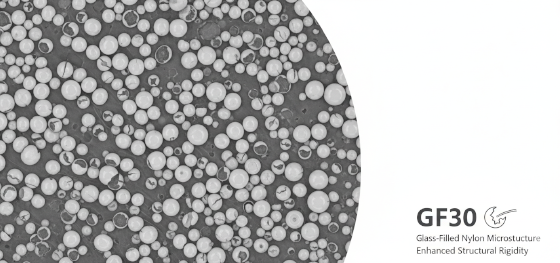
Sometimes, the raw polymer reaches its physical ceiling. When a design requires the stiffness of a cast metal but the weight of a plastic, we turn to "Composite Fortification." JUCHENG specializes in the processing of Glass-Filled (GF) and Carbon-Fiber (CF) reinforced nylon powders. Glass-filled grades can use beads or fibers, depending on the product. EOS's PA 3200 GF glass-bead grade is stiffer than PA 2200 Balance in the table, but both report the same HDT at 0.45 MPa. Specify the actual load, temperature and exposure duration rather than assuming higher stiffness means higher usable temperature.
Carbon-Fiber Nylon takes this even further, providing a massive boost in tensile modulus. It turns a "plastic" part into a structural component capable of replacing aluminum brackets in non-critical aerospace assemblies. However, machining or finishing these composites is a technical high-wire act. The fibers are abrasive and can cause "fuzzing" on the surface if the fusion parameters are incorrect. Composite behavior depends on grade, build direction and the complete finishing process. Where stiffness, wear or fatigue is critical, qualify the final geometry and process under the actual loading conditions.
Dati Tecnici: Tabella delle Prestazioni Meccaniche
The table compares three EOS selective laser sintering grades using supplier data for dry specimens built in the X orientation. These are screening values, not Jucheng production test results. Heat deflection under the stated load is not a continuous-use temperature rating.
| Proprietà | EOS PA 2200 Balance (PA12) | EOS PA 1101 (PA11) | EOS PA 3200 GF (glass-bead PA12) |
|---|---|---|---|
| Tensile Strength (ISO 527) | 48 MPa | 50 MPa | 51 MPa |
| Strain at Break (ISO 527) | 18% | 30% | 9% |
| HDT (ISO 75, 0.45 MPa) | 157°C | 180°C | 157°C |
| Tensile Modulus (ISO 527) | 1,650 MPa | 1,650 MPa | 3,200 MPa |
Il Verdetto di JUCHENG: Prototipazione vs. Lavorazione CNC
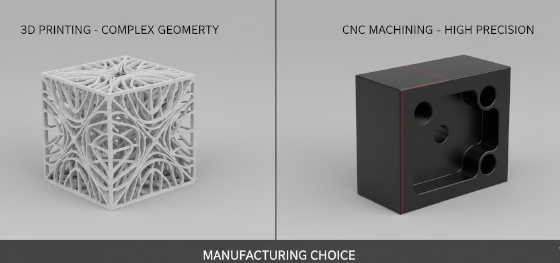
The final hallmark of a one-stop-shop like Jucheng Precision is the ability to tell you when not to use 3D printing. In the materiali per stampa 3D world, nylon is a godsend for complexity, but it cannot always compete with the raw density and sub-micron accuracy of a 5-axis mill. When a design features a massive solid volume or requires an H7 bearing tolerance, we will steer you toward our CNC Nylon Machining cells.
We view these technologies as partners, not competitors. For a single assembly, we may print the complex, topologically-optimized outer housing via stampa 3D in nylon and machine the high-precision internal lock mechanisms via CNC. This hybrid approach ensures you get the lightweight benefits of additive and the functional precision of subtractive. We bridge the gap between design theory and real-world assembly. Whether you are building an innovative medical device or a mission-critical satellite mount, our expertise in high-fidelity polymers ensures your vision is delivered with absolute integrity. Contact Jucheng Precision today for a comprehensive technical DFM review and let our material protocols clarify and elevate your next manufacturing challenge.

