


Gli ingegneri hardware che progettano parti di sospensioni automobilistiche portanti affrontano un dilemma terrificante sul pavimento della fabbrica. Affidarsi a un'iniezione di metallo violenta e ad alta velocità intrappola microscopiche bolle d'aria che alla fine causeranno la rottura del pezzo sotto forti vibrazioni autostradali. Eseguire il processo di pressofusione utilizzando metodi tradizionali rapidi semplicemente non può fornire la densità interna di grado militare richiesta per questi componenti massicci. Spostare la strategia della tua fabbrica al processo di pressofusione a bassa pressione neutralizza completamente questo rischio cambiando fondamentalmente il modo in cui il metallo liquido combatte la gravità.
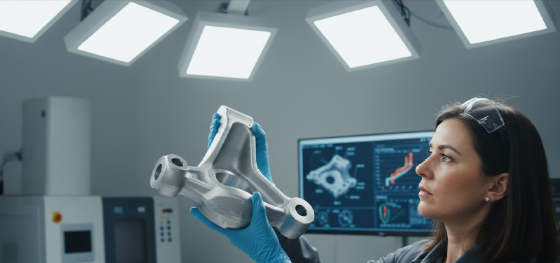
I team di approvvigionamento spesso storcono il naso davanti ai tempi di ciclo più lenti di questa metodologia senza comprendere il massiccio guadagno strutturale. Versare il metallo lentamente e deliberatamente verso l'alto nello stampo elimina completamente la turbolenza atmosferica. Operando dal nostro hub di produzione di precisione di Shenzhen, Jucheng Precision sfrutta questa tecnica di riempimento delicato per produrre hardware strutturale massiccio e incredibilmente denso che supera con sicurezza le più severe ispezioni a raggi X aerospaziali.
Compromettere la densità interna del metallo non è mai un'opzione per macchinari commerciali critici. Esploriamo esattamente come invertire il flusso dell'alluminio liquido risolva la porosità da gas, sblocchi trattamenti termici avanzati e fornisca la forza fisica inflessibile richiesta per mantenere intatti i tuoi prodotti di alta gamma sotto stress estremo.
contenuto:
Il riempimento anti-gravità: come funziona realmente la LPDC?
Integrità strutturale: perché l'iniezione ad alta velocità fallisce qui?
Trattamento termico: sbloccare la resistenza di grado aerospaziale
Dati tecnici: confronto tra LPDC e alta pressione
Hub JUCHENG: il centro di metallurgia strutturale di Shenzhen
FAQ: risposte oneste su tempi di ciclo e attrezzature
Il riempimento anti-gravità: come funziona realmente la LPDC?

Come si riempie uno stampo in acciaio massiccio senza creare violente onde metalliche?
Posizionando il crogiolo sigillato di metallo fuso direttamente sotto lo stampo e iniettando una piccola quantità di gas pressurizzato, forzando il liquido a salire lentamente e senza intoppi attraverso un tubo di ceramica nella cavità.
Gravity usually works against hardware manufacturers by pulling liquid metal down too fast, causing it to splash and fold over atmospheric air. Reversing this flow path creates absolute thermodynamic control. The rising pool of liquid aluminum pushes all the empty air out of the top exhaust vents long before the metal begins to freeze.
Maintaining constant upward pressure as the part solidifies provides an incredible secondary benefit. As the heavy metal shrinks during the cooling phase, the pressurized crucible continues to feed fresh liquid alloy directly into the core, completely eliminating shrinkage voids. This delivers a dense, solid brick of metal perfectly shaped to your CAD file.
Integrità strutturale: perché l'iniezione ad alta velocità fallisce qui?
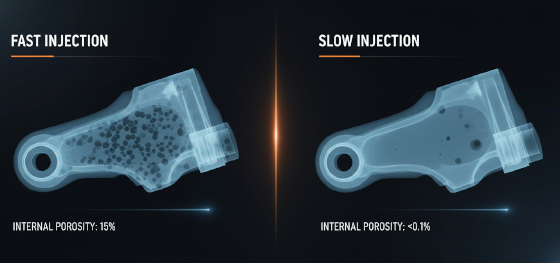
Why can't you build heavy automotive wheels using ultra-fast injection presses?
Blasting metal into a mold at a hundred miles per hour traps millions of microscopic air bubbles inside the structure, instantly destroying the load-bearing capacity required for highway speeds.
Selecting the processo di pressofusione ad alta pressione is brilliant for paper-thin telecom heatsinks, but it is a death sentence for heavy suspension arms. If your product is responsible for keeping a massive electric vehicle securely on the road, you cannot tolerate a sponge-like internal core.
Slow, deliberate filling remains the only commercial way to pass stringent X-ray inspections. Jucheng Precision routinely cuts our low-pressure samples in half, polishes the cross-section, and proves to our B2B clients that the internal matrix is absolutely flawless and void-free.
Trattamento termico: sbloccare la resistenza di grado aerospaziale

What happens when you put a porous metal casting into a 1000-degree tempering oven?
The trapped air bubbles violently expand from the extreme heat, pushing outward and permanently deforming the part with massive surface blisters.
Engineers demand T6 heat treatments to maximize the yield strength of raw aluminum. You heat the part to extreme temperatures, quench it in water, and artificially age it. This hardens the metal drastically, but it requires a perfectly solid starting component.
Because our anti-gravity process removes all the trapped gas during injection, these heavy castings survive the brutal T6 tempering cycle flawlessly. You achieve the incredible tensile strength normally associated with expensive forged billet aluminum, but at a fraction of the raw manufacturing cost.
Dati tecnici: confronto tra LPDC e alta pressione

Balancing your required production speed against your demand for ultimate physical strength dictates your entire factory strategy. The matrix below proves why heavy industries gladly accept slower cycle times to guarantee part survival.
| Engineering Metric | JUCHENG Low Pressure Setup | HPDC ad alta velocità standard |
|---|---|---|
| Porosità interna da gas | Virtually Zero (X-Ray passing) | Da moderata ad alta |
| Heat Treatment (T6) | Excellent (No blistering) | Impossible (Ruins the part) |
| Velocità del ciclo di produzione | Slow (Minutes per shot) | Very Fast (Seconds per shot) |
| Tooling Wear & Tear | Low (Gentle metal flow) | High (Violent abrasive impact) |
Paying for the slower machine cycle is simply the cost of doing business in the heavy automotive and aerospace sectors. If you attempt to shortcut this physical reality to save pennies on machine time, your parts will critically fail under load, inviting massive liability lawsuits.
Hub JUCHENG: il centro di metallurgia strutturale di Shenzhen

Why trust Jucheng Precision to manufacture your critical load-bearing hardware?
Because we maintain strict metallurgical controls inside our Shenzhen factory, utilizing automated slow-fill presses and dedicated X-ray inspection cells to verify every single structural component we ship.
Brokers who outsource your heavy hardware have no idea what is actually happening inside the metal. Operating our own precision manufacturing hub guarantees that the pressure curves, the thermal water lines, and the final metal density exactly match your engineering blueprints.
Stop risking your heavy-duty assembly lines on porous, fragile metal parts. Send your load-bearing CAD files to our engineering team today for a comprehensive DFM review. We will map the perfect anti-gravity fill path and deliver unyielding structural hardware.
FAQ: risposte oneste su tempi di ciclo e attrezzature

Can I design paper-thin walls using this slow filling method?
Generally no. Because the metal moves slowly, paper-thin walls will freeze and block the flow before the cavity fills completely. This process is strictly meant for thicker structural designs.
Does the slow injection speed ruin the surface finish of the metal?
The surface finish is highly acceptable, but it rarely achieves the ultra-smooth, mirror-like cosmetic finish of fast injection. Secondary CNC machining is often required for precise mating surfaces.
Are the steel molds cheaper because the pressure is lower?
Yes, slightly. Because the mold does not need to survive extreme hydraulic slamming forces, the tooling can be designed with less massive reinforcement, somewhat reducing the upfront NRE cost.
Is sand casting a viable alternative to this method for heavy parts?
Only for extremely low volumes. Sand casting provides similar internal densities but delivers terrible dimensional accuracy and horrific surface roughness, requiring massive CNC labor to fix.

