


Le scadenze sono i governatori ultimi delle decisioni ingegneristiche. Nel volatile panorama dello sviluppo prodotto, il tempo tra un file CAD finalizzato e un componente fisico e funzionale è dove la quota di mercato viene vinta o persa. La maggior parte dei progettisti vede la scelta di macchina cnc vs stampante 3d come una semplice gara, ma la velocità nella produzione è una metrica multidimensionale. Non riguarda solo la velocità con cui si muove un ugello o ruota un mandrino; riguarda il "Tempo per la Certezza." Questo è il nodo tecnico di Velocità CNC vs Stampaggio 3D. Una tecnologia offre l'agilità di un velocista olimpico per i primi metri, mentre l'altra fornisce il ritmo incessante e automatizzato di un treno merci sulla lunga distanza. Scegliere la strada sbagliata può lasciare il tuo team di R&S in attesa di parti già obsolete o mandare in bancarotta il tuo ciclo produttivo attraverso colli di bottiglia di lavoro manuale.

Jucheng Precision opera come un hub di produzione ad alta velocità, e abbiamo notato un punto di attrito costante: gli ingegneri spesso confondono "Velocità di Stampaggio" con "Velocità di Consegna." Una stampante 3D potrebbe finire un pezzo in dodici ore, ma se quel pezzo richiede sei ore di rimozione manuale dei supporti e un ciclo di polimerizzazione di quattro ore, l""Efficienza del Mandrino" di una fresatrice CNC improvvisamente sembra molto più attraente. Operiamo oltre 150 macchine proprio per risolvere questo enigma temporale. Integrando la velocità CNC a 5 assi con l'agilità senza attrezzaggi di MJF e SLA, forniamo ai nostri clienti una roadmap di produzione parallela. Questa guida va oltre il solito glossario di vendita per esplorare la meccanica effettiva del debito di setup, il paradosso della complessità, e perché la scelta strategica giusta per la velocità determina il ROI finale del tuo lancio hardware.
La redditività in un mercato competitivo si trova nella compressione del ciclo di feedback. Non stai solo comprando metallo o plastica; stai comprando la capacità di fallire velocemente e correggere più velocemente. Che tu stia costruendo un prototipo medico urgente o una produzione di migliaia di clip automobilistiche, la logica dell'orologio è il tuo governatore di produzione primario. Analizziamo le leggi fisiche della velocità di produzione e vediamo come la previdenza tecnica può bloccare l'integrità della tua timeline nella realtà fisica.
Lo Sprint al Prototipo: Perché l'Additivo Domina il Primo Giorno
Velocità del Mandrino: Scalare il Lotto tramite Efficienza Sottrattiva
Paradosso della Complessità: Quando lo Stampaggio Supera la Fresatura
Latenza Post-Processo: La Tassa Nascosta sul Tempo
Protocollo Agile di JUCHENG: Produzione Parallela Ottimizzata
Lo Sprint al Prototipo: Perché l'Additivo Domina il Primo Giorno
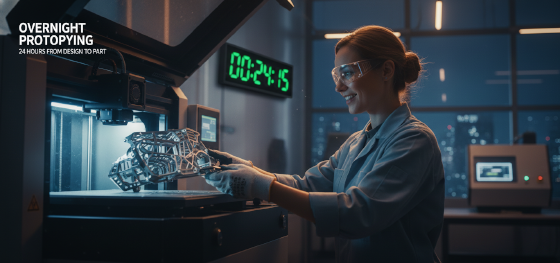
Nel confronto tra Velocità CNC vs Stampaggio 3D, lo stampaggio 3D è il re indiscusso delle prime 24 ore. La ragione è la totale eliminazione dell""Attrito di Preparazione." In un ambiente sottrattivo, un pezzo non può essere realizzato finché un ingegnere non crea un programma CAM (Computer-Aided Manufacturing), un'officina utensili non procura frese specifiche, e un tecnico non costruisce attrezzature personalizzate per tenere il blocco grezzo. Questo tempo "NRE" (Non-Recurring Engineering) può consumare giorni prima che il primo truciolo venga tagliato. Per un singolo prototipo urgente, questo è un muro temporale massiccio.
La produzione additiva opera con "Logica Zero-Attrezzaggio." Quando invii un file SLA o MJF a Jucheng Precision, i nostri ingegneri eseguono un rapido controllo DFM, e il file va direttamente allo slicer della macchina. Non ci sono morsetti personalizzati da costruire né percorsi utensile da ottimizzare per la deflessione. La macchina semplicemente costruisce. Questo ci permette di fornire "Consegna il Giorno Successivo" per modelli funzionali. Se hai una riunione con investitori mercoledì, una stampante 3D può trasformare il tuo file CAD di martedì in un oggetto fisico mentre dormi. Questa agilità è vitale per la fase iniziale di R&S dove i design sono fluidi e un'attesa di due settimane per un pezzo CNC soffocherebbe lo slancio creativo del progetto. Trattiamo lo stampaggio 3D come la "corsia di emergenza" per l'innovazione, bypassando i tradizionali ostacoli burocratici dell'officina meccanica.
Velocità del Mandrino: Scalare il Lotto tramite Efficienza Sottrattiva

La narrazione della velocità cambia drasticamente nel momento in cui superi le prime cinque unità. Questa è la "Soglia di Throughput" di Velocità CNC vs Stampaggio 3D. While a 3D printer takes the same amount of time to build the 100th part as it did the first (often several hours), a CNC machine is built for repetitive automation. Once the "Setup Debt" is paid and the machine is dialed in, the time per part (cycle time) drops into minutes or even seconds.
At Jucheng Precision, we utilize high-speed spindles (up to 24,000 RPM) and automated pallet changers to exploit this efficiency. If a complex aluminum bracket takes 10 hours to print on a metal 3D printer, but can be milled in 15 minutes on a CNC center, the math is simple. For a batch of 100 parts, the printer takes 1,000 hours (over 40 days), while the mill—including a 10-hour setup—completes the job in 35 hours (less than 2 days). Subtractive manufacturing is the champion of the "Per-Part" clock. We utilize this velocity to help our clients bridge the gap between "prototype" and "market volume." By moving your project to our CNC floor at the correct moment, we effectively crush your lead times for production batches, delivering thousands of parts in the same window it would take a printer to deliver fifty.
Paradosso della Complessità: Quando lo Stampaggio Supera la Fresatura

There is a technical exception to the batch-speed rule: Geometric Complexity. In the world of the macchina cnc vs stampante 3d, complexity is "free" for the printer but "expensive" for the mill. If your part features intricate internal cooling channels, porous lattice structures, or deep, narrow undercuts, a CNC machine must move slowly. It must navigate dozens of tool changes, use tiny, fragile cutters that break easily, and perhaps require multiple manual rotations in a vice. For these high-complexity components, the "Cycle Time" of CNC can actually exceed that of a 3D printer.
This is the Complexity Paradox. At JUCHENG, we analyze the "Geometric Load" of your CAD file. If we see a manifold with hundreds of internal intersections, we will often suggest 3D printing (specifically MJF or DMLS) even for larger batches. Because the printer builds an entire "slice" regardless of its internal detail, it outruns the mill in a high-complexity race. We help our clients find this tipping point, ensuring you don't waste time trying to mill a part that was physically meant to be "grown." By matching the process to the complexity of the void, we minimize the total manufacturing time and get your functional assemblies into testing before your competitors have even finished their first fixture design.
Latenza Post-Processo: La Tassa Nascosta sul Tempo
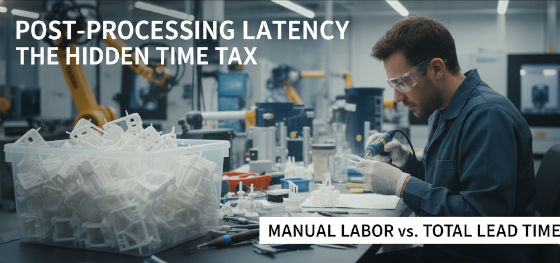
True manufacturing speed is measured from "Design Finish" to "Part Ready for Use." This is where many 3D printing quotes are misleading. A raw print is rarely a finished part. It often requires support removal, thermal curing, bead blasting, or chemical smoothing. This "Post-Processing Latency" is the hidden time tax of additive manufacturing. If you have 500 parts that each require 10 minutes of manual sanding, you have added 83 hours of skilled manual labor to your lead time. In Velocità CNC vs Stampaggio 3D comparisons, this is where additive often loses its advantage.
CNC machined parts typically come off the machine with the correct surface finish and tapped threads already in place. The part is "Born Finished." At Jucheng Precision, we operate an integrated finishing lab to mitigate the additive time tax, utilizing automated vapor smoothing and vibratory deburring to speed up the post-print cycle. However, we are honest with our clients: if your part requires a high-quality aesthetic finish and a tight tolerance, the time-to-market is often faster via CNC because the machine does the work of the human hand during the primary cycle. We don't just look at the build time; we look at the "Labor-to-Finish" ratio, ensuring your timeline isn't derailed by the bottleneck of manual craftsmanship.
Protocollo Agile di JUCHENG: Produzione Parallela Ottimizzata

Choosing a partner for a high-speed launch is a decision of manufacturing depth. Most shops only offer one technology, forcing your design into a timeline that suits their machines, not your market window. Jucheng Precision operates a "Parallel Production" protocol. Because we possess over 150 CNC machines and dozens of industrial 3D printers, we can run your prototype and your production ramp-up simultaneously.
We use 3D printing to provide you with the "Bridge Parts" needed for initial assembly and marketing while our CNC department builds the fixtures and optimizes the programs for your volume run. This integrated approach ensures that your project never hits a technical plateau. We provide full material traceability and documented process validation for both paths, giving our aerospace and medical clients the speed of a startup with the technical rigor of a Tier-1 supplier. When you receive a shipment from JUCHENG, you aren't just getting metal and plastic; you are getting the benefit of a synchronized timeline. We bridge the gap between "now" and "forever." Contact our engineering team today for a comprehensive technical DFM review and see how our dual-technology protocols can clarify and accelerate your next manufacturing breakthrough.

