


Il volo è una costante sfida alla fisica. Nel mondo ad alta posta in gioco di applicazioni industriali della lavorazione CNC, il cielo non è un limite—è un laboratorio implacabile che esige perfezione. Ogni grammo di peso in eccesso su un aeromobile rappresenta una perdita in efficienza del carburante e capacità di carico, eppure ogni cedimento strutturale rappresenta una potenziale catastrofe. Questa è la realtà senza compromessi della Lavorazione CNC Aerospaziale. È un settore in cui le tolleranze "standard" vengono scartate a favore di certezza a livello di micron, e dove i materiali utilizzati sono spesso difficili da modellare quanto gli ambienti che sono progettati per sopravvivere.
Presso Jucheng Precision, abbiamo progettato il nostro impianto per soddisfare queste esigenze atmosferiche. Riconosciamo che gli ingegneri aerospaziali cercano più di un fornitore; hanno bisogno di un partner tecnico che comprenda le sfumature della distensione delle tensioni e il comportamento metallurgico delle leghe esotiche. Operando dai nostri centri a 5 assi avanzati, forniamo l'infrastruttura produttiva per realizzare strutture monolitiche e involucri a parete sottile che rimangono stabili sotto stress supersonico. Questa guida esplora i fondamenti meccanici dell'ingegneria del volo, il ruolo critico della selezione dei materiali e perché l'impegno di JUCHENG per la tracciabilità assoluta definisce il nostro successo nella catena di fornitura aerospaziale globale.
L'efficienza in aria inizia con la precisione a terra. Che tu stia costruendo un gruppo carrello di atterraggio commerciale o un alloggiamento per satellite per una missione spaziale profonda, il successo del pezzo dipende dall'integrità del processo produttivo. Esaminiamo i pilastri tecnici che permettono a JUCHENG di tradurre progetti di volo complessi in realtà fisica verificata.
Il Mandato della Gravità: Padroneggiare il Rapporto Resistenza-Peso
Metallurgia del Volo: Navigare dal 7075 all'Inconel
Rivoluzione Monolitica: Strategie Simultanee a 5 Assi
Stabilità a Parete Sottile: Lavorazione Senza Deformazione Dimensionale
Tracciabilità: Tracciabilità Assoluta e Standard di Difesa
Il Mandato della Gravità: Padroneggiare il Rapporto Resistenza-Peso
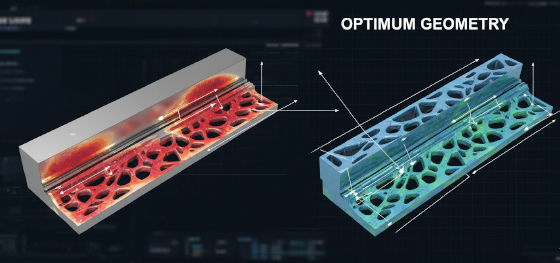
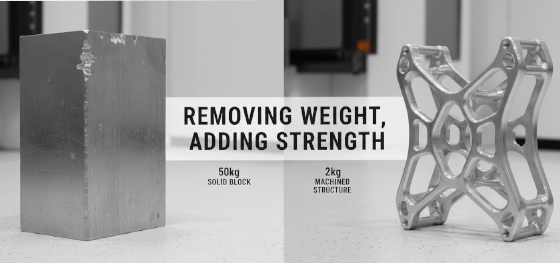
Nell'ingegneria aerospaziale, il peso è il nemico finale. Ogni chilo inutile richiede più spinta, più carburante e più supporto strutturale. Questo ha portato al mandato "Resistenza-Peso" che governa Lavorazione CNC Aerospaziale. A differenza dei macchinari industriali dove la massa può essere utilizzata per fornire smorzamento, i pezzi aerospaziali devono essere scheletrici ma invincibili. Questo crea una sfida geometrica: i progettisti devono rimuovere quanto più materiale possibile, lasciando solo i "percorsi di carico" necessari per tenere insieme il pezzo.
Raggiungere questo richiede una profonda comprensione dell'ottimizzazione strutturale. Spesso riceviamo progetti per "tasche dentro tasche", dove lo spessore del materiale è ridotto a meno di 1mm in aree non critiche. Lavorare queste geometrie leggere è una prova di gestione della pressione dell'utensile. Se la fresa esercita troppa forza, la sottile rete metallica si defletterà o vibrerà, portando a segni di "chatter" o a un completo cedimento strutturale. Presso Jucheng Precision, utilizziamo mandrini ad alta velocità e algoritmi CAM avanzati per mantenere un "carico di truciolo" costante, assicurando di poter evacuare il 95% della massa di un blocco lasciando un telaio ad alta integrità. Trattiamo ogni staffa aerospaziale come uno studio di efficienza, bilanciando la necessità di leggerezza con il requisito assoluto di sicurezza nel applicazioni industriali della lavorazione CNC arena.
Metallurgia del Volo: Navigare dal 7075 all'Inconel
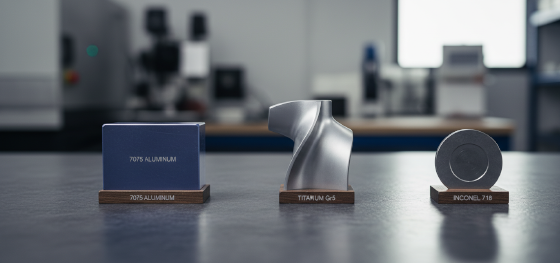
The materials found in an aircraft are a diverse mix of "fast" and "tough" alloys. For structural airframes and wing ribs, Alluminio 7075-T6 is the standard. It offers the strength of many steels but at one-third of the density. However, 7075 is prone to internal stress; if you cut it too fast without a proper cooling strategy, the part will "potato chip" or warp. JUCHENG specializes in the nuanced Machining of 7075 Aluminum, utilizing multi-stage stress relief to ensure large structural plates stay flat.
As we move toward the engine and exhaust sections, the heat requirements skyrocket. Here, we master Titanium Grade 5 Machining and Inconel 718. These materials are "Superalloys" because they maintain their strength at temperatures where aluminum would melt. Machining Inconel is a battle of attrition; it is work-hardens instantly and is incredibly abrasive on cutting edges. We utilize high-torque, rigid CNC centers and specialized ceramic or cobalt-carbide tooling to overcome these materials. By managing the thermal life of the tool and the part, we ensure that the finished component retains the metallurgical properties required for jet engine survival. We don't just cut these alloys; we survive them, providing our clients with the extreme-environment hardware they demand.
Rivoluzione Monolitica: Strategie Simultanee a 5 Assi
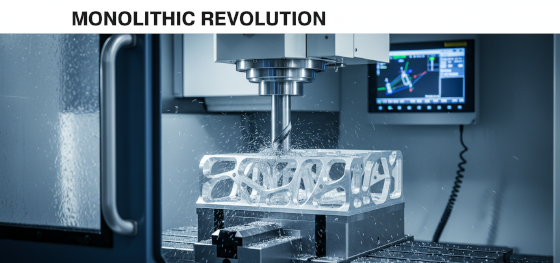
The biggest shift in Lavorazione CNC Aerospaziale over the last decade has been the move toward "Monolithic" parts. Instead of riveting ten different components together, modern engineers design a single, complex part machined from a solid billet. This reduces the part count, eliminates the weight of fasteners, and increases overall reliability. However, machining these parts is impossible on a standard 3-axis mill. You need the freedom of a 5th axis.
Jucheng Precision operates more than 25 high-performance 5-axis centers dedicated to aerospace work. This technology allows us to reach deep into "undercut" pockets and machine complex organic curves in a single setup. By never releasing the part from the fixture, we eliminate the cumulative errors that occur during re-clamping. This "One-Setup" accuracy is vital for maintaining the strict position tolerances required for engine mounts and sensor housings. Our 5-axis simultaneous capability also allows for the use of shorter, more rigid tools, which reduces vibration and delivers a superior surface finish. We bridge the gap between design complexity and manufacturing feasibility, allowing your engineers to dream in five dimensions.
Stabilità a Parete Sottile: Lavorazione Senza Deformazione Dimensionale
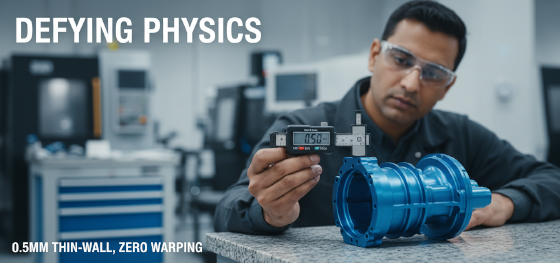
In Lavorazione CNC Aerospaziale, "thin" is a relative term. We often produce enclosures and heat exchangers with wall thicknesses of 0.5mm or less. The technical challenge here is not the thickness itself, but the "spring-back" of the material. When you remove 98% of a metal block to leave a thin skin, the internal residual stresses are released, causing the part to twist or warp. Many shops ship parts that meet the print on day one but are out of spec by the time they reach the customer.
At Jucheng Precision, we use a "Staged Material Removal" protocol to conquer thin walls. We perform a heavy roughing pass, followed by an annealing cycle to relax the metal, and finally a series of high-speed finishing passes using "light-touch" tool paths. This methodical approach ensures that the part stays dimensionally stable. We also utilize specialized vacuum fixtures and "ice-clamping" techniques to support these delicate walls during the cut, preventing the vibration that leads to surface cracking. By controlling the physics of the material's relaxation, we deliver aerospace components that stay "true" from our inspection room to your final assembly line.
Tracciabilità: Tracciabilità Assoluta e Standard di Difesa

The final hallmark of a world-class aerospace facility is not the machines, but the data. In the defense and flight sectors, a part without a documented history is a liability. Lavorazione CNC Aerospaziale requires an absolute audit trail. If a structural fastener fails at 30,000 feet, the manufacturer must be able to trace that failure back to the specific batch of raw ore.
Jucheng Precision implements a rigorous traceability system. Every raw billet is verified via our in-house XRF spectrometer before it enters the machine. We maintain full records of Heat Numbers, Mill Test Reports (MTRs), and process validation logs. Our quality control department utilizes high-resolution CMMs and laser scanners to provide a 100% inspection report for critical dimensions. This level of transparency is why JUCHENG is a trusted partner for applicazioni industriali della lavorazione CNC in the military and aerospace sectors. We don't just give you a part; we give you the verified certainty that your hardware is flight-ready. Whether you are building a commercial satellite or a high-performance turbine assembly, our engineering team provides the technical rigor and documentation required to succeed in the sky. Contact Jucheng Precision today for a technical DFM review and see how our aerospace protocols can elevate your next mission-critical project.

