


I responsabili finanziari e gli addetti agli approvvigionamenti spesso vedono l'officina meccanica attraverso il prisma freddo di un foglio Excel. Nel loro mondo, la scelta tra macchina cnc vs stampante 3d non è un dibattito sulla tecnologia—è un dibattito sul risultato finale. La maggior parte degli ingegneri entra nel ciclo produttivo con un presupposto pericoloso: che la stampa 3D sia la soluzione universale per la complessità a basso costo. Sebbene ciò sia vero per un singolo prototipo tenuto in mano, la stessa logica può mandare in bancarotta un progetto nel momento in cui scala a cinquanta unità. La realtà del costo della stampa 3d vs cnc è un panorama volatile in cui il vincitore è deciso non dalla forma del pezzo, ma dalla quantità nell'ordine di acquisto e dal volume di materiale consumato.

Presso Jucheng Precision, operiamo come hub a doppia tecnologia. Non abbiamo un pregiudizio verso un processo perché possediamo l'intero spettro di frese a 5 assi ad alta velocità e sistemi additivi di livello industriale. Questo ci mette in una posizione unica per agire come revisori fiscali imparziali per i vostri progetti. Comprendiamo che "economico" è un termine relativo che cambia con il ticchettio dell'orologio di produzione. Se scegliete l'additivo per una tiratura di grandi volumi, pagate una "tassa lineare" su ogni pezzo. Se scegliete il sottrattivo per un mockup singolo, affogate in un "debito di setup". Questa guida è un manifesto economico di 1.300 parole progettato per aiutarvi a navigare il punto di pareggio tra il laser e il mandrino, assicurando che il vostro progetto rimanga tanto redditizio quanto preciso.
L'efficienza nella produzione moderna si trova nella rimozione del tempo macchina non necessario. Non state solo pagando per metallo o plastica; state affittando la capacità di un impianto da un milione di dollari. Che stiate costruendo un sensore aerospaziale personalizzato o una serie di contenitori industriali, la logica della curva del costo unitario è il vostro principale regolatore di produzione. Analizziamo le leggi fisiche e finanziarie della quantità e vediamo come la lungimiranza tecnica possa bloccare l'integrità del vostro budget nella realtà fisica.
Pareggio Economico: Analisi dell'Intersezione di Quantità
Fattori di Costo Additivi: La Tassa sull'Altezza Z e sul Volume
Fattori di Costo Sottrattivi: Utensileria, Setup e Scarti
Tasse di Tempo Nascoste: Lavoro Manuale vs. Efficienza del Mandrino
Raccomandazione di JUCHENG: Strategia di Selezione Basata sui Dati
Pareggio Economico: Analisi dell'Intersezione di Quantità
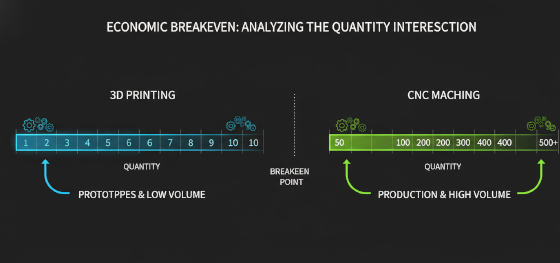
Il grafico più potente nell'officina meccanica è la curva "Costo Unitario vs. Quantità". In qualsiasi costo della stampa 3d vs cnc analisi, queste due tecnologie iniziano alle estremità opposte del grafico. La stampa 3D inizia con un prezzo di ingresso notevolmente basso. Per un singolo pezzo complesso, il costo è essenzialmente il prezzo del materiale più poche ore di tempo macchina. Non ci sono attrezzature da costruire né programmi CAM complessi da scrivere. Questo rende il "Costo del Primo Pezzo" della produzione additiva quasi imbattibile. Per prototipi tra 1 e 10, la stampante 3D è il campione indiscusso del budget.
CNC machining, conversely, starts with a massive "Setup Debt." Before the spindle ever touches metal, a programmer must spend hours defining tool paths, a technician must build custom fixtures, and a set of specialized cutters must be loaded. This "Non-Recurring Engineering" (NRE) fee can be several hundred dollars for a single part. However, once that setup is complete, the per-part price drops precipitously. The machine can produce the 100th part for a fraction of the cost of the first. At JUCHENG, we generally find the breakeven point occurs between 30 and 50 units. If your order is below this threshold, the printer usually wins. If you are ordering 100 units or more, the efficiency of the CNC spindle amortizes the setup costs so effectively that the total invoice will be significantly lower than an additive run. We provide our clients with these comparative curves during the DFM phase, ensuring you don't choose a technology that feels cheap today but becomes a burden tomorrow.
Fattori di Costo Additivi: La Tassa sull'Altezza Z e sul Volume
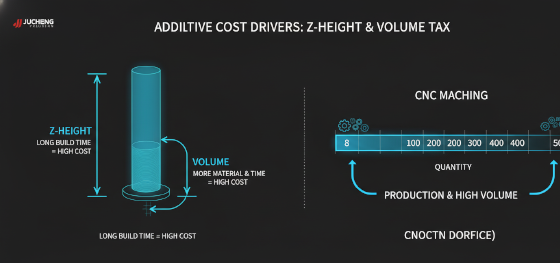
To understand why additive manufacturing is a "linear" cost model, you must look at how it consumes time and material. In 3D printing, volume is the enemy of the budget. Unlike CNC, where a large block of aluminum is relatively inexpensive, 3D printing powders and resins are priced by the gram and are significantly more costly than raw billet. If your design is bulky and solid, you are paying a "Volume Tax" for every cubic centimeter of material used. This is why hollowing out parts is such a critical cost-saving strategy in additive manufacturing.
The second major driver is the "Z-Height Tax." In technologies like SLA or FDM, the time it takes to print is largely determined by how tall the part is. Every additional layer requires a movement of the build plate and a fresh recoating cycle. A part that is tall and thin will take much longer to print than the same part laid flat, even if the material volume is identical. At JUCHENG, we optimize our 3D builds for "Packing Density." In technologies like MJF (Multi Jet Fusion), we can stack hundreds of parts into a single three-dimensional build volume. If we can fit more parts into one "bake," the cost-per-part drops. However, if your geometry is large and occupies most of the build chamber alone, the price remains stubbornly high because you are effectively renting the entire machine for a single part. This volume-and-height-based pricing means that as your part gets larger and more solid, the costo della stampa 3d vs cnc gap narrows quickly in favor of the mill.
Subtractive Cost Drivers: Tooling, Setups, and Block Size

Subtractive manufacturing operates under a completely different set of economic stressors. The primary driver in CNC is "Spindle Time"—the number of minutes the tool is actually in contact with the material. This makes complexity the enemy of the CNC budget. A part with hundreds of intricate pockets and deep internal radii requires multiple tool changes and slower feed rates, driving the price up. In the costo della stampa 3d vs cnc battle, complexity is "free" for the printer but "premium" for the mill.
Another critical factor is the "Buy-to-Fly" ratio—the amount of raw material you have to purchase compared to the final part volume. For a complex CNC part, you might start with a 10kg block of aluminum only to mill away 9kg of it into waste chips. You are paying for that 9kg of "lost" material. Furthermore, the number of setups dictates the labor cost. If a part requires five different orientations in a vice, it requires five different fixtures and five different touch-off cycles. Jucheng Precision mitigates this through our 5-axis infrastructure, which allows us to finish five sides of a part in one setup, drastically reducing the labor-load. By understanding that CNC cost is driven by machine-hours and material waste, we can help you simplify your designs to exploit the speed of the spindle, turning a complex "expensive" part into a streamlined "production" part that wins the cost race at scale.
Tasse di Tempo Nascoste: Lavoro Manuale vs. Efficienza del Mandrino
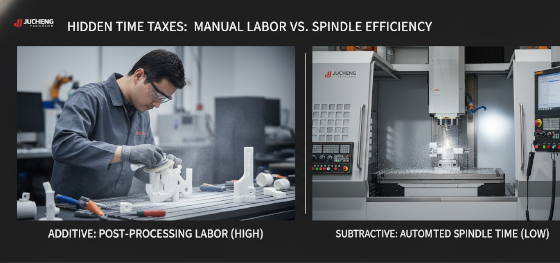
When comparing costo della stampa 3d vs cnc, many designers forget to account for the "Tail End" of the process. A 3D printer doesn't produce a finished part; it produces a "Near-Net-Shape" preform. Every 3D printed part—especially those in resin or metal—requires significant post-processing. Support structures must be manually clipped off, surfaces must be sanded to remove layer lines, and parts often need thermal curing or bead blasting to achieve an acceptable finish. This is highly variable, skilled manual labor. It doesn't scale well. If you have 500 parts, you need a small army of technicians to sand them all.
CNC machining is the opposite. The "Manual Labor" is front-loaded. It takes time to program and set up the machine, but once the green button is pushed, the process is automated. The part comes off the machine with a finished surface, tapped threads, and verified dimensions. In a production run, the "Human-Hour per Part" for CNC is nearly zero. At JUCHENG, we analyze these hidden taxes for our clients. We often find that for parts requiring a high-quality surface finish, the cost of manual post-processing for a 3D print actually makes the CNC option cheaper, even at lower quantities. We look past the "machine time" to the total "labor cycle," ensuring your material choice reflects the true cost of human intervention in the manufacturing loop.
Raccomandazione di JUCHENG: Strategia di Selezione Basata sui Dati
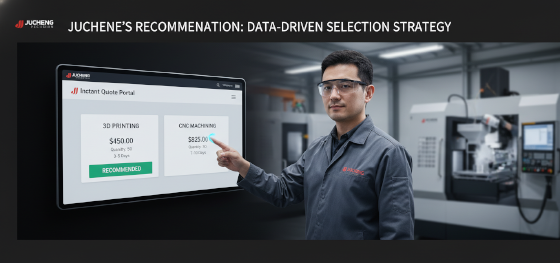
So, which technology wins the budget battle? Jucheng Precision remains neutral because we are experts in both. Our recommendation is always driven by the specific physics and the intended volume of your project. We don't just quote parts; we quote strategies.
| Project Variable | 3D Printing Advantage | CNC Machining Advantage |
|---|---|---|
| Quantity 1-10 | High (No Setup Fee) | Low (High Setup Cost) |
| Quantity 100+ | Low (Linear Material Cost) | High (Scale Efficiency) |
| Complessità | Extreme Freedom (Internal Voids) | Limited (Line-of-Sight) |
| Finitura Superficiale | Requires Manual Labor | Finished Off-Machine |
Choose 3D Printing if: You are in the early R&D phase, need a complex geometry that is impossible to mill (like internal cooling channels), or require a functional prototype within 48 hours for a critical board meeting. It is the king of agility.
Choose CNC Machining if: You have finalized your design, need a batch of 50 or more, or require production-grade material properties and absolute surface perfection. It is the king of scalability and structural certainty.
At Jucheng Precision, our instant quoting system often provides side-by-side pricing for both macchina cnc vs stampante 3d options. This allows you to make an informed, data-driven decision based on the actual manufacturing capacity of our floor. We bridge the gap between a digital mock-up and a profitable product line. Whether you are building the next generation of medical diagnostics or a high-performance EV chassis, our technical rigor ensures your designs are realized with the best possible ROI. Contact our engineering team today for a comprehensive DFM review and let us help you choose the manufacturing path that clarifies and secures your project budget.

