


La rigidità è il dio tradizionale dell'officina meccanica, ma la flessibilità è la nuova valuta della velocità. Per decenni, il reparto CNC e il laboratorio di stampa 3D sono esistiti in silos separati—uno per la produzione pesante e l'altro per i modellini delicati. Quel muro tecnico è stato smantellato. Nel panorama moderno della produzione di alta precisione, le parti per macchine CNC stampate in 3D sono emerse come il principale abilitatore della logica sottrattiva complessa. Non siamo più limitati ai piani piatti di una morsa standard in acciaio o agli alti costi delle attrezzature in alluminio fresate su misura. Utilizzando polimeri ad alta resistenza per trattenere, guidare e proteggere i pezzi in metallo, stiamo effettivamente usando l'agilità della produzione additiva per potenziare la potenza grezza della fresatrice. Non si tratta solo di risparmiare materiale; si tratta della riduzione aggressiva dei tempi di attrezzaggio e della totale eliminazione dei danni superficiali su hardware critico per la missione.
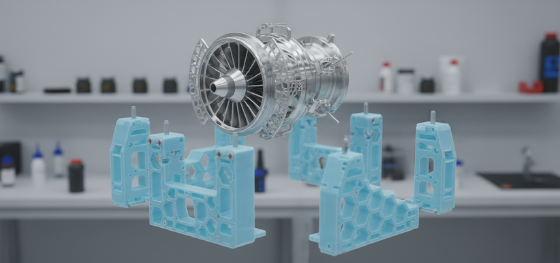
L'integrazione strategica di le parti per macchine CNC stampate in 3D consente a una struttura di reagire a un file CAD complesso in ore anziché settimane. In JUCHENG, non consideriamo la stampa 3D come un servizio autonomo; la trattiamo come un sottosistema tecnico che supporta l'intera infrastruttura CNC a 5 assi. Che si tratti di un set di ganasce morbide conformi progettate per avvolgere un impianto medico organico o di una pinza robotica leggera che accelera una linea di assemblaggio ad alto volume, la sinergia tra additivo e sottrattivo definisce il nostro vantaggio competitivo. Questa guida esplora le fondamenta meccaniche del workholding in polimero, il ruolo tattico della validazione fisica del percorso e perché l'approccio integrato di JUCHENG a post-elaborazione della stampa 3D garantisce che i vostri pezzi siano gestiti con la stessa riverenza tecnica delle tolleranze a livello di micron che richiedono.
La redditività in officina si ottiene minimizzando il tempo in cui il mandrino è inattivo. Se aspetti sei giorni perché l'utensileria fresi un'attrezzatura personalizzata, stai perdendo la corsa al mercato. Analizziamo le leggi fisiche della produzione ibrida e vediamo come la lungimiranza tecnica può trasformare i polimeri stampati in 3D nella spina dorsale strutturale della vostra produzione CNC.
Ancoraggi Ergonomici: L'Ascesa delle Ganasce Morbide Personalizzate
Validazione del Percorso: Stampare la Simulazione Fisica
Sinergia Robotica: Utensili e Pinze per Fine Braccio
Integrità Strutturale: Gestione delle Forze di Serraggio nei Polimeri
Lo Standard Ibrido di JUCHENG: Pianificazione del Processo Unificato
Ancoraggi Ergonomici: L'Ascesa delle Ganasce Morbide Personalizzate
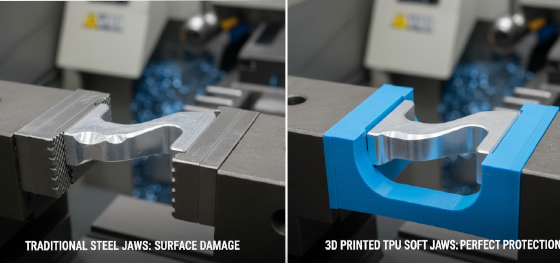
L'incontro più frequente tra stampa 3D e fresatrice CNC avviene nella morsa. Le ganasce in acciaio tradizionali sono progettate per geometrie "quadrate"—usano forza bruta e superfici piatte per fissare un pezzo. Ma i design moderni di aerospaziale ed elettronica di consumo sono raramente quadrati; sono organici, curvi e spesso presentano superfici finite che non possono tollerare un solo graffio. È qui che le parti per macchine CNC stampate in 3D forniscono un'alternativa non distruttiva. Utilizziamo Nylon MJF ad alta resistenza o resine "Tough" per stampare ganasce morbide personalizzate che sono l'esatto inverso della geometria del pezzo.
This "Conformal Grip" distributes the clamping force across the entire surface area of the part rather than concentrating it at a few pressure points. This is essential for thin-walled enclosures that would otherwise buckle or deform under the torque of a standard vice. Furthermore, by using softer polymers like TPU for the contact face, we can hold high-polish stainless steel or mirror-finished acrylic components with zero risk of surface marring. These fixtures are not just "holders"—they are accuracy stabilizers. Because the part is cradled in a geometry that matches its own, vibration is dramatically reduced, allowing for faster spindle speeds and superior surface finishes. At JUCHENG, we turn workholding into an engineered advantage, ensuring that the final stage of your part's manufacturing journey doesn't leave a single industrial footprint.
Validazione del Percorso: Stampare la Simulazione Fisica
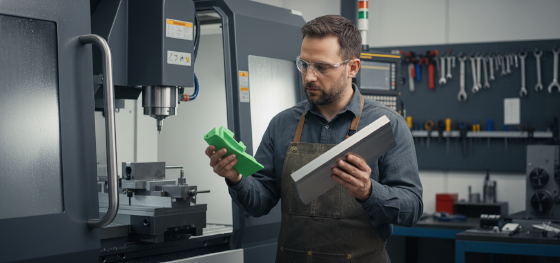
In the 5-axis milling world, a collision is a catastrophe. If a five-thousand-dollar diamond-tipped cutter strikes a ten-thousand-dollar piece of Inconel due to a programming error, the cost to the project is immense. Digital simulations can only go so far; they don't account for the "hand-feel" of tool clearance or the subtle physics of chip evacuation in a deep bore. Jucheng Precision uses le parti per macchine CNC stampate in 3D as the ultimate physical "dry run." We often print a low-cost PLA or ABS version of a complex component before we ever touch a raw metal billet.
These "Sacrificial Masters" allow our machinists to verify the fixture fitment and the tool approach angles in the real world. If a tool holder comes within 1mm of the part’s wall during a complex rotation, the 3D printed model will show us exactly where the danger lies. This risk-management strategy is vital for high-value aerospace and defense projects where "Revision 1" must be perfect. By bridging the gap between the CAM screen and the physical machine enclosure, we eliminate the uncertainty of 5-axis motion. We don't just "hope" the code is right; we have already felt the tool path move against a printed replica. This level of technical oversight is why JUCHENG maintains a near-zero scrap rate on high-complexity alloy parts, providing our clients with the speed of a prototype shop and the security of an aerospace facility.
Sinergia Robotica: Utensili e Pinze per Fine Braccio
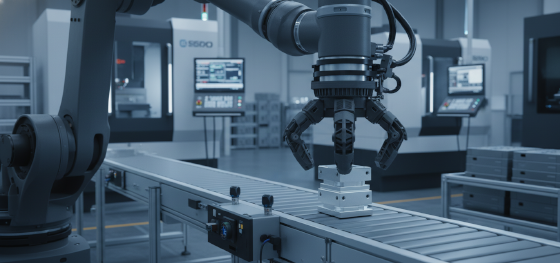
The efficiency of a modern factory is dictated by its automation. Robotic arms move parts between machining centers, cleaning tanks, and inspection stations at high speeds. The "fingers" of these robots—known as End-of-Arm Tooling (EOAT)—must be perfectly matched to the part’s geometry to ensure a reliable grip without causing damage. Traditionally, these grippers were milled from aluminum, which made them heavy and slow. le parti per macchine CNC stampate in 3D have transformed this sector by allowing for radical lightweighting and "Topological Optimization."
JUCHENG utilizes MJF technology to print functional grippers with integrated internal air channels for pneumatic suction. These parts are 60% lighter than their aluminum predecessors, allowing the robotic arm to move 20% faster while consuming less energy. Because the grippers can be custom-contoured to the specific part being machined, the risk of a part being dropped or misaligned on the next fixture is nearly zero. This synergy is a cornerstone of our high-volume automotive and electronics production lines. We use 3D printing to build the "infrastructure of speed," ensuring that the transition between subtractive cycles is as fluid as the cut itself. By engineering the interface between the part and the robot, we lock in a level of production consistency that manual shops simply cannot match.
Integrità Strutturale: Gestione delle Forze di Serraggio nei Polimeri
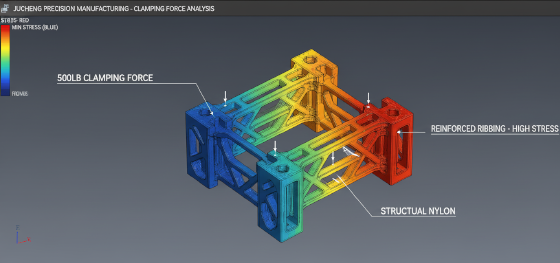
A persistent myth in manufacturing is that plastic is too weak to be used as a structural fixture. This is a misunderstanding of modern polymer science. When we design le parti per macchine CNC stampate in 3D for workholding, we aren't just printing a solid block. We are engineering a structural lattice. At Jucheng Precision, our DFM team performs Finite Element Analysis (FEA) on our jigs and fixtures to ensure they can withstand the massive hydraulic clamping forces of our CNC machines.
We utilize reinforced materials like Glass-Filled Nylon (PA12-GF) or Carbon-Fiber PEEK to provide the stiffness required for heavy milling. These materials offer the compressive strength of soft metals with the damping characteristics of a polymer. This damping is a hidden technical advantage; a 3D printed fixture can actually absorb the high-frequency vibrations of a cut better than a steel fixture, leading to superior surface integrity on the workpiece. We also integrate "wear-inserts"—small steel or brass bushings pressed into the 3D printed part—at the points of highest friction. This hybrid "Metal-on-Plastic" engineering ensures that the fixture survives for thousands of cycles on the production floor while protecting the delicate geometry of your design. We treat the jig as a high-performance machine component, ensuring its structural soul is as optimized as the parts it produces.
Lo Standard Ibrido di JUCHENG: Pianificazione del Processo Unificato
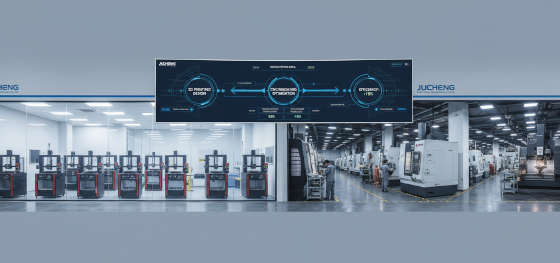
The greatest risk in high-end manufacturing is the gap between the "Designer" and the "Maker." Jucheng Precision eliminates this gap by operating as a unified technical hub. We don't just "hit go" on a printer and a mill; we coordinate their physics. Our integrated approach to post-elaborazione della stampa 3D means that the same engineers who optimize your CAD file for a 5-axis mill are also the ones designing the 3D printed soft jaws that will hold it.
This "Unified Process Planning" is why JUCHENG can deliver complex, multi-functional parts with such high repeatability. We use 3D printing to create the "custom environment" needed for precision CNC success. We understand that a component is only as good as the stability it was born in. By owning the entire lifecycle—from material verification via spectrometer to the final CMM validation of the assembly—we ensure your designs are realized with absolute integrity. Whether you are building a revolutionary heart pump or a high-speed satellite housing, our hybrid protocols clarify and elevate your vision. We don't just make parts; we engineer the systems that make them perfect. Contact Jucheng Precision today for a comprehensive DFM review and see how our integrated additive and subtractive protocols can stabilize your next manufacturing breakthrough.

