


L'odore acre e nauseabondo dell'acido polilattico (PLA) fuso che gocciola su un blocco motore V8 caldo è un errore che un ingegnere automobilistico junior commette solo una volta. L'anno scorso, un cliente di corse mi ha consegnato un supporto per sospensione in polimero frantumato che si è spezzato perfettamente lungo le linee di strato nel momento in cui l'auto ha colpito una buca. Tenendo la plastica rovinata tra le mani, ho passato il pollice sulle creste fragili e delaminate. Era un esempio da manuale di confusione tra materiali da hobbistica da scrivania e realtà meccanica di livello industriale. Progettare un pezzo per auto stampato in 3D richiede di scartare brutalmente il marketing hype e rispettare l'implacabile fisica della strada aperta.

La prototipazione di collettori di aspirazione complessi o cornici per cruscotto personalizzate costringe i responsabili degli approvvigionamenti a scegliere tra produzione additiva e lavorazione CNC sottrattiva. Una tecnologia costruisce geometrie dal nulla utilizzando polveri polimeriche e laser ad alta potenza, mentre l'altra scolpisce violentemente billettoni di alluminio solido con carburo rotante. Confondere questi due paradigmi strutturali garantisce guasti catastrofici sul campo.
Sopravvivere all'ambiente automobilistico richiede una padronanza assoluta delle temperature di deflessione termica e dei limiti anisotropi dei materiali. I fabbricanti devono calcolare matematicamente quando una stampa in nylon caricato con vetro può sostituire in sicurezza un costoso supporto metallico lavorato. L'economia di precisione si basa interamente sull'abbinamento della specifica chimica del polimero alle brutali sollecitazioni cinetiche nascoste sotto il cofano.
contenuto:
Pezzo per Auto Stampato in 3D vs Lavorazione CNC: Come si Confrontano?
Quando Specificare Componenti Automobilistici Additivi?
Quando BISOGNA Evitare la Stampa FDM per Carichi Strutturali?
Come la Deflessione Termica Distrugge i Prototipi nel Vano Motore?
Quali Sono i Veri Costi NRE per la Scalabilità Rapida?
Come Jucheng Ottimizza la Prototipazione Auto a Shenzhen?
Quali Sono le FAQ più Critiche sulla Stampa 3D Automobilistica?
Pezzo per Auto Stampato in 3D vs Lavorazione CNC: Come si Confrontano?

Il nylon stampato in 3D possiede esattamente la stessa resistenza a trazione del nylon lavorato a CNC? Assolutamente no. Le parti lavorate a CNC vantano una resistenza completamente isotropa da un blocco solido e compresso, mentre le stampe 3D basate su estrusione soffrono di debolezza anisotropa, in particolare si rompono facilmente lungo i confini degli strati sull'asse Z.
La lavorazione CNC industriale rimuove materiale da barre di plastica fortemente compresse e stress-relieved. Se si fresca un supporto per cambio motore in Delrin massiccio, quella parte assorbirà perfettamente lo shock cinetico indipendentemente dalla direzione dell'impatto. La struttura cristallina grezza rimane indisturbata, fornendo dati meccanici puri e inalterati secondo catalogo, di cui gli ingegneri automobilistici possono fidarsi ciecamente.
Base Modellazione a deposizione fusa (FDM) costruisce parti impilando fili di plastica fusa. Il legame termico tra lo strato 10 e lo strato 11 è matematicamente molto più debole del filamento continuo stesso. Tuttavia, la sinterizzazione laser selettiva (SLS) di alta gamma elimina completamente questa debolezza degli strati. Utilizzando laser ad alta potenza per fondere polvere di nylon, la SLS crea un solido isotropo quasi al 100% denso, capace di resistere a test su strada aggressivi senza rompersi.
| Metrica di produzione | Stampa 3D industriale (SLS/MJF) | Lavorazione CNC a 5 assi | Impatto sul design automobilistico |
|---|---|---|---|
| Complessità geometrica | Illimitati (canali interni liberi) | Limitata (richiede linea di vista) | La stampa crea collettori di raffreddamento impossibili |
| Rigidità strutturale | Da moderata ad alta | Massimo assoluto | La CNC domina i componenti del telaio portanti |
| Tolleranza della finitura superficiale | Rougher (Powder texture) | Flawless Mirror Finish | CNC required for tight bearing press-fits |
| Scarto di Materiale | Near Zero (Recycled powder) | High (Up to 80% chips) | Printing slashes material costs on hollow parts |
Quando Specificare Componenti Automobilistici Additivi?

Are printed components viable for end-use functional testing on a race track? Yes, provided you specify engineering-grade nylon or TPU. They are ideal for complex HVAC ducting, custom dashboard gauge pods, and intricate fluid manifolds that would require expensive multi-part CNC assemblies.
Hardware engineers exploit additive manufacturing specifically for conformal cooling and topology optimization. A racing team can design a brake caliper cooling duct with bizarre, spiraling internal pathways that perfectly wrap around the tight chassis dimensions. A CNC milling cutter simply cannot bend around corners to machine these internal voids. 3D printing executes this impossible geometry flawlessly in a single overnight build.
Bridge production thrives on powder-bed technologies like Multi Jet Fusion (MJF). When an automotive EV startup needs 300 custom wiring harness clips instantly, cutting an eighty-thousand-dollar steel injection mold paralyzes their cash flow. Dropping those 300 clips into a single MJF build chamber delivers production-grade, highly flexible nylon parts the very next day without a single dollar spent on NRE tooling.
Quando BISOGNA Evitare la Stampa FDM per Carichi Strutturali?
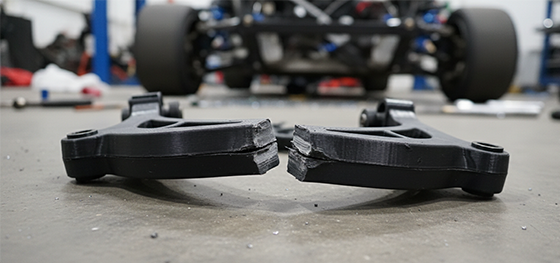
Can an FDM printed bracket safely support an alternator under heavy vibration? Never. Basic extrusion prints suffer catastrophic fatigue failure under continuous harmonic engine vibration, eventually tearing themselves apart along the weak layer boundaries.
Placing an anisotropic FDM part under sheer kinetic stress is engineering suicide. I have witnessed printed suspension mounts crack instantly the moment a mechanic applied ninety foot-pounds of torque to the mounting bolt. The plastic simply lacks the dense molecular cross-linking required to prevent the layers from shearing violently away from one another during acceleration.
You must immediately upgrade to CNC machined aluminum or forged steel whenever the blueprint demands rigid structural integrity. If a part failure results in a loss of vehicle control, steering degradation, or pressurized brake fluid blowout, additive polymers must be completely removed from the prototyping equation. Human safety factors demand unyielding solid metal.
Come la Deflessione Termica Distrugge i Prototipi nel Vano Motore?

Will standard ABS prints survive bolted directly near an exhaust manifold? No. Engine bays routinely exceed 120°C (250°F). Standard plastics hit their glass transition temperature long before this, softening like warm butter and collapsing entirely under their own gravitational weight.
Evaluating the Heat Deflection Temperature (HDT) separates amateur cosmetic designs from aerospace-grade survival. If you mount a beautiful resin SLA intake manifold onto a turbocharged engine, the ambient exhaust heat will slowly deform the plastic. The vacuum seal breaks, the engine runs dangerously lean, and catastrophic internal detonation occurs within minutes of the initial track test.
Surviving the under-hood inferno mandates exotic, ultra-high-performance polymers. Industrial systems printing Ultem 9085 or PEEK easily withstand continuous operating temperatures pushing 200°C without shedding a single micron of dimensional tolerance. These advanced aerospace filaments aggressively rival the thermal stability of raw aluminum while shaving pounds of weight off the front axle.
Quali Sono i Veri Costi NRE per la Scalabilità Rapida?

Is 3D printing inherently cheaper than CNC machining for car parts? Only for complex, hollow geometries in extreme low volumes. If you need a simple, solid block of material, CNC machining a raw billet often costs significantly less than buying expensive specialized polymer filaments.
Additive manufacturing eliminates CAM programming and fixturing setups, dragging initial NRE costs down to practically zero. However, producing 500 massive car bumpers via 3D printing is financial insanity. The printer takes excruciatingly long hours to build massive objects, driving the variable unit cost sky-high. The laser beam can only move so fast across the powder bed.
Subtractive machining dominates large, simple geometric forms. Slapping a thick aluminum plate onto a high-speed router allows massive cutting heads to clear pounds of metal in seconds. Procurement executives must aggressively plot the volumetric intersection curve where the slowness of the printer begins incinerating the budget compared to the raw muscle of a CNC spindle.
Come Jucheng Ottimizza la Prototipazione Auto a Shenzhen?

Can a single facility seamlessly combine 3D printed plastics with tight CNC metal tolerances? Yes. Operating within the [2026] Shenzhen precision manufacturing hub, Jucheng merges high-end HP MJF additive technologies directly alongside our 150-machine CNC fleet.
Navigating global hardware procurement requires an absolute rejection of unverified plastic tolerances. If you print a complex nylon intake but need a perfectly flat, leak-proof mating surface, we mount the 3D printed part directly onto a 5-axis CNC. We physically mill the printed plastic face flat to guarantee an absolute micron-level vacuum seal for your gaskets.
Our engineering teams intervene heavily during the CAD review phase. Backed by uncompromising ISO9001:2015 and IATF16949 automotive protocols, our Free DFM reviews identify thermal failure risks before the laser fires. We execute intelligent hardware scaling without MOQ restrictions, ensuring your exact digital design survives the harsh realities of the racetrack.
Quali Sono le FAQ più Critiche sulla Stampa 3D Automobilistica?

Resolving hardcore kinetic and thermal variables prevents devastating assembly line bottlenecks when scaling complex digital automotive models into physical prototypes.
Can you thread a bolt directly into a 3D printed plastic hole?
It is highly discouraged for automotive applications. Cutting threads directly into layered plastic creates massive stress concentrators that strip out instantly under torque. You must design the CAD file to accept ultrasonic brass heat-set inserts. Melting these metal anchors into the plastic provides permanent, indestructible machine threads.
Does SLA resin printing work for exterior car body panels?
No. Standard stereolithography (SLA) resins are notoriously brittle and hypersensitive to prolonged ultraviolet (UV) radiation. If you bolt a raw SLA resin spoiler to a car, the sunlight will slowly degrade the polymer chains over weeks, turning it yellow and causing it to shatter catastrophically upon the first gravel impact.
Can a 3D printed automotive part be electroplated with chrome?
Yes, but the preparation is excruciating. Because plastics are non-conductive, the part must be sanded completely flat, coated in a specialized conductive copper or nickel spray, and then submerged in the chemical bath. Any microscopic layer lines left un-sanded will be violently magnified and highlighted by the shiny chrome finish.

