


Walk into any aerospace hangar, and you will be surrounded by two metals: Aluminum and Titanium. They are the twin pillars of modern flight. Both are silver, both are non-magnetic, and both are revered for being "lightweight." But peering under the skin of a jet fighter reveals a strict segregation. The fuselage skin is aluminum; the engine exhaust cones are titanium.

Why? The battle of titanium vs aluminum is not a contest of good versus bad. It is a contest of specific physics. Aluminum is the king of low-cost light-weighting, while titanium is the master of high-stress survival.
At Jucheng Precision, we often see designs where engineers over-spec titanium when aluminum would suffice, wasting budget. Conversely, an aluminum alloy specified for a hot location must be checked against the actual service conditions. This guide breaks down the physical, thermal, and economic boundaries between these two aerospace giants.
The Weight Champion: Aluminum
Strength-to-Weight: The Titan
The Heat Limit: Where Aluminum Fails
Machinability and Cost Gap
Fatigue Life: The Infinite Cycles
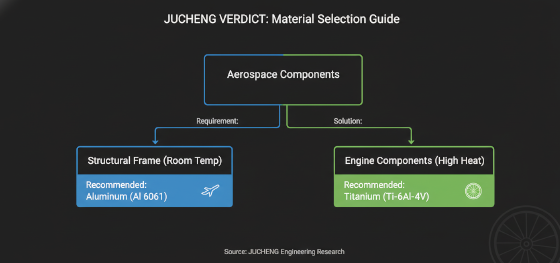
JUCHENG's Verdict: The Decision Matrix
The Weight Champion: Aluminum

Let's clear up a massive misconception immediately: Titanium is NOT lighter than Aluminum. In fact, it is significantly heavier.
Aluminum (6061/7075): Typical densities are about 2.70 g/cm³ for 6061 and 2.80 g/cm³ for 7075.
Titanio (Ti-6Al-4V): Density is ~4.43 g/cm³.
For two identical parts, the Ti-6Al-4V part will weigh about 58–64% more than one made from 7075 or 6061, respectively. At a fixed volume, aluminum is lighter. If the geometry can change, compare the mass of designs that meet the same stiffness and load requirements.
Strength-to-Weight: The Titan
So, why do we use titanium if it's heavier? Because it is exponentially stronger.
A high-end aluminum alloy like 7075-T6 has a yield strength of about 503 MPa. Titanium Grade 5 hits 900-1100 MPa. Titanium is practically twice as strong. This brings us to the "Strength-to-Weight Ratio." Even though titanium is heavier per cubic centimeter, you need less of it to hold the same load.
For a landing gear strut, an aluminum version would need to be massively thick to prevent buckling. A titanium version can be a slender, elegant tube. In space-constrained applications, titanium wins because it packs more strength into a smaller package.
The Heat Limit: Where Aluminum Fails

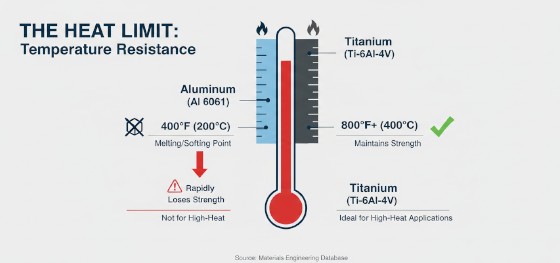
This is the dealbreaker. The temperature capability is usually the deciding factor in the titanium vs aluminum debate.
Aluminum alloys can lose strength well below their melting ranges. For heat-treated alloys such as 6061-T6 and 7075-T6, the strength available in service depends on the alloy, temper, temperature and exposure time. Use design allowables for the actual material and thermal history.
Ti-6Al-4V can be a candidate where aluminum does not meet the hot-strength requirement, but its strength also declines as temperature rises. Compare the actual grades and conditions against the operating loads, temperature and time at temperature.
Machinability and Cost Gap
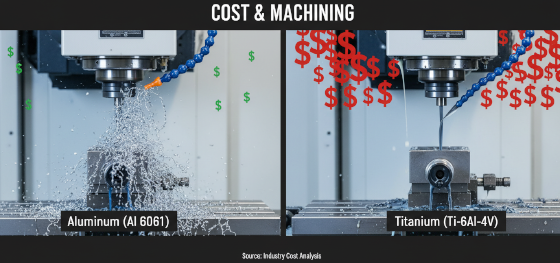
For the procurement manager, the difference is painful. Aluminum is the most abundant metal in the earth's crust; Titanium is difficult to refine.
Costo del materiale: Titanium costs 7x to 10x more than Aluminum per kilogram.
Machining Cost: Aluminum is "Free Machining." We can run our CNC machines at 12,000 RPM, removing material rapidly with minimal tool wear. Titanium requires slow speeds, specialized cooling, and expensive tooling to prevent work hardening.
When we provide quotes for lavorazione CNC del titanio versus aluminum machining, the price difference can be stark. If your part does not need the heat resistance or extreme strength of titanium, staying with aluminum is the single best way to reduce project costs.
Fatigue Life: The Infinite Cycles
There is one final hidden property: Fatigue Limit.
Aluminum does not have a distinct fatigue limit. This means that no matter how small the stress, if you cycle aluminum enough millions of times (bend it back and forth), it will eventually crack and fail. It has a finite lifespan.
Titanium (like steel) has a true endurance limit. If the stress is kept below a certain threshold, the part can theoretically cycle infinitely without failing. This makes titanium the superior choice for dynamic parts like springs, helicopter rotor hubs, and medical implants that must survive millions of heartbeats or rotations.
JUCHENG's Verdict: The Decision Matrix
Making the right call requires looking at the environment your part will live in.
Stick to Aluminum if:
• The selected aluminum alloy and temper meet the strength requirements at the actual operating temperature and exposure duration.
• You need maximum weight savings for a given volume (bulk).
• Cost is a primary concern.
• You want to anodize the part in bright colors for aesthetics.
Upgrade to Titanium if:
• The selected titanium grade meets the elevated-temperature requirements that the aluminum option cannot meet.
• You need high strength in a thin, compact space.
• The part will be exposed to saltwater or harsh chemicals.
• The part undergoes cyclic loading (fatigue).
Jucheng Precision is equipped to handle both. We have high-speed spindles dedicated to aluminum and high-torque machines dedicated to titanium. Send us your requirements, and we will help you manufacture the perfect balance of performance and price.

