


Il tuo prototipo arriva. L'hai progettato per avere angoli perfetti di 90 gradi. Lo controlli con una squadra. È di 91 gradi. Hai progettato un foro rotondo vicino a una piega. Sul pezzo, il foro è un leggero ovale. Perché?

Questo non è necessariamente un difetto di fabbricazione. Questo è il fantasma nella macchina. È la fisica nascosta del processo di fabbricazione della lamiera. Il metallo è un materiale vivo. Ha memoria. Oppone resistenza.
Comprendere questa lotta è la chiave per progettare ottimi pezzi. Questa guida ti porterà in profondità nel processo. Rivelerà le forze in gioco e come un produttore professionista le controlla.
Anatomia di un pezzo imperfetto
Dare vita al grezzo con luce e precisione
Dentro l'arte violenta della piegatura
Combattere la memoria del metallo: il ritorno elastico
Costruire l'insieme dalle sue parti
Anatomia di un pezzo imperfetto

Nel mondo di Lavorazione della lamiera, il materiale stesso ha una voce. Spinge e tira. Ricorda il suo stato piatto. Un progettista che non ascolta il materiale sarà sempre sorpreso dal risultato finale.
Quando il tuo preciso modello CAD diventa un oggetto fisico leggermente diverso, è a causa di queste forze. Il metallo si è stirato dove non te lo aspettavi. Si è piegato all'indietro quando volevi che rimanesse fermo.
Un processo di fabbricazione professionale non consiste nel forzare il metallo nella forma. Consiste nel comprendere queste forze e usarle a tuo vantaggio. È una danza tra la macchina e la memoria del materiale.
Dare vita al grezzo con luce e precisione
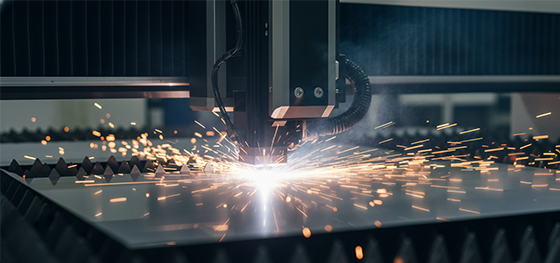
Ogni grande pezzo inizia con un "grezzo" perfetto. Il grezzo è il modello piatto 2D del tuo pezzo, tagliato da un grande foglio. La precisione di questo primo passo è critica.
Lo strumento principale per questo è un taglio laser a fibra. Questa è la parte "taglio" del processo. Un raggio di luce ad alta intensità fonde e vaporizza istantaneamente il metallo. Un getto di gas soffia via il metallo fuso, lasciando un bordo perfettamente pulito.
Il laser è controllato da un computer che legge direttamente il tuo file di progettazione. Può tagliare qualsiasi forma, non importa quanto complessa, con una tolleranza di circa +/- 0,1 mm. Questa precisione digitale all'inizio è la base per un pezzo finale accurato. Altri processi di taglio, come la punzonatura CNC, sono utilizzati per pezzi con molti fori ripetuti.
Dentro l'arte violenta della piegatura

Bending is where the part comes to life. But it is a violent and complex event at the microscopic level.
When a sheet of metal is forced into a bend, the atoms on the outside of the bend are pulled apart. They are in tension. The atoms on the inside of the bend are squeezed together. They are in compression.
This stretching and squeezing is what causes the deformation around your holes. If a hole is too close to the bend line, it will be pulled into the stretching zone and become distorted. This is not a mistake. It is physics. A good designer must account for this.
This internal stress is the source of all the challenges in forming metal.
Combattere la memoria del metallo: il ritorno elastico
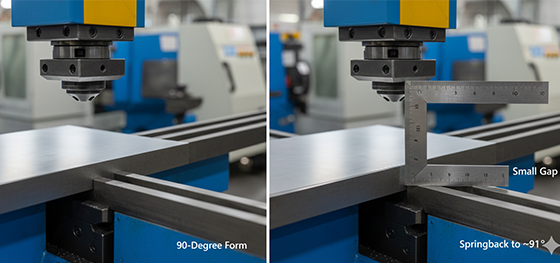
Once the bending tool is removed, the internal stresses in the metal want to relax. This causes the metal to "spring back" slightly.
This is why your 90-degree angle becomes a 91-degree angle. The metal is trying to return to its original flat state.
A professional manufacturer knows how to defeat this enemy. Their press brake machines are equipped with advanced sensors. They can predict how much a certain material will spring back.
To create a perfect 90-degree angle, they will actually bend the metal slightly further, for example, to 89 degrees. They let it spring back, and it settles at exactly 90 degrees. This is a science called "air bending," and it requires a huge amount of process knowledge and a very precise machine.
Costruire l'insieme dalle sue parti
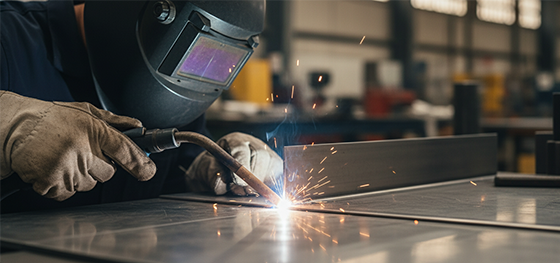
The final part of the di fabbricazione della lamiera is putting it all together.
If the product is an assembly of multiple parts, they are joined together. This is the "joining" stage. Welding is a common method for creating strong, permanent joints. For a clean, precise weld on aluminum or stainless steel, TIG welding is the preferred choice.
Other joining methods include inserting rivets or hardware. Once assembled, the part then goes on to the final finishing steps, like powder coating.
Understanding this entire chain of events, from the hidden physics of bending to the final weld, is what separates a designer from a master of the craft. It is a partnership with the material, not a fight against it.

