


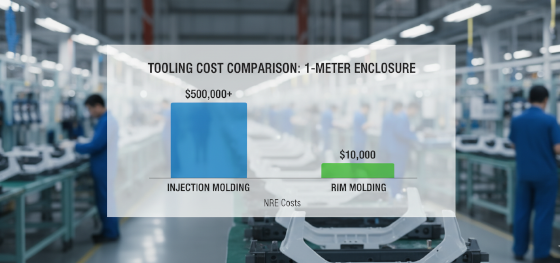
Navigare nel panorama finanziario dello sviluppo hardware su larga scala nel mercato attuale porta spesso a una domanda schiacciante: come finanziare il massiccio investimento iniziale per gli stampi di produzione? Nei settori della robotica autonoma e della tecnologia medica, il dibattito tra stampaggio a iniezione reattivo e stampaggio a iniezione è guidato principalmente dalla spesa in conto capitale necessaria per passare da un file CAD al primo pezzo fisico. Mentre lo stampaggio ad alta pressione è lo standard per i beni di consumo ad alto volume, costringe gli ingegneri in uno stato di "Debito di stampaggio" quando i pezzi superano i 1.000 mm di lunghezza. Comprendere le variabili alla base del Costo dello stampo RIM vs stampaggio a iniezione è la strategia essenziale per gli sviluppatori che necessitano di involucri di qualità produttiva senza l'impegno a sei cifre degli stampi tradizionali in acciaio.
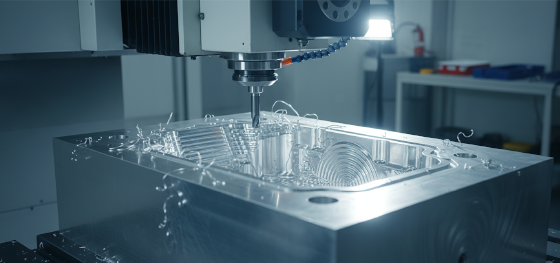
L'economia degli stampi è governata dalla pressione interna della cavità. Poiché il poliuretano liquido reagisce a meno di 100 psi, lo stampo non deve resistere alle violente forze idrauliche presenti nei cicli di termoplastici fusi. Jucheng Precision affronta questi critici ostacoli di budget fornendo soluzioni di Produzione a basso volume di alto livello che privilegiano l'uso di leghe di alluminio ad alta resistenza rispetto all'acciaio per utensili temprato. Jucheng Precision utilizza una flotta di oltre 150 macchine CNC e 25 unità Haas/Mazak a 5 assi per produrre stampi rapidi in alluminio che forniscono pezzi rappresentativi della produzione in appena 15 giorni lavorativi. Che tu stia costruendo un cofano per trattore autonomo o una console chirurgica, il nostro hub di Shenzhen fornisce la potenza produttiva per scalare la tua innovazione con un budget ridotto.
Operando sotto un triplice mandato di ISO 13485, ISO 14001 e IATF 16949, Jucheng Precision funge da consulente strategico per i team di innovazione globali. Jucheng Precision fornisce una analisi DFM gratuita in 24 ore per garantire che il tuo design sia ottimizzato per lo stampaggio a bassa pressione, prevenendo la sovraingegnerizzazione che gonfia la spesa in R&S. Questa guida esplora i compromessi essenziali tra acciaio e alluminio, i rapporti di costo tipici e la modificabilità dello stampo necessaria per padroneggiare il costo dello stampo RIM vs stampaggio a iniezione, per garantire che la tua flotta Beta raggiunga il campo senza il rischio finanziario dello stampaggio convenzionale.
contenuto:
Il Divario di Pressione: Perché lo Stampaggio a Iniezione Richiede Acciaio e il RIM Usa Alluminio?
Dati Tecnici: Confronto tra Rapporti di Attrezzaggio e Ammortamento Unitario
Attrezzaggio Agile: La Facilità di Modificare l'Alluminio rispetto all'Acciaio Temprato
Costi dell'Infrastruttura: Forze di Serraggio e Spese Generali della Macchina
Hub JUCHENG: Maestria nell'Attrezzaggio Rapido in Alluminio a Shenzhen
FAQ: Risposte Reali per Budget, Durata dello Stampo e Modifiche di Progetto
Il Divario di Pressione: Perché lo Stampaggio a Iniezione Richiede Acciaio e il RIM Usa Alluminio?
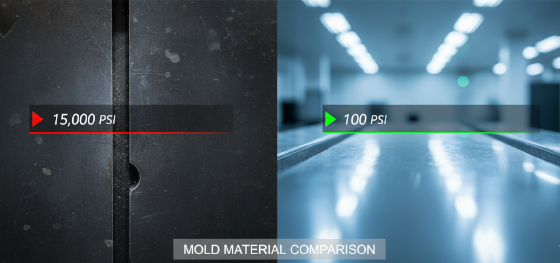
La durabilità dell'attrezzaggio è una reazione diretta alle forze applicate durante il ciclo di stampaggio. Nello stampaggio a iniezione tradizionale, il fuso termoplastico viscoso viene forzato in una cavità a pressioni superiori a 15.000 psi. Per evitare che le pareti dello stampo si deformino o che le linee di separazione si aprano, l'attrezzaggio deve essere lavorato da blocchi massicci di acciaio per utensili temprato P20 o H13. Questo requisito di materiale ad alta resistenza aumenta significativamente il Costo dello stampo RIM vs stampaggio a iniezione, poiché l'acciaio è più lento da lavorare e richiede costose elettroerosioni (EDM) per i dettagli fini. Jucheng Precision aiuta i clienti a evitare questa "Trappola d'Acciaio" utilizzando la chimica a bassa pressione del poliuretano.
Perché il RIM può utilizzare alluminio per produzioni seriali?
Poiché la pressione nella cavità è tipicamente inferiore a 100 psi, lo stress meccanico sull'attrezzaggio è minimo, consentendo all'alluminio di grado aerospaziale di mantenere tolleranze sub-millimetriche per fino a 10.000 colpi.
La velocità di lavorazione è il principale motore economico del vantaggio dell'alluminio. L'alluminio 7075-T6 è da tre a quattro volte più veloce da fresare rispetto all'acciaio per utensili temprato. Nel nostro hub di Shenzhen, Jucheng Precision utilizza oltre 150 macchine CNC per scolpire grandi cavità di stampo in pochi giorni anziché mesi. Questa riduzione del "Tempo di Mandrino" è il segreto per cui uno stampo RIM per un pannello di 2 metri costa una frazione di un equivalente stampo a iniezione. Scegliendo sistemi RIM a base di alluminio, non solo si risparmia sui costi dei materiali, ma si eliminano i tempi di consegna di diversi mesi che possono uccidere la finestra di opportunità di un progetto.
I requisiti di finitura superficiale influenzano anche la scelta del materiale dell'attrezzaggio. Ottenere la finitura ad alta lucentezza richiesta per i pannelli di controllo medicali è più facile con l'alluminio perché il materiale è più ricettivo alla lucidatura e all'incisione chimica. Jucheng Precision applica texture VDI 3400 direttamente sulla superficie dello stampo in alluminio utilizzando la texturizzazione laser a 5 assi. Questa capacità di finitura integrata garantisce che i vostri pezzi sembrino prodotti al dettaglio direttamente dallo stampo, riducendo ulteriormente il budget totale per le lavorazioni secondarie. Questa sinergia tra attrezzaggio a basso costo ed estetica di alto livello è il motivo per cui Jucheng Precision rimane il partner preferito per gli OEM globali di robotica.
Dati Tecnici: Confronto tra Rapporti di Attrezzaggio e Ammortamento Unitario
Success in hardware procurement depends on a clear understanding of the NRE-to-piece-price ratio. While injection molding offers the lowest per-part cost, the amortization of a $100,000 tool over only 500 units results in an effective price that is ten times higher than RIM. Jucheng Precision provides transparent cost modeling to help you calculate your Costo dello stampo RIM vs stampaggio a iniezione ROI. The following table compares the typical financial variables for a 1.2-meter robotic enclosure for the current MedTech and industrial markets.
| Economic Variable | RIM Tooling (Aluminum) | IM Tooling (Steel) | Budget Impact |
|---|---|---|---|
| Costo NRE Iniziale | $3,500 - $9,000 | $50,000 - $150,000+ | 70-85% Capital Savings |
| Lead Time to T1 | 12 - 18 Days | 8 - 12 Settimane | Faster Iterative Cycle |
| Modification Cost | Low (Welding/Milling) | High (EDM/New Inserts) | Reduced Design Risk |
| Economic Volume | 100 - 3,000 Units | 5.000+ unità | Ideal for Niche Markets |
The "Capital Savings" data illustrates why RIM is the essential "Bridge to Production" strategy. By utilizing aluminum molds, Jucheng Precision allows you to launch your first 1,000 units with minimal financial exposure. If the market demand explodes, you can transition to high-volume steel tools later, having already validated your design and captured the market. This logica di ammortamento is the cornerstone of Jucheng’s service model, ensuring that our clients can scale their manufacturing without being crushed by the high entry costs of traditional Stampaggio Personalizzato di Plastiche.
Attrezzaggio Agile: La Facilità di Modificare l'Alluminio rispetto all'Acciaio Temprato
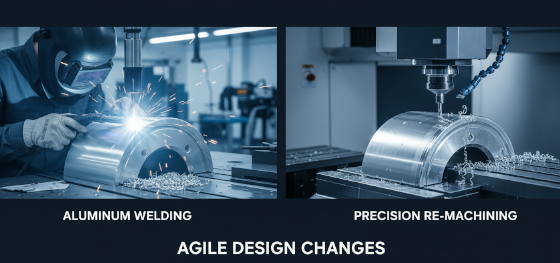
Design changes between Alpha and Beta trials are a statistical certainty in high-tech robotics. In the context of Costo dello stampo RIM vs stampaggio a iniezione, the ability to modify the tool is just as important as the initial build price. Hardened steel molds are notoriously difficult to change; once the metal is heat-treated, adding a feature often requires slow EDM cycles or the complete replacement of a mold insert. Aluminum molds used in the RIM process offer a level of modificabilità dello stampo that is unmatched. Jucheng Precision can often weld new material onto an aluminum mold face and re-machine it in our CNC bay within 48 hours, allowing your hardware development to move at the speed of software.
Can a RIM mold be updated for new sensor mounts?
Yes. Aluminum's high weldability and machinability allow us to move sensor ports or mounting holes between production batches for a fraction of the cost of steel tool rework.
Complex side-actions and cam-slides are also more affordable to modify in aluminum. For large enclosures with undercuts or integrated cable exits, the mold must move in multiple directions. Jucheng Precision utilize 25 unità Haas/Mazak a 5 assi to machine these interlocking moving parts with +/- 0.01mm precision. If a field trial reveals that an internal rib is interfering with a wiring harness, we can adjust the tool geometry quickly. This flexibility eliminates the "Design Paralysis" that occurs when engineers are afraid to freeze a design because of high steel tooling costs. We provide the mechanical sandbox you need to refine your innovation.
Internal stress relief of the tool itself is managed through Jucheng’s specialized aging cycles. Large aluminum blocks can possess residual stresses from the casting or forging process. Before we finish-machine the critical parting lines and seal tracks, we perform thermal stabilization on the mold bases. This ensures that the basi di precisione we achieve in our Shenzhen hub remain stable over thousands of shots. By delivering "Statistically Reliable" tooling, Jucheng Precision ensures that part #100 of your Beta fleet is identical to part #1, providing the geometric evidence required for ISO 13485 and IATF 16949 compliance.
Costi dell'Infrastruttura: Forze di Serraggio e Spese Generali della Macchina
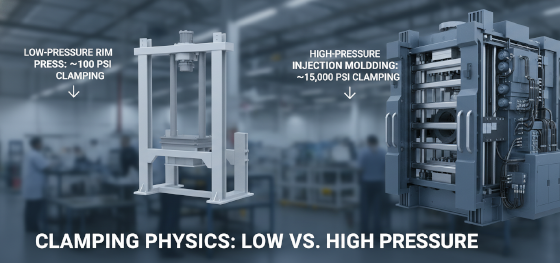
The hidden driver of Costo dello stampo RIM vs stampaggio a iniezione is the machine required to hold the mold shut. In high-pressure injection molding, a 1-meter long diagnostic shell creates a massive "Projected Area." To prevent the mold from blowing open during the 15,000 psi injection, a press with at least 3,000 tons of clamping force is required. These machines are incredibly expensive to operate and require reinforced concrete foundations. Because the RIM process happens at less than 100 psi, Jucheng Precision utilize low pressure clamping infrastructure—simple hydraulic frames that are 90% cheaper to build and operate than their high-pressure counterparts.
How does machine size affect my part price?
Lower machine overhead and energy consumption allow Jucheng Precision to offer competitive piece prices for oversized parts, even at low volumes.
Energy efficiency is the secondary infrastructure win for the RIM process. Conventional injection machines must keep massive steel barrels at 300 degrees Celsius 24 hours a day. Operating under our ISO 14001 environmental certification, Jucheng Precision’s RIM department utilizes near-room temperature curing. We only heat the aluminum molds to a moderate 50 degrees Celsius to stabilize the chemical reaction. This 80% reduction in thermal energy consumption directly lowers your production overhead and supports the ESG goals of modern MedTech and AgTech corporations. We don't just save you money on tooling; we build your hardware in a sustainable, efficient ecosystem.
Scaling the physical part size is easier with low-pressure infrastructure. Jucheng Precision regularly produce structural fenders and hoods up to 2.5 meters in length. In a high-pressure environment, a part of this scale would be physically impossible or financially ruinous. By utilizing the Costo dello stampo RIM vs stampaggio a iniezione advantage, we allow you to design massive monolithic panels that reduce the number of individual parts in your assembly. This "Structural Consolidation" is the ultimate weight-saving and cost-saving move for autonomous platforms, ensuring your technology stands as a solid, unyielding unit throughout its entire service life.
Hub JUCHENG: Maestria nell'Attrezzaggio Rapido in Alluminio a Shenzhen
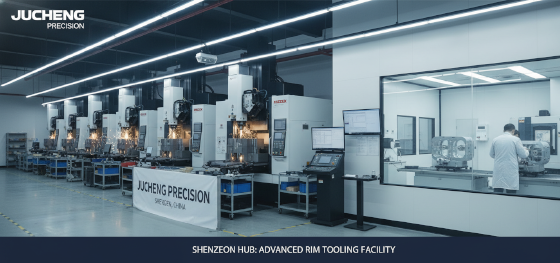
Dominating the large-format hardware market requires a partner that doesn't just buy tools, but masters the engineering of them. Jucheng Precision operates with a 24/7 manufacturing mindset in our Shenzhen precision manufacturing hub, delivering high-tolerance RIM tooling and structural components with industry-leading speed. we provide a "Bridge to Production" that ensures your innovations move from CAD to field trial with 100% metallurgical and chemical confidence. Jucheng Precision has Nessun MOQ, allowing you to source 1 to 5 units for initial tooling validation without the crushing cost of mass-production infrastructure.
Integrando il vostro progetto strutturale con l'esperienza di JUCHENG si garantisce che la vostra Costo dello stampo RIM vs stampaggio a iniezione decision is based on performance data, not guesswork. we offer comprehensive DFM reviews within 24 hours, identifying potential gas-trap zones or wall-thickness bottlenecks in your design before they become field failures. Whether you are building an autonomous medical assistant or a heavy-duty industrial mobile base, Jucheng Precision provides the rigid, precise, and chemicals-optimized foundations that keep your innovation moving through the high-speed cycles and the years of hard labor.
Our facility is equipped with dedicated high-pressure RIM assembly cells and dedicated quality labs, allowing JUCHENG to manage the entire hardware lifecycle in one location. we manage the complexity of multi-material bonding and automotive-grade finishing so your engineering team can focus on the motion control and the AI. By combining Shenzhen's speed with industrial-grade material verification and global quality standards, JUCHENG remains the preferred partner for the world's most aggressive hardware challenges. Contact the Shenzhen hub today to start your next consegna rapida in 4 giorni progetto.
FAQ: Risposte Reali per Budget, Durata dello Stampo e Modifiche di Progetto
Is the piece price higher if the tooling is cheaper?
Yes. RIM piece prices are typically higher than injection molding, but the 80% savings on tooling often make it the more profitable choice for under 2,000 units.
What is the typical lead time for a 1-meter RIM mold?
Aluminum rapid tools of this size are typically completed and delivering T1 samples in 15 to 20 business days.
How do you handle mold maintenance in Shenzhen?
Jucheng Precision performs 100% in-house tool maintenance, including ultrasonic cleaning and parting-line restoration after every production run.
Can I change the surface texture after the tool is made?
Yes. Aluminum tools can be bead-blasted or laser-etched to update textures between Alpha and Beta builds.
Does JUCHENG provide a guarantee on mold life?
Yes. We guarantee our 7075 aluminum RIM tools for up to 10,000 cycles, providing long-term security for your mid-scale production.
Tooling debt and long lead times are absolute project killers in the robotics and medical sectors. Partnering with Jucheng Precision ensures that your functional iterations are built with the cost-effective Costo dello stampo RIM vs stampaggio a iniezione and specialized aluminum tooling techniques the industry demands. Reach out to our Shenzhen manufacturing hub today for a complete DFM review and build the unyielding foundation your autonomous fleet requires.

