


La forza bruta è spesso la prima vittima del design complesso. Nel panorama della produzione tradizionale, se hai bisogno di un componente che sia sia cristallino che virtualmente indistruttibile, sei costretto nel costoso mondo del vetro ad alta pressione o delle lastre di policarbonato forgiato. Tuttavia, per la R&D iterativa e la produzione a basso volume, questi metodi creano un collo di bottiglia terminale in termini di costi di attrezzaggio. Questo è il divario tecnico colmato da un servizio professionale di stampa 3D in policarbonato. Il policarbonato (PC) è l""Iron Man" dei polimeri ingegneristici, offrendo una resistenza agli urti 250 volte superiore al vetro e una stabilità termica che gli permette di sopravvivere nei vani motore e negli autoclave medicali. Tuttavia, il PC non è solo un altro filamento; è un ribelle termico che resiste al ciclo di costruzione. Raggiungere il successo nella produzione additiva del PC richiede più di un semplice ugello ad alta temperatura: richiede una sovranità assoluta sulle dinamiche di raffreddamento del materiale.
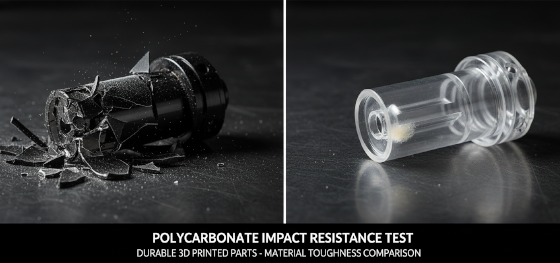
Jucheng Precision opera come un hub ad alta fedeltà per i marchi automobilistici e aerospaziali più esigenti al mondo. Riconosciamo che per un involucro sensore robusto o una guida di luce ad alta chiarezza, "abbastanza resistente" è un fallimento ingegneristico. Integrando sistemi FDM e SLA di livello industriale che utilizzano camere di costruzione riscaldate attivamente, forniamo un santuario tecnico per questa resina capricciosa. Abbiamo superato l'era dei modelli generici "trasparenti" per fornire hardware funzionale e pronto al volo che mantiene la sua integrità sotto vibrazioni supersoniche e intensi cicli termici. Questa guida è un'immersione profonda di 2000 parole nella termodinamica della fusione a 300°C, nella logica della raffinazione ottica in fase vapore e nel perché l'approccio integrato di JUCHENG al servizio di stampa 3D in policarbonato garantisce che i tuoi progetti sopravvivano alla transizione dal modello digitale alla brutale realtà del campo.
La redditività nella prototipazione ad alte prestazioni è conquistata da chi riesce a validare presto la fisica degli impatti. Non stai solo acquistando una parte in plastica; stai acquistando la certezza verificata che il tuo assemblaggio sopravviverà a un test di caduta o a un'ondata di fluido ad alta pressione. Che tu stia costruendo una valvola medica innovativa o uno scudo protettivo per un braccio robotico, la logica del legame carbonato è il tuo più grande vantaggio tattico. Analizziamo le leggi fisiche della produzione industriale di PC e vediamo come la lungimiranza tecnica può imprimere l'anima del tuo prossimo progetto hardware nella realtà fisica.
Combattimento termodinamico: gestire la transizione vetrosa a 140°C
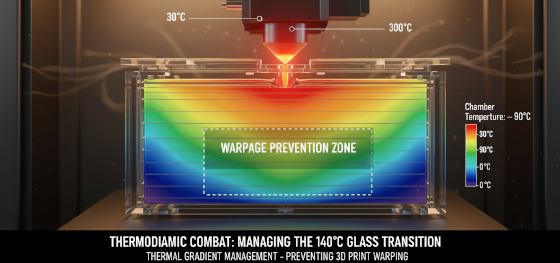
Il principale fattore differenziante tra un modello visivo e un componente strutturale è la gestione delle tensioni interne. Il policarbonato possiede un'alta temperatura di transizione vetrosa (Tg) di circa 147°C. Quando un servizio di stampa 3D in policarbonato utilizza macchine desktop standard, il materiale viene estruso in aria a temperatura ambiente. Questo crea uno shock termico violento. Mentre la plastica si raffredda dal suo punto di fusione di 300°C a 25°C in pochi secondi, le catene polimeriche si contraggono in modo non uniforme, portando a "deformazioni" e delaminazione tra gli strati. Questi non sono solo difetti estetici; sono fratture strutturali in attesa di accadere.
JUCHENG elimina questo rischio attraverso una sovranità termica assoluta. I nostri centri FDM industriali operano all'interno di camere di costruzione riscaldate attivamente e con circolazione d'aria che mantengono un ambiente costante tra 90°C e 110°C. Questo mantiene la plastica in uno stato semi-rilassato e ricotto durante l'intero ciclo di costruzione di più giorni. Minimizzando la differenza di temperatura tra l'ugello e l'atmosfera, garantiamo che gli strati si fondano a livello molecolare, creando un solido strutturale denso piuttosto che una pila di fili incollati. Questo controllo ambientale è ciò che ci permette di fornire involucri in PC di grandi dimensioni—fino a 400 mm di lunghezza—con una planarità e una precisione dimensionale che rivaleggiano con le parti stampate a iniezione. Non ci limitiamo a "avviare" una macchina; orchestriamo una curva di raffreddamento che blocca la geometria in posizione, assicurando che le tue caratteristiche di accoppiamento si adattino perfettamente sulla linea di assemblaggio.
Realismo ottico: ottenere una trasparenza simile al vetro
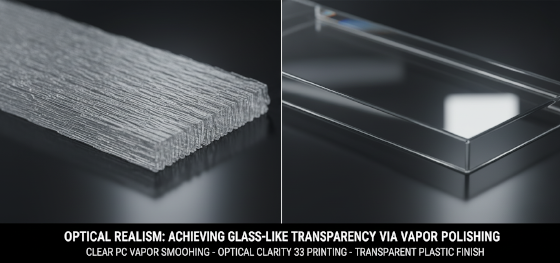
La trasparenza nel mondo dei materiali per stampa 3D è spesso una bugia. Una stampa 3D grezza in policarbonato è al massimo traslucida, coperta da linee di strato che disperdono la luce come una finestra smerigliata. Per gli ingegneri automobilistici che validano una nuova guida di luce a LED o i progettisti medici che costruiscono un collettore di fluidi trasparente, questa opacità è un difetto terminale. Raggiungere un vero "Realismo Ottico" richiede una transizione dal pavimento della macchina al laboratorio di finitura chimica. Jucheng Precision ha padroneggiato l'alchimia della levigatura a vapore specificamente per il policarbonato.
Questo processo automatizzato espone la parte a un vapore chimico controllato che scioglie i picchi microscopici della superficie a livello molecolare. Mentre la superficie si liquefa momentaneamente, la tensione superficiale la tira piatta, "cancellando" efficacemente le linee di strato. Una volta che il solvente evapora, il risultato è una "pelle" sigillata e ad alta lucentezza virtualmente indistinguibile da una superficie stampata a iniezione. Questo trattamento non solo migliora l'aspetto; sigilla i pori interni, rendendo la parte a tenuta stagna e resistente all'adesione batterica—un fattore critico per i prototipi di strumenti chirurgici. Colmiamo il divario tra "prototipo grezzo" e "hardware pronto per il mercato", fornendo la profondità visiva che la tua identità di marca richiede.
Invincibilità strutturale: il PC come scudo antiurto definitivo
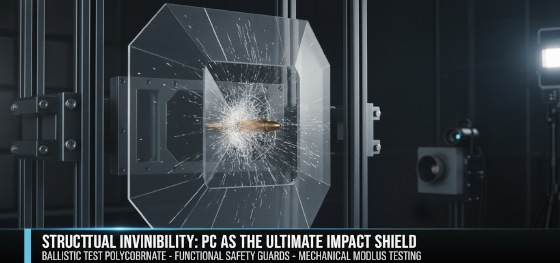
Perché pagare per un servizio professionale di stampa 3D in policarbonato quando il nylon standard è più economico? La risposta è "Tenacità alla frattura". Il policarbonato è unico per la sua capacità di assorbire energia cinetica e deformarsi plasticamente prima di rompersi. In un test di impatto Izod, le resine standard falliscono a meno di 50 J/m. Il policarbonato supera regolarmente i 600 J/m. Questa "Invincibilità Strutturale" lo rende la scelta obbligata per componenti esposti a detriti ad alta velocità, come scudi protettivi per celle robotiche o alloggiamenti funzionali per scanner industriali portatili.
At JUCHENG, we utilize the material's high flexural modulus to build "Living Frames"—parts that can bend and flex under stress but return to their original shape without fatigue cracking. This resilience is vital for aerospace interiors where safety-critical components must not shatter into dangerous needles during a structural load-event. We provide the mechanical baseline data to prove that our 3D printed PC components possess 90% of the strength of a wrought sheet, ensuring your functional prototypes survive the most brutal vibration and drop audits. We treat the part’s survival as a functional specification, providing the engineered armor needed for your most ambitious designs to thrive in the real world.
Additive Technology Divide: FDM vs. SLA for Polycarbonate
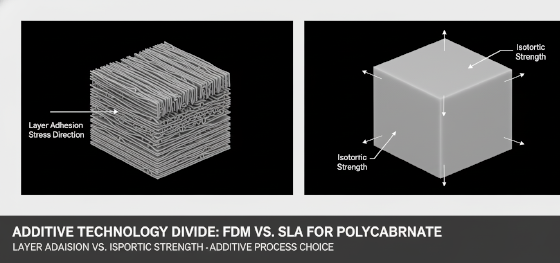
Navigating the equipment choice is the first fork in the road for any engineering project. Not all polycarbonate is processed using the same physics. At our facility, we utilize two distinct additive pathways based on the part's mechanical destiny. Industrial FDM (Fused Deposition Modeling) is the champion of structural "Grit." It utilizes a solid filament of PC that is melted and extruded. Because the material is a production-grade thermoplastic, the resulting parts possess the highest impact strength and thermal resistance. This is the preferred method for machine guards and rugged internal brackets where aesthetics are secondary to raw survival. However, FDM is anisotropic; its strength is dependent on the layer orientation. We manage this through precise tool-path orchestration, ensuring that the highest stress loads align with the strongest axis of the material.
SLA (Stereolithography) represents the "Optical" alternative. Instead of melting a filament, it utilizes a liquid photopolymer resin that has been engineered to simulate polycarbonate’s properties. While these simulants may lack the extreme fracture toughness of FDM-extruded PC, they offer absolute "Geometric Sovereignty." SLA produces nearly isotropic parts with mirror-smooth surfaces and microscopic detail resolution. This is the definitive choice for clear lenses, light pipes, and complex medical manifolds where internal fluid flow must be visible. JUCHENG helps our clients perform a "Mission Audit"—if your part must withstand a sledgehammer, we go FDM; if it must pass an optical bench test, we go SLA. By providing both technologies under one roof, we eliminate the bias found in smaller bureaus, ensuring your delivers the specific physics your assembly requires.
Environmental Survival: Heat, Flame, and Chemical Resistance
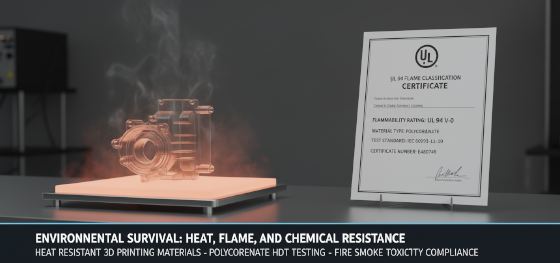
Industrial environments are hostile to standard plastics. A part designed for the medical sector or the automotive engine bay must survive more than just physical impact; it must survive the chemistry of its surroundings. Polycarbonate is favored by JUCHENG’s clients for its impressive Heat Deflection Temperature (HDT), which typically reaches 135°C to 140°C. Unlike lower-grade polymers that soften in a warm enclosure, PC maintains its structural "spine," ensuring that mounting points don't loosen and seals don't weep under thermal load.
Safety compliance is another critical pillar of our polycarbonate 3d printing service. For our aerospace and electronics partners, we utilize specialized PC resins that meet the UL94 V-0 flame-retardant standard. These materials are "self-extinguishing," meaning they won't contribute to the spread of a fire—a mandatory requirement for aircraft cabin interiors and high-voltage power enclosures. However, we also provide a technical warning regarding chemical exposure. Polycarbonate is notoriously sensitive to common alcohols and certain industrial solvents. Exposure to these chemicals can trigger "Crazing"—thousands of tiny hairline fractures that destroy both the clarity and the impact strength of the part. JUCHENG’s engineers evaluate your cleaning and sterilization protocols before we start the build, suggesting protective coatings or material alternatives like PEEK if your environment is chemically aggressive. We don't just print a part; we engineer its long-term survival against the elements.
Hybrid Metamorphosis: CNC Machining the Unprintable Fits
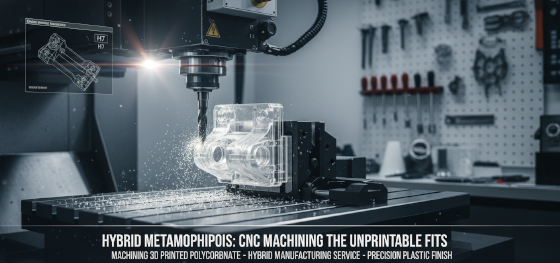
Complexity is a superpower, but it shouldn't come at the cost of precision. Additive manufacturing provides the "Impossible Geometry"—internal labyrinths and topologically optimized frames—but it often fails at the "Critical Interface." A 3D printer cannot consistently deliver an H7 bearing bore or a mirror-finish seal surface to a +/- 0.01mm tolerance. Jucheng Precision eliminates this "Accuracy Gap" through our hybrid manufacturing workflow. We treat the 3D printer as a high-tech foundry that produces an "Advanced Preform."
Our polycarbonate 3d printing service includes the option for "Post-Build Precision." We print your complex PC parts with an extra 1.5mm of "Machining Stock" on all critical assembly datums. Once the part has been thermally stabilized to release internal stresses, it moves to our 5-axis CNC floor. Our high-speed mills then carve away the near-net texture, revealing the surgical accuracy needed for high-performance assemblies. This integrated approach is why JUCHENG is the preferred partner for global robotics and medical firms. We eliminate the accountability gap between vendors, providing a single, verified engineered solution that possesses the lightweight freedom of additive and the sub-micron certainty of CNC. We bridge the gap between design theory and real-world assembly, ensuring your parts fit perfectly the first time, every time.
Technical Validation: Locking in Component Integrity
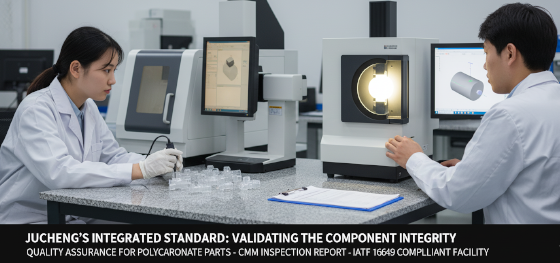
The final hallmark of a professional 3D printing partner is the refusal to accept visual quality as a proxy for technical precision. In the world of high-stakes aerospace and medical hardware, an unverified part is a dangerous liability. Jucheng Precision operates a facility where additive manufacturing is a documented engineering discipline, not a visual craft. Our polycarbonate 3d printing service protocol includes full material lot-traceability and documented process validation. We understand that your reputation depends on the integrity of the plastic we extrude or cure.
Our metrology lab utilize high-resolution CMM (Coordinate Measuring Machines) and laser scanners to generate 3D "Error Maps" of your components. We compare the physical part against your master STEP file to identify any thermal drift that occurred during the cooling phase. We also perform "Shore Hardness" audits and cross-hatch adhesion tests on secondary coatings to ensure the structural "skin" of the part is as tough as the core. For our automotive clients, we provide full PPAP documentation, providing the paper trail required for Tier-1 supply chain compliance. When you receive a shipment from JUCHENG, you aren't just getting 3D prints; you are getting verified engineered solutions that have been audited for survival. We don't just ship plastic; we manufacture trust through data-driven quality control.
Strategic Verdict: Why Professional PC Printing Defines Success
Success in the modern market requires the ability to move from CAD to a functional, field-ready component in days. The decision to utilize a professional stampa 3D in policarbonato is a strategic move toward manufacturing agility. It allows your engineers to test real impact physics and thermal loads without the anchor of high-pressure tooling costs. By choosing Jucheng Precision, you are accessing a decade of industrial data and a facility that treats polymers with the technical reverence usually reserved for aerospace metals.
Our integrated approach—combining 5-axis CNC precision, chemical vapor smoothing, and IATF 16949-aligned quality standards—makes us the definitive partner for your most challenging transparent and high-strength designs. We remove the uncertainty of material behavior, delivering parts that are visually striking and structurally invincible. Don't let your innovation be limited by the low quality of desktop prints or the high cost of fragmented vendors. Experience the clarity and the capability that industrial-grade polycarbonate replication can bring to your next breakthrough. Contact Jucheng Precision today for a technical DFM review and let our engineers help you build a bigger, better, and more profitable physical reality. We clarify the complex, ensuring your most ambitious visions are armored for survival in the real world.

