


Tradurre motivi artistici complessi e profili funzionali intricati in hardware fisico richiede un controllo ottico avanzato. Utilizzando progettazione di lamiere tagliate al laser consente agli sviluppatori di bypassare costose attrezzature rigide eseguendo tagli geometrici altamente complessi con estrema ripetibilità. Questo percorso di produzione digitale si basa su un raggio termico concentrato per vaporizzare il materiale lungo percorsi utensile precisi, traducendo grafiche vettoriali 2D direttamente in pannelli metallici altamente ripetibili con scarti di materiale minimi.
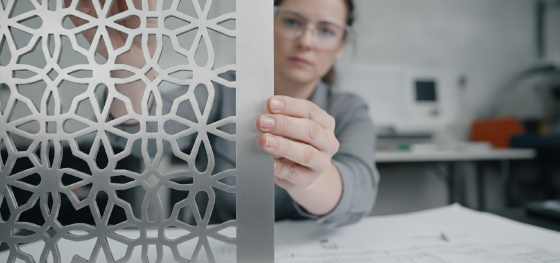
Tuttavia, progettare motivi laser dettagliati senza valutare le reazioni termiche metallurgiche è un rischio importante sulla linea di sviluppo. Quando gruppi di fessure sono posizionati troppo vicini tra loro, l'intensa energia termica può deformare la lamiera piana, causando gravi imbarcamenti e fratture da stress localizzate. Bilanciare proattivamente i rapporti di area aperta con le proprietà del materiale grezzo è il modo migliore per garantire la planarità del pezzo.
Esaminiamo come il taglio termico eccelle sia in applicazioni architettoniche che meccaniche, rivediamo le regole CAD essenziali per preparare file vettoriali puliti ed esploriamo come la scelta del gas di assistenza determini la qualità del bordo tagliato.
contenuto:
Il potenziale artistico e industriale del taglio laser CNC
Dalla grafica vettoriale al metallo: preparazione dei file CAD
Qualità del bordo e tolleranze in progetti complessi
Taglio laser a fibra ad alta velocità presso JUCHENG
FAQ: Domande critiche sulla progettazione di lamiere tagliate al laser
Il potenziale artistico e industriale del taglio laser CNC

Cosa rende la profilatura laser CNC estremamente versatile per componenti hardware e architettonici moderni?
Offre una libertà geometrica illimitata per tagliare qualsiasi cosa, da staffe meccaniche di alta precisione a schermi architettonici perforati altamente decorativi, senza richiedere stampi personalizzati.
Il taglio laser colma il divario tra ingegneria strutturale ad alta resistenza e styling industriale estetico. Per i componenti strutturali, taglia con precisione cerchi di bulloni e guide per schede. Nelle applicazioni architettoniche, viene utilizzato per fabbricare pannelli per la privacy di grande formato, cancelli personalizzati e rivestimenti murali decorativi.
Because the fiber optic beam is entirely software-driven, moving from a prototype design to full-scale production requires zero physical tooling changes. This allows engineers to refine their geometries on the fly, optimizing layouts to minimize material waste while delivering sharp contours that are free from mechanical shearing stresses.
Dalla grafica vettoriale al metallo: preparazione dei file CAD

What CAD modeling steps are required to prepare a design for clean laser profiling?
Designers must export clean, continuous vector paths in DXF or DWG formats, ensuring all overlapping geometry lines and micro-gaps are fully closed.
Translating vector graphics directly into physical components is a massive milestone in modern progettazione di lamiere, bridging the gap between digital modeling and the laser controller. Exporting clean vector graphics from your 3D CAD modeling software ensures the laser cutter reads the path correctly. Double-cutting overlapping lines or running a laser head over fragmented curves can cause severe edge burning and dimensional errors.
When preparing laser cut sheet metal designs for custom grilles or brackets, scaling your CAD features relative to the laser spot size is also vital. The laser beam possesses a physical thickness known as the kerf width. Designers must adjust their hole clearances and flange offsets to compensate for this minor material removal, ensuring that nested slots interlock tightly during final assembly.
Qualità del bordo e tolleranze in progetti complessi
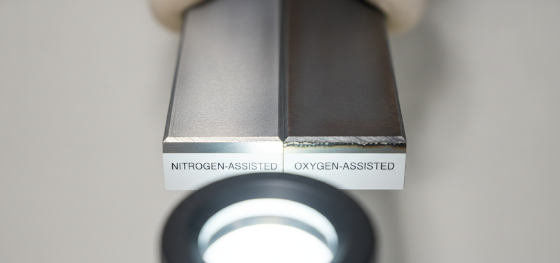
How do different assist gases dictate the cleanliness of laser-cut steel edges?
Nitrogen assist gas prevents oxygen exposure to deliver a bright, weld-ready edge, while oxygen assist gas reacts with carbon steel to cut thick gauges quickly but leaves a dark oxide scale.
The selection of cutting gas significantly impacts the physical properties of the finished cut. Utilizing high-pressure nitrogen assist gas is preferred for stainless steel and aluminum. Nitrogen cools the cut zone and completely blows away the molten metal, preventing oxidation and delivering a bright, clean edge that is ready for immediate welding without secondary grinding.
For thick carbon steel plates, oxygen assist gas is deployed to initiate an active chemical reaction that generates extra heat, allowing the laser to slice through thick gauges quickly. However, this reaction leaves a dark, brittle layer of iron oxide along the edge. If not removed, this oxide layer can cause subsequent powder coatings to peel off, exposing the bare metal to rapid atmospheric rust.
Taglio laser a fibra ad alta velocità presso JUCHENG

What sets JUCHENG's CNC laser cutting apart from traditional sheet metal shops?
We operate high-power, multi-kilowatt fiber lasers integrated with active optical stabilization, allowing us to maintain tight dimensional tolerances on highly intricate geometries.
Our workshop floor is engineered to eliminate production bottlenecks during rapid prototyping and low-to-medium volume manufacturing. By connecting our advanced cutting systems directly to our digital engineering network, we interpret complex CAD data instantly, translating your vector paths into clean physical profiles. Every design undergoes an initial, automated manufacturability check where our engineers evaluate kerf widths and heat-affected zone (HAZ) expansion, helping you optimize material nesting before we cycle the laser heads.
We back our operations with strict quality certifications, including ISO 9001 and IATF 16949, ensuring that industrial and automotive brackets meet rigorous regulatory standards. With our flexible no MOQ policy and rapid delivery turnaround, JUCHENG provides a reliable, high-yield manufacturing partner to help you transition custom flat patterns into continuous production-grade hardware.
FAQ: Domande critiche sulla progettazione di lamiere tagliate al laser
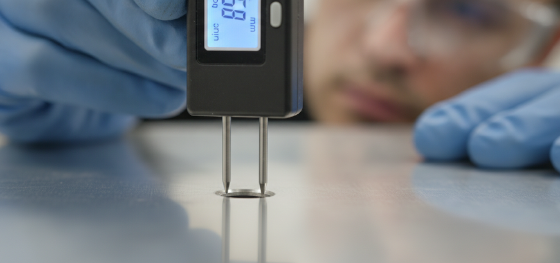
What is the minimum hole size achievable in laser cut sheet metal designs?
As a general manufacturing rule, the minimum hole diameter should not be less than the material thickness. Forcing a high-temperature laser beam to cut a hole smaller than the sheet thickness concentrates intense thermal energy in a tiny area, causing the metal to melt and warp, resulting in irregular, non-circular holes.
Can highly reflective metals like brass and copper be laser cut safely?
Yes, but they require advanced fiber lasers. High-purity copper e ottone reflect standard CO2 laser wavelengths like a mirror, bouncing the energy back into the cutting head and burning out the focus optics. Fiber lasers operate at a much shorter wavelength that reflective metals absorb easily, delivering clean, dross-free cuts without optical feedback risks.
How do you prevent outer edge micro-cracking when bending laser-cut parts?
The intense heat of laser cutting can create a brittle, hardened layer along the cut edge, especially on hard carbon steels. If a bend is executed directly along this cut edge, the brittle material will undergo localized micro-cracking. We prevent this by adjusting laser cutting parameters to minimize the heat-affected zone, or utilizing secondary tumbling to smooth the cut edges before forming.
What causes dross (slag) on the bottom edge of a laser cut panel?
Dross occurs when the cutting head moves too fast or when the assist gas pressure is too low, preventing the molten metal from being blown completely out of the kerf. This remaining metal solidifies on the underside of the sheet, requiring manual grinding to remove. We eliminate dross by continuously optimizing our gas pressure levels and laser cutting speeds to ensure clean, burr-free cuts.

