


Ogni centimetro cubo di materiale all'interno di un componente funzionale è una voce sulla tua fattura di produzione. Nel mondo ad alto rischio della produzione additiva, "solido" è spesso sinonimo di "spreco". A differenza della tradizionale lavorazione CNC, dove il costo è determinato dal tempo necessario per rimuovere il metallo, le spese di stampa 3D sono fondamentalmente proporzionali al volume di materiale consumato. Se stai progettando un alloggiamento delle dimensioni di un palmo con una sezione interna solida di 20 mm, stai effettivamente pagando per nascondere costosa resina ingegnerizzata o polvere di nylon dove nessuno la vedrà o utilizzerà mai. Ecco perché svuotare i modelli 3D per risparmiare sui costi è la leva più efficace che un ingegnere possa utilizzare per ottimizzare il ROI del progetto. Tuttavia, lo svuotamento non è un semplice compito di cliccare un pulsante in CAD; è un'operazione tecnica che introduce nuovi rischi fisici, dall'instabilità strutturale al pericoloso effetto "ventosa".
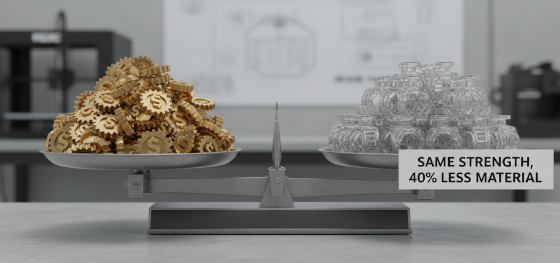
Presso Jucheng Precision, consideriamo progetto di stampa 3D come una disciplina di efficienza volumetrica. Comprendiamo che per una startup che costruisce un dispositivo medico portatile o un'azienda aerospaziale che prototipa un involucro per satellite, una riduzione del materiale del 40% può fare la differenza tra un prodotto realizzabile e un progetto cancellato. Ma un componente svuotato senza una corretta ingegneria è una responsabilità. La resina non polimerizzata intrappolata può portare a crepe ritardate, e la polvere non sinterizzata può agire come un dissipatore di calore indesiderato che deforma l'intero assemblaggio. Questa guida va oltre i tutorial di base per esplorare i meccanismi reali dell'ottimizzazione del guscio, la fisica critica dei fori di sfiato, e perché i protocolli DFM integrati di JUCHENG assicurano che i tuoi progetti svuotati siano tanto strutturalmente solidi quanto finanziariamente snelli.
La redditività nella produzione 3D si ottiene padroneggiando il vuoto interno. Non stai solo risparmiando denaro; stai progettando un componente più leggero, più veloce da stampare e più stabile. Che tu stia lavorando con resine SLA ad alta purezza o nylon MJF rinforzati, comprendere la logica dello svuotamento è essenziale. Analizziamo i pilastri tecnici della riduzione volumetrica e vediamo come la previsione tecnica possa trasformare l'integrità dei tuoi progetti più ambiziosi in una realtà fisica ed economica.
Economia volumetrica: ridurre la massa per risparmiare sul budget
Trappole interne: perché i fori di sfiato sono obbligatori
Struttura a guscio: ottimizzazione delle pareti per progetti svuotati
Rischi tecnologici: ventose e pani di calore
Autosupporto geometrico: strategia di reticolo interno
Logica di preventivazione di JUCHENG: confronto ROI tra solido e svuotato
Economia volumetrica: ridurre la massa per risparmiare sul budget
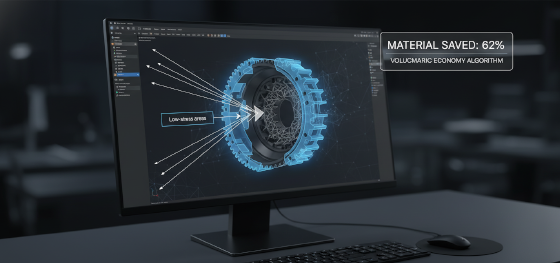
Il principale motore economico per svuotare i modelli 3D per risparmiare sui costi è la riduzione diretta del consumo di materia prima. Nella produzione additiva, a differenza della fresatura CNC, si paga per ciò che rimane sul piatto di costruzione, non per ciò che viene rimosso. Un cubo di 100 mm stampato solido in resina ad alte prestazioni potrebbe costare 400€ solo di materiale. Lo stesso cubo, svuotato con uno spessore di parete di 3 mm, consuma solo il 20% di quel materiale, riducendo il costo di 320€ immediatamente. Questa matematica si applica a quasi tutti i polimeri di alta qualità, dalle resine simili al PEEK per lavorazione ai nylon riempiti di carbonio utilizzati nei materiali per stampa 3D mercato.
Beyond the raw resin price, hollowing also impacts the "Time-to-Spindle" efficiency. In technologies like FDM or DMLS, fewer paths for the laser or nozzle to trace mean shorter build times. While SLA build times are largely determined by height, reducing the volume of material per layer reduces the exothermic heat generated during the cure, which leads to better dimensional stability. At JUCHENG, we leverage these volumetric savings to provide our clients with more competitive lead times. We treat every internal void as a financial victory, ensuring that your budget is allocated toward the surfaces that matter—the functional walls and assembly fits—rather than the dead weight of a solid core. By optimizing the mass of your component, you aren't just saving pennies; you are re-engineering the economics of your entire product launch.
Trappole interne: perché i fori di sfiato sono obbligatori
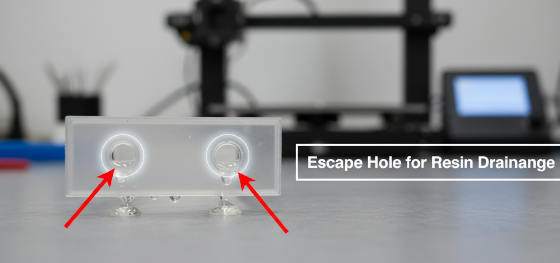
Creating a hollow cavity is an engineering failure if you don't provide a way for the trapped material to leave. In the progetto di stampa 3D cycle, the concept of the "Trapped Volume" is the primary cause of post-processing scrap. In SLA or DLP printing, an enclosed hollow space will trap liquid, uncured resin inside. Once the part moves to the post-curing chamber, that trapped liquid will expand under UV heat, causing the part to explode or develop "weeping" cracks where the resin eventually leaks out. Similarly, in powder-bed systems like SLS or MJF, trapped nylon powder will stay inside the part, effectively acting as a solid core and negating any weight-saving benefits.
To achieve svuotare i modelli 3D per risparmiare sui costi safely, you MUST design "Escape Holes" into your part. At JUCHENG, we recommend a minimum hole diameter of 3mm to 5mm to allow for efficient drainage and air-flow during the cleaning stage. We suggest placing at least two holes: one to allow the fluid or powder to exit, and another to allow air to enter (preventing a vacuum lock). Ideally, these holes should be placed in non-cosmetic areas or integrated into the functional design, such as a hidden mounting point. Without these vents, your "cost-saving" hollow part becomes a chemical bio-hazard or a heavy block of baked powder. We perform a mandatory "Trap Audit" during our DFM reviews to identify these sealed chambers, ensuring that your designs are optimized for a clean, dry, and stable final state.
Struttura a guscio: ottimizzazione delle pareti per progetti svuotati
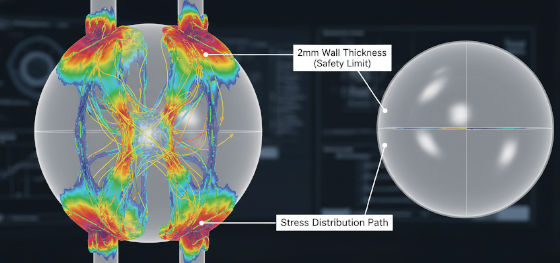
How thin can you go before the part collapses under its own weight? This is the structural high-wire act of functional shelling. If the walls are too thick, you haven't saved enough material to justify the effort. If they are too thin, the part will be fragile, prone to warping during the cooling phase, or fail the first time it is dropped. In progetto di stampa 3D, the target for wall thickness is determined by the material modulus. For a rigid resin or a standard nylon, JUCHENG recommends a minimum shell thickness of 2mm to 3mm for functional parts. Anything thinner risks a "paper-skin" effect, where the surface feels brittle and lacks the tactile quality of a production-grade part.
Successful shelling also requires an audit of "Geometric Consistency." You should avoid sharp transitions between a thick solid section and a thin hollow shell. These "Stress Bottlenecks" lead to warping as the material cools at different rates. We use generous fillets and internal tapers to distribute the mechanical load evenly across the part’s geometry. When svuotare i modelli 3D per risparmiare sui costi, we treat the shell as a structural membrane. For large enclosures, we may suggest varying the wall thickness—keeping it thick near mounting points for strength and thinning it out in the center of flat panels for weight savings. This "Topological Intelligence" ensures that your hollow part doesn't behave like a flimsy mockup, but like a structurally engineered component capable of surviving the brutal vibration and impact of industrial service.
Rischi tecnologici: ventose e pani di calore
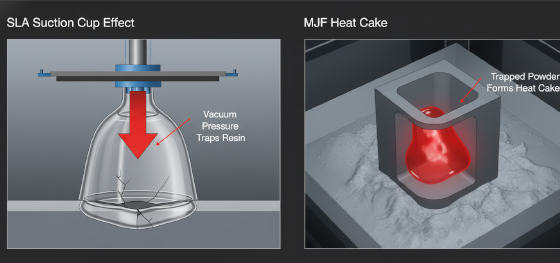
Each 3D printing technology has its own "Vengeance" for poorly hollowed models. In SLA and DLP (the "bottom-up" systems), hollowing out a part can create a "Suction Cup." As the build plate lifts the part out of the resin for the next layer, the air trapped inside the hollow cavity creates a vacuum. This suction force is massive enough to tear the part off the supports or cause "peel failure" where the layers shift. svuotare i modelli 3D per risparmiare sui costi in resin requires an escape hole placed close to the build plate to break this vacuum instantly.
In powder-bed systems like MJF, the hazard is "Heat Cakes." A large hollow space filled with powder acts as a thermal insulator. During the intense infrared fusion cycle, the heat trapped inside that volume can cause the loose powder to "sinter" or bake into a solid, un-removable mass. This ruins the weight-saving goal and creates internal stress that can warp the exterior skin. At JUCHENG, we utilize advanced thermal simulation to identify these heat-traps. We don't just "shell" the part; we engineer the internal voids to allow for heat dissipation. If the cavity is too large for a simple void, we might suggest an open-lattice approach to maintain airflow. Understanding these technological hazards is what separates a world-class manufacturing facility from a basic service bureau. We don't just follow your CAD; we protect your part from the physics of its own creation.
Autosupporto geometrico: strategia di reticolo interno
What if your design requires a large internal volume but must also withstand heavy crushing loads? A hollow part will buckle, but a solid part is too expensive. This is where svuotare i modelli 3D per risparmiare sui costi meets "Internal Latticing." Instead of a completely empty void, we fill the cavity with a skeletal, bio-inspired structure. This provides the best of both worlds: a 60% to 80% reduction in material mass with a 90% retention of structural rigidity. Lattices act like internal scaffolding that remains permanently inside the part.
JUCHENG’s engineers utilize advanced generative design software to optimize these internal lattices. For aerospace brackets, we might use an octa-tet or gyroid cell to maximize stiffness. For ergonomic grips, we use flexible TPU lattices to create a "Digital Foam." Crucially, these lattices must be designed for "Clean-out." If the lattice is too dense, the resin or powder will still be trapped. We ensure the lattice "unit cell" is large enough to allow for thorough ultrasonic cleaning or bead blasting. By engineering the void with these skeletal structures, we deliver parts that are incredibly light but functionally invincible, proving that progetto di stampa 3D is as much about what is *inside* the part as what is outside.
Logica di preventivazione di JUCHENG: confronto ROI tra solido e svuotato
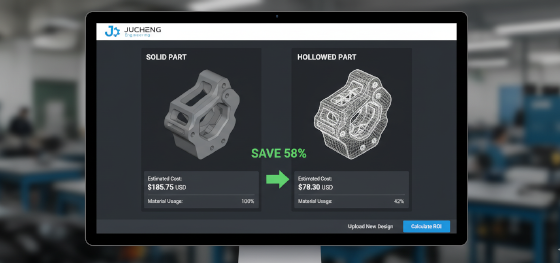
Transparency in pricing is the final hallmark of a professional manufacturing partner. At Jucheng Precision, we believe our clients should have the data to make their own economic decisions. Our automated quoting engine doesn't just provide a single number. We often present our clients with a "Volumetric Comparison." We show you the cost of building your part solid versus the cost of building it hollowed with optimized walls and escape holes. We have seen projects where a simple DFM adjustment to the hollow shell reduced the part price from $250 to $85.
This level of collaborative engineering is why JUCHENG is the preferred partner for global hardware innovators. We act as an extension of your R&D team, auditing your CAD files not just for manufacturability, but for financial efficiency. We understand that in the race to market, every dollar saved on a prototype is a dollar earned for production. Whether you are building a large-format automotive dashboard or a complex medical sensor, our svuotare i modelli 3D per risparmiare sui costi protocols ensure your vision is realized without the burden of unnecessary mass. Contact Jucheng Precision today for a comprehensive technical review and see how our volumetric optimization can clarify and secure your next breakthrough.

