


Entra in qualsiasi officina di precisione e probabilmente vedrai file di barre di plastica cilindriche bianche. Per un occhio inesperto, sembrano identiche. Condividono la stessa estetica "vaniglia industriale". Ma chiedi a un tornitore esperto di metterle su un tornio, e la verità viene fuori all'istante. Un materiale produce scaglie croccanti, simili a neve, che odorano leggermente di formaldeide. L'altro produce nastri lunghi e pericolosi che si avvolgono attorno al mandrino come un nido di uccello e odorano di capelli bruciati. Questo è il classico confronto ingegneristico: Delrin vs Nylon.
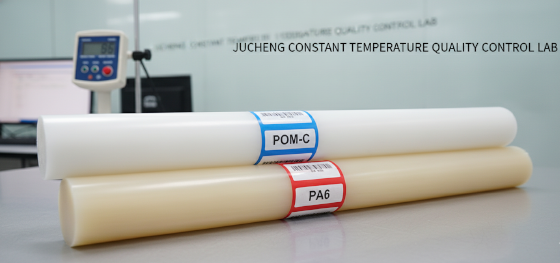
Nel mondo di lavorazione CNC del nylon, scegliere il polimero sbagliato è un errore che spesso non si rivela finché il pezzo non è in campo. Potresti ottenere tolleranze perfette in una stanza climatizzata, solo per vedere il pezzo gonfiarsi e bloccarsi una volta esposto a un ambiente umido. Da Jucheng Precision, non siamo solo un'officina che taglia plastica; fungiamo da consulenti sui materiali. Sappiamo che la scelta tra Acetale (Delrin) e Poliammide (Nylon) non riguarda quale sia "migliore", ma quale fisica sei disposto ad accettare.
Questa guida approfondisce il DNA strutturale di questi due titani ingegneristici. Andremo oltre le schede tecniche superficiali per esplorare come si comportano sotto un utensile da taglio, come reagiscono all'acqua e dove trovano la loro collocazione definitiva nel tuo assemblaggio. Se stai lottando per decidere quale plastica bianca specificare per il tuo prossimo progetto, questa analisi tecnica chiarirà la strada da seguire.
contenuto:
Igroscopia: La Guerra dell'Umidità
Anima Meccanica: Impatto vs Rigidità
Comportamento alla Lavorazione: Trucioli e Finiture
Attrito e Usura: Eccellenza nello Scorrimento
Applicazioni Critiche: Precisione vs Resilienza
La Matrice di Selezione di JUCHENG: La Decisione Finale
Igroscopia: La Guerra dell'Umidità
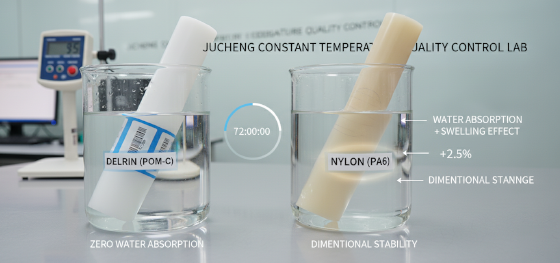
Se c'è una sola ragione per cui il Nylon fallisce in applicazioni di alta precisione, è la sete. Il Nylon è igroscopico, il che significa che assorbe attivamente acqua dall'aria. In una fabbrica costiera umida, un pezzo in Nylon 6 può gonfiarsi fino al 2% o 3% in volume. Questo non è solo un cambiamento superficiale; le molecole d'acqua penetrano effettivamente nelle catene polimeriche, spingendole aparte. Ciò provoca l'espansione del materiale, che può trasformare un cuscinetto di precisione in un disastro bloccato.
Nel Delrin vs Nylon Al confronto, il Delrin è il campione indiscusso della stabilità. L'Acetale (Delrin) ha un tasso di assorbimento dell'umidità quasi dieci volte inferiore rispetto al Nylon. Rimane quasi del tutto indifferente all'umidità. Questo rende il Delrin la scelta obbligata per parti che devono mantenere tolleranze strette indipendentemente dal tempo—pensa a componenti di sistemi di alimentazione, pompe di dosaggio medicali o ingranaggi di precisione. Da Jucheng Precision, diciamo spesso ai nostri clienti: se il pezzo deve adattarsi esattamente allo stesso modo a Londra come a Dubai, specifica Delrin. Se specifichi Nylon, stai essenzialmente progettando un bersaglio mobile.
Anima Meccanica: Impatto vs Rigidità
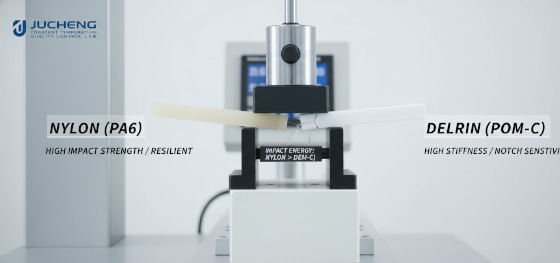
Mentre il Delrin vince sulla stabilità, il Nylon è il peso massimo quando si tratta di tenacità grezza. Il Nylon ha un maggiore "allungamento a rottura" e una superiore resistenza all'impatto. È un materiale che cede e rimbalza dove altri si spezzano. Se fai cadere un pezzo in Delrin su un pavimento di cemento, potrebbe scheggiarsi o rompersi a causa della sua sensibilità all'intaglio. Se fai cadere un pezzo in Nylon, di solito rimbalza. Questa resilienza rende il Nylon il candidato superiore per componenti soggetti a impatti come facce di martelli, piastre di usura per trasportatori e paraurti strutturali.
Tuttavia, la rigidità è un'altra storia. Il Delrin ha un modulo a flessione più elevato, il che significa che è più rigido. Non "scorre" o si deforma sotto carico costante quanto il Nylon. Quando stai progettando una clip a scatto, il Delrin fornisce quel soddisfacente "click" netto grazie alla sua rigidità elastica. Il Nylon tende a sentirsi "più morbido". Da Jucheng Precision, analizziamo il profilo di carico del tuo pezzo durante la nostra revisione DFM. Se il tuo pezzo deve rimanere rigido sotto un carico pesante, ti spingiamo verso il Delrin. Se deve sopravvivere a urti o vibrazioni, il Nylon è la tua migliore polizza assicurativa.
Comportamento alla Lavorazione: Trucioli e Finiture
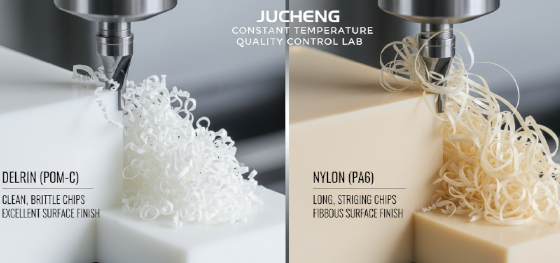
Dal punto di vista del macchinista, Delrin vs Nylon is a battle between a dream and a chore. Delrin is arguably the best-machining plastic in existence. It is free-cutting, produces small, brittle chips that fly away from the tool, and leaves a beautiful, matte-finish surface without any extra effort. Because it doesn't melt easily, we can run our CNC machines at high speeds, which translates to lower part costs for our clients.
Nylon is a gummy material. It doesn't want to break; it wants to tear. This leads to the infamous "stringy chips" that wrap around the tool spindle, creating heat and potentially ruining the part’s surface. Achieving a high-quality finish on Nylon requires exceptionally sharp, high-rake tooling and a lot of air-cooling. It is a slower process that requires more operator attention. At Jucheng Precision, we have mastered the nuances of Nylon tool paths to prevent the "fuzz" or burrs that typically plague cheaper shops. We manage the heat to ensure that the material's internal stress isn't triggered, preventing the part from warping after it leaves the machine.
Attrito e Usura: Eccellenza nello Scorrimento

Both of these materials are "self-lubricating," but they handle wear in different ways. Delrin has a lower coefficient of friction against metals, which makes it feel "slicker" to the touch. This is why it is used for almost every precision plastic gear in the world. It starts moving with less force (lower breakaway torque) and runs quiet. However, Delrin is somewhat sensitive to abrasive wear—if grit or sand gets into the system, it will grind the Acetal down quickly.
Nylon, particularly when filled with molybdenum disulfide (MoS2) or oil, is a beast when it comes to abrasive wear resistance. It has a "tougher" surface that can absorb small particles of debris without failing. In a dirty, industrial environment—like a mining conveyor or an outdoor tractor—a Nylon bushing will likely outlast a Delrin one. It is less about "slickness" and more about "durability." Our engineering team at JUCHENG evaluates the cleanliness of your part's operating environment to help make this call. We don't want you to have a gear that is slick but wears out in a week because of dust exposure.
Applicazioni Critiche: Precisione vs Resilienza
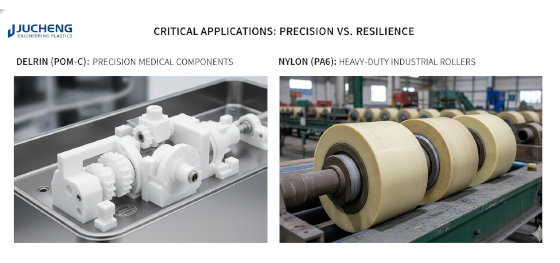
Let’s look at where the lines are drawn in the industry. Delrin is the king of the "small and precise." You will find it in high-end consumer electronics, medical valves, and precision instrumentation. If a part has a complex internal thread or a tiny aperture that must stay round, it belongs in Delrin. The material's rigidity and lack of moisture absorption make it a predictable partner for designers who live in the world of +/- 0.02mm.
Nylon is the king of the "large and load-bearing." It is found in crane sheaves, heavy-duty rollers, and engine-room components. Because it can be cast into massive shapes with low internal stress, it handles the macro-world better than Delrin. Its ability to survive high temperatures (especially Nylon 66) gives it a permanent home in automotive engine bays. When we ship large-format Nylon parts from Jucheng Precision, we are usually shipping components intended for some of the world's most brutal mechanical assemblies.
La Matrice di Selezione di JUCHENG: La Decisione Finale

To help you navigate the Delrin vs Nylon choice, Jucheng Precision follows a strict decision matrix. We ask three primary questions about your part's destiny.
1. Does it touch water? If yes, choose Delrin. The dimensional shift of Nylon in wet environments is almost impossible to manage.
2. Does it take a beating? If the part experiences sudden impacts or shock loads, Nylon is the only safe choice.
3. Is it a precision fit? For sliding fits, tight-tolerance bores, and high-speed gears, Delrin’s superior machinability and stability make it the winner.
Our facility is equipped with specialized high-speed spindles and climate-controlled production zones to manage both materials effectively. Whether you need the rigid precision of Acetal or the rugged resilience of Polyamide, Jucheng Precision has the technical rigor and the manufacturing capacity to deliver. We don't just cut plastic; we ensure your engineering vision survives the real world. Contact our engineering team today for a free DFM review and see how our plastic manufacturing expertise can clarify your design process.

