


I progettisti di elettronica ad alte prestazioni e sistemi aerospaziali spesso affrontano una crisi localizzata della fisica: come impedire all'alluminio di ossidarsi senza trasformarlo in un isolante elettrico. L'alluminio, per tutta la sua brillantezza strutturale, è un metallo reattivo. Se non trattato, sviluppa una pellicola di ossido opaca e non conduttiva che rovina la schermatura contro le interferenze elettromagnetiche (EMI) e compromette i punti di messa a terra. Mentre l'anodizzazione offre una protezione leggendaria, costruisce una barriera ceramica che blocca completamente l'elettricità. Questo collo di bottiglia tecnico è risolto dalla conversione cromatica, spesso indicata con i nomi commerciali Alodine o Chem Film. È il campione invisibile dell'industria elettronica, fornendo una barriera chimica microscopica che uccide la corrosione mantenendo gli elettroni che fluiscono liberamente.
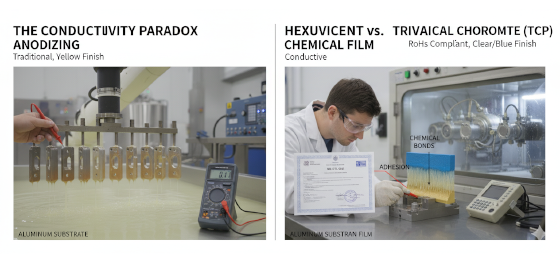
Presso Jucheng Precision, integriamo questa finitura critica nel nostro trattamento superficiale per lavorazioni CNC ecosistema per progetti in cui l'integrità del segnale e la sopravvivenza ambientale sono ugualmente importanti. Comprendiamo che un chem-film di successo non è solo un processo di immersione e asciugatura; è un delicato equilibrio tra attivazione superficiale e tempi di immersione. Se il bagno è contaminato o il risciacquo è insufficiente, il rivestimento non riuscirà ad aderire, portando a costosi guasti in hardware mission-critical. Questa guida esplora la chimica dello strato di conversione, la transizione verso il cromo trivalente conforme alla RoHS e i rigorosi standard MIL-spec che JUCHENG segue per garantire che i vostri assemblaggi complessi rimangano completamente conduttivi e perfettamente protetti.
L'efficienza nella protezione superficiale richiede un profondo rispetto per le esigenze elettriche del substrato. Non si può semplicemente applicare una finitura per l'aspetto; la si deve applicare per la missione. Che si stia costruendo un telaio per satellite o un alloggiamento per server rinforzato, comprendere i meccanismi dello strato di cromatazione è la chiave per prevenire problemi di interferenza elettronica "morti all'arrivo". Esaminiamo i pilastri tecnici della conversione chimica e perché rimane indispensabile nella lavorazione CNC di precisione.
contenuto:
Paradosso della conduttività: l'imperativo della messa a terra
Cromo esavalente vs. trivalente: il cambiamento globale di conformità
Rigore militare: navigare le specifiche MIL-DTL-5541
La base di adesione: perché la vernice ha bisogno di Alodine
Lo standard JUCHENG: verifica della resistenza di contatto
Paradosso della conduttività: l'imperativo della messa a terra
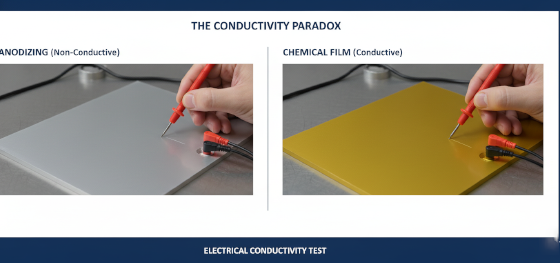
La ragione principale per cui un ingegnere specifica conversione cromatica rispetto all'anodizzazione è semplice: continuità elettrica. L'anodizzazione crea uno spesso strato di ossido di alluminio ($Al_2O_3$), che è un isolante elettrico di prima classe. Se si anodizza un alloggiamento radio, si trasformano efficacemente la scatola in una serie di piastre metalliche isolate, distruggendo la sua capacità di agire come una gabbia di Faraday. Ciò comporta rumore di segnale e potenziali scintille interne in ambienti ad alta tensione. Il chem film, tuttavia, è un processo di conversione che produce una pellicola gelatinosa estremamente sottile, tipicamente misurata in angstrom o pochi micron.
Questa sottigliezza microscopica è il segreto del suo successo. È abbastanza spessa da passivare la superficie dell'alluminio, prevenendo la crescita di corrosione bianca, ma abbastanza sottile da permettere agli elettroni di attraversare lo strato. Presso Jucheng Precision, utilizziamo questo "Paradosso conduttivo" per aiutare i nostri clienti a progettare parti multifunzionali. Vediamo spesso parti in cui l'esterno richiede la finitura dura e colorata dell'anodizzazione di Tipo II, ma le superfici di accoppiamento interne devono rimanere conduttive per la messa a terra. Utilizzando la mascheratura di precisione seguita dalla conversione cromatica, forniamo parti che sono corazzate all'esterno ed elettricamente trasparenti all'interno. Questa strategia a doppia finitura è essenziale per filtri per telecomunicazioni, scatole per avionica e componenti a microonde ad alta frequenza dove ogni ohm di resistenza conta.
Cromo esavalente vs. trivalente: il cambiamento globale di conformità
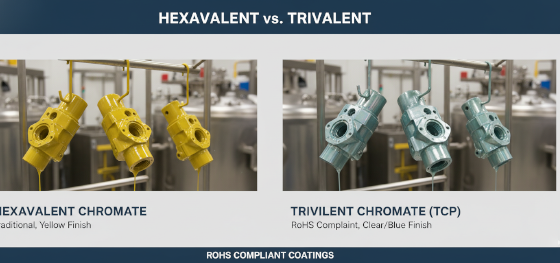
Storicamente, il mondo del conversione cromatica was dominated by Hexavalent Chromium ($Cr^{6+}$). This is the "classic" Alodine finish, recognizable by its distinct iridescent yellow, gold, or tan color. It provides excellent corrosion resistance and has a unique "self-healing" property—if the coating is scratched, the hexavalent ions can actually migrate to the wound and re-passivate the metal. However, hexavalent chromium is a known carcinogen and is strictly regulated under RoHS (Restriction of Hazardous Substances) and REACH mandates. For companies shipping products into Europe or California, the yellow finish is increasingly a liability.
The industry has pivoted toward Trivalent Chromium ($Cr^{3+}$), often referred to as TCP (Trivalent Chromium Pre-treatment). This modern chemistry is environmentally safe and fully RoHS compliant. Trivalent coatings are typically clear or have a faint blue tint, which can make inspection more difficult since they don't have the high-contrast yellow of the old process. Jucheng Precision operates fully validated trivalent lines to support our global clients. We utilize "dye-indicators" in some cases to assist in visual inspection, ensuring that every square millimeter has been properly treated. While trivalent coatings lack the same self-healing capacity of their predecessors, modern formulations have closed the gap in salt-spray performance, often meeting or exceeding 168 hours of protection. We help you choose the chemistry that satisfies both your engineering goals and your regulatory obligations.
Rigore militare: navigare le specifiche MIL-DTL-5541
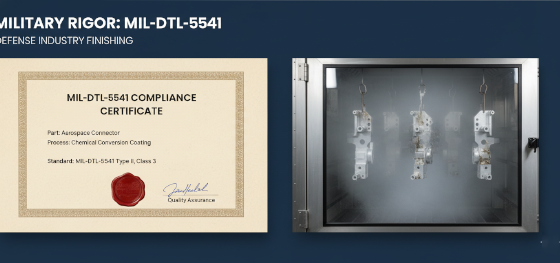
In the world of defense and aerospace, "doing it right" is not enough—you must do it to the book. The governing document for conversione cromatica is MIL-DTL-5541. This military specification divides the finish into two classes: Class 1A and Class 3. Understanding the difference is vital for project success. Class 1A is designed for maximum corrosion protection and is often used as a base for paint. It is a thicker coating that prioritizes durability over conductivity.
Class 3 is the "Electrical Class." It is specifically engineered to maintain low contact resistance. It is a thinner, more controlled layer meant for electrical connectors, circuit board mounts, and EMI gaskets. At Jucheng Precision, we treat these military classes with surgical rigor. We monitor bath temperature, pH levels, and immersion times to the second. A Class 3 finish that is accidentally left in the tank for too long becomes a Class 1A finish—and a failed part if your grounding requirements are tight. We provide full documentation and mill test reports that reference these specific MIL-spec callouts, giving our aerospace partners the paper trail required for high-integrity aircraft and satellite components.
La base di adesione: perché la vernice ha bisogno di Alodine
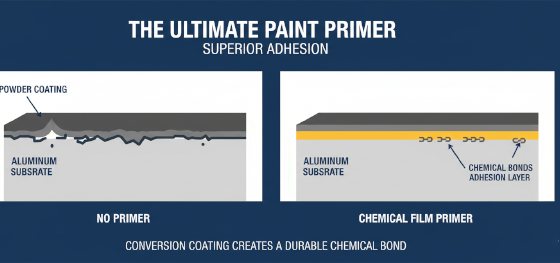
Beyond corrosion and conductivity, chem film serves a third, vital role: it is the perfect primer. Aluminum is notoriously difficult to paint. Raw aluminum develops a natural oxide layer that is slightly oily and very unstable. If you apply powder coating or liquid paint directly to raw aluminum, the coating will eventually flake off in large sheets, a failure known as delamination. Chromate conversion coating provides a stable, chemically active surface that "locks" onto the paint.
The microscopic "nooks and crannies" of the conversion film provide a high surface energy that increases the mechanical and chemical bond of the topcoat. JUCHENG recommends a chem-film pre-treatment for any aluminum part destined for high-durability powder coating. This dual-layer system—Alodine base plus polymer topcoat—is the gold standard for outdoor enclosures and marine equipment. It ensures that even if the paint is scratched, the aluminum underneath won't start to "creep" and lift the rest of the finish. We manage this integrated workflow in-house, ensuring that the time between the chem-film tank and the powder booth is minimized, preventing any surface contamination that would compromise the bond.
Lo standard JUCHENG: verifica della resistenza di contatto

The final hallmark of a professional finisher is the ability to prove the performance. In the trattamento superficiale per lavorazioni CNC of electronic parts, the visual appearance of the chem film is secondary to its electrical performance. At Jucheng Precision, we don't just "dip and ship." We utilize specialized surface resistance probes to verify that our Class 3 coatings meet the specific micro-ohm requirements of your engineering drawing.
Our quality control team performs standardized contact resistance tests, measuring the millivolt drop across the surface under a specific load. This data is recorded and provided to our clients as part of their final inspection package. We also perform "Tape Adhesion Tests" (ASTM D3359) to ensure the film is structurally integrated with the aluminum substrate. Whether you are building 10,000 small electronic connectors or a single massive satellite chassis, Jucheng Precision has the technical rigor and the metallurgical expertise to deliver. We don't just provide a finish; we provide a verified engineering solution. Contact our team today for a full DFM review and see how our chromate conversion protocols can secure your next high-performance aluminum project.

