


Nel catalogo dei materiali ingegneristici, il colore raramente è una questione di moda. Per la maggior parte delle materie plastiche, scegliere una variante nera è una decisione ingegneristica deliberata basata sulla sopravvivenza. Mentre il nylon naturale standard (che è tipicamente di colore bianco sporco o crema) è un materiale eccellente per parti meccaniche da interni, spesso soccombe alle dure realtà del mondo esterno. Luce solare, attrito e calore sono i nemici naturali dei polimeri. Per contrastare queste forze, i produttori introducono additivi chimici specifici che trasformano il materiale a livello molecolare, dando origine alla finitura nera profonda che riconosciamo come nylon nero.
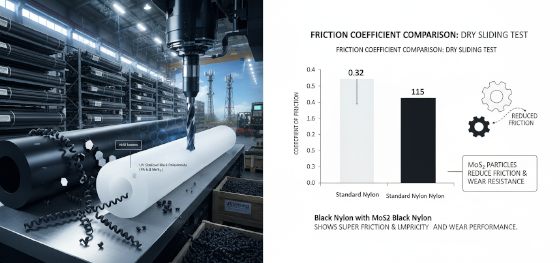
Il successo nella lavorazione CNC del nylon per applicazioni ad alte prestazioni spesso dipende dalla comprensione che il nylon nero non è semplicemente "nylon naturale con un colorante". È un composito migliorato progettato per una durabilità a lungo termine. Che sia riempito con Carbon Black per la stabilità UV o Disolfuro di Molibdeno (MoS2) per una lubrificazione estrema, il nylon nero richiede un approccio tecnico specifico durante la fase di produzione. Presso Jucheng Precision, abbiamo perfezionato la lavorazione del nylon nero per settori che vanno dall'agricoltura all'aerospaziale, garantendo che ogni parte non solo abbia un aspetto professionale, ma funzioni perfettamente nelle condizioni più difficili.
Se il tuo progetto coinvolge componenti che vivranno sotto la luce diretta del sole o all'interno di un cambio ad alta velocità senza lubrificazione costante, il nylon nero è probabilmente il materiale che fa per te. Questa guida approfondisce la chimica nascosta delle poliammidi nere, i vantaggi tecnici degli additivi MoS2 e le strategie di precisione che JUCHENG impiega per fornire parti estetiche e di alta precisione ai nostri partner globali.
contenuto:
La chimica nascosta: Carbon Black e MoS2
Superiore resistenza UV per longevità all'aperto
Il fattore lubrificazione: perché il nylon nero funziona più freddo
Sfide di lavorazione e controllo estetico
Scorte strategiche e competenza di JUCHENG
La chimica nascosta: Carbon Black e MoS2
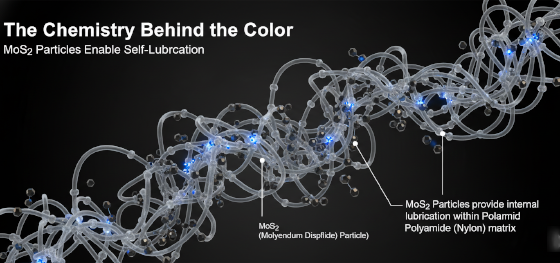
Per capire perché la lavorazione del nylon nero è così critico, dobbiamo prima guardare cosa lo rende nero. Esistono due tipi principali di nylon nero utilizzati nella moderna produzione CNC, ciascuno con uno scopo distinto. Il primo è il nylon riempito con Carbon Black. Il Carbon Black è un pigmento fine che viene mescolato nella resina. Oltre a fornire colore, agisce come assorbitore UV, impedendo la rottura delle catene polimeriche quando esposte alla luce.
Il secondo, e probabilmente più importante per l'ingegneria meccanica, è il nylon riempito con MoS2 (spesso chiamato Nylon MD). Il Disolfuro di Molibdeno è un lubrificante secco che viene disperso nella matrice di nylon. Questi fiocchi microscopici di MoS2 conferiscono al materiale la sua caratteristica lucentezza metallica grigio scuro o nera. Agiscono come cuscinetti a sfera interni, riducendo drasticamente l'attrito della parte. Questa integrazione chimica significa che le proprietà autolubrificanti non sono solo un rivestimento superficiale: sono presenti in tutto lo spessore del materiale. Presso Jucheng Precision, identifichiamo l'additivo specifico nella scelta del materiale durante la nostra revisione DFM per garantire che la chimica interna del materiale sia allineata con i tuoi obiettivi prestazionali.
Superiore resistenza UV per longevità all'aperto
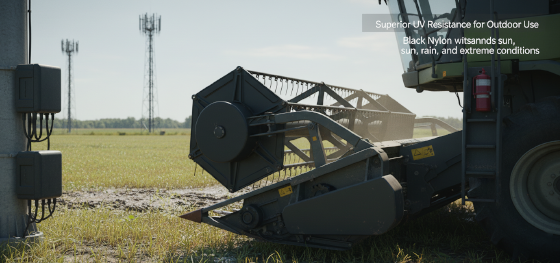
Photodegradation is the slow death of plastics. Natural nylon, when exposed to direct sunlight, undergoes a chemical reaction that causes "embrittlement." The material turns yellow, develops surface micro-cracks, and eventually loses its impact strength, causing parts to snap under loads they once easily carried. This is a primary failure mode for outdoor equipment in the agricultural and telecommunications sectors.
Black nylon effectively solves this problem. The carbon black particles act as a "sunblock" for the polymer. They absorb the ultraviolet radiation and dissipate it as heat before it can damage the long molecular chains of the polyamide. This UV stability ensures that parts machined by Jucheng Precision maintain their mechanical integrity for years, even in the harshest desert or marine environments. For our clients building outdoor sensors, drone components, or solar panel tracking mounts, black nylon is the mandatory standard for reliability. It represents the difference between a part that lasts one season and a part that lasts a decade.
Il fattore lubrificazione: perché il nylon nero funziona più freddo
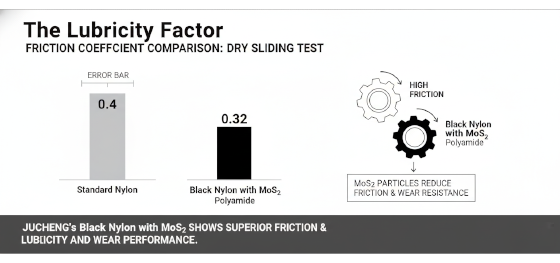
In high-friction applications like gears, wear strips, and bushings, heat is the ultimate enemy. When a standard nylon gear runs against a metal shaft, friction generates thermal energy. If that heat cannot be dissipated, the nylon softens, its dimensions shift, and the gear teeth eventually strip. la lavorazione del nylon nero with MoS2-filled grades addresses this by significantly lowering the starting friction of the system.
The MoS2 particles increase the material's "crystallinity," making the black nylon slightly harder and more wear-resistant than its natural counterpart. More importantly, they provide a higher PV (Pressure-Velocity) limit. This means a black nylon bushing can operate at higher speeds or under heavier loads before reaching its failure temperature. At JUCHENG, we frequently recommend MoS2-filled black nylon for automated machinery components where external lubrication is messy or impossible to maintain. The parts run quieter, cooler, and longer, providing a maintenance-free solution that lowers the total cost of ownership for the end-user.
Sfide di lavorazione e controllo estetico
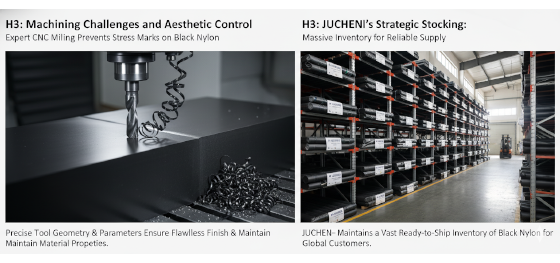
From a machinist's perspective, lavorazione CNC del nylon on black grades requires a delicate touch to maintain aesthetic perfection. One of the most common issues is "stress whitening." If the cutting tool is dull or if the feed rate is too high, the localized pressure can cause the black nylon to turn a chalky white at the point of contact. These marks are permanent and ruin the professional look of the component.
Jucheng Precision solves this by utilizing ultra-sharp, polished carbide tooling with high positive rake angles. We want to "shear" the material cleanly rather than "plowing" through it. We also manage the chip load meticulously. Because black nylon is often stiffer than natural nylon (due to the MoS2), the chips can be quite abrasive. We use high-pressure air and flood coolant to ensure these chips are evacuated instantly before they can re-cut and leave scratch marks on the finished surface. This attention to detail results in a deep, consistent black finish that is free of burrs and fuzz—a quality standard that JUCHENG is known for in the high-end industrial market.
Scorte strategiche e competenza di JUCHENG
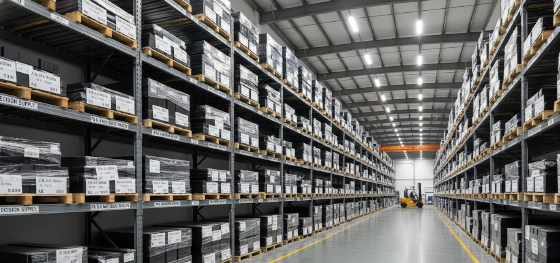
Material availability is often the bottleneck of production. At Jucheng Precision, we recognize that our clients in the agricultural, heavy equipment, and outdoor lighting industries cannot afford to wait weeks for specialty stock. We maintain a strategic inventory of high-quality black nylon 6 and 66, as well as MoS2-filled variants, in various rod and plate dimensions. This allows us to move from quote to production in days rather than weeks.
Our expertise extends to the management of nylon's greatest weakness: moisture absorption. Even though black nylon is more stable in sunlight, it is still hygroscopic. It still swells in humid environments. JUCHENG engineers provide custom tolerance advice based on your part's final destination. We calculate the expected moisture expansion and "over-machine" or "under-machine" accordingly, ensuring that your black nylon parts fit perfectly whether they are being installed in the humid tropics or the dry arctic. When you choose Jucheng Precision, you aren't just getting a shop that cuts plastic; you are getting an engineering partner that understands the long-term lifecycle of your components. Contact us today to see how our expertise in la lavorazione del nylon nero can armor your designs against the elements.

