


La luce è il critico più onesto della produzione. Nel vuoto digitale di un ambiente CAD, "trasparente" è una semplice casella da spuntare, ma nel panorama fisico della materiali per stampa 3D, raggiungere la vera trasparenza è una lotta brutale contro le leggi della rifrazione. La maggior parte degli ingegneri rimane delusa dal primo tentativo di stampare in 3d trasparente componenti; ciò che arriva come un modello di cristallo sullo schermo spesso emerge dalla macchina come un oggetto lattiginoso e traslucido che disperde la luce come una finestra smerigliata. Questa opacità non è un fallimento del materiale, ma un fallimento del processo. La trasparenza non è una proprietà intrinseca della sola resina: è un risultato ingegnerizzato che richiede la rimozione di ogni microscopica linea di strato e vuoto interno che potrebbe intrappolare un fotone.

Presso Jucheng Precision, riconosciamo che una guida di luce o un collettore medico è funzionale solo se è invisibile. Abbiamo trascorso anni a padroneggiare la delicata sinergia tra fotopolimeri ad alta purezza e post-elaborazione avanzata per fornire componenti che rivaleggiano con la chiarezza del vetro stampato a iniezione. Comprendiamo che il successo nel processo di stampa 3d ottico si trova negli ultimi cinque micron di rifinitura superficiale. Che tu stia validando un nuovo design di faro automobilistico o un intricato chip microfluidico, il percorso verso la chiarezza "acqua-trasparente" richiede un impianto che rispetti la fisica dell'indice di rifrazione. Questa guida va oltre i tutorial di base per esplorare i pilastri tecnici dell'ottica SLA, la realtà ad alta intensità di lavoro della lucidatura meccanica e perché i protocolli di finitura integrati di JUCHENG assicurano che i tuoi progetti siano visti attraverso, non solo visti.
L'efficienza nella produzione trasparente è una questione di gestione dell'energia superficiale. Non stai solo costruendo un pezzo; stai creando un'interfaccia per la luce. Analizziamo i pilastri tecnici della produzione additiva trasparente e vediamo come JUCHENG trasforma stampe opache in capolavori ottici.
Sovranità rifrattiva: Perché SLA domina l'ottica trasparente
Livellamento meccanico: La scala di levigatura a più stadi
Alchimia chimica: La lucidatura a vapore e i suoi limiti
Trappola della traslucenza: La fisica dei filamenti FDM trasparenti
Validazione fotometrica: Prototipazione per illuminazione automobilistica
Standard integrato JUCHENG: Preservare l'anima ottica
Sovranità rifrattiva: Perché SLA domina l'ottica trasparente

Se vuoi un pezzo attraverso cui leggere il testo, devi eliminare la dispersione interna. Ecco perché la stereolitografia è il leader indiscusso nella ricerca di stampare in 3d trasparente hardware. The technology uses a liquid vat of photopolymer resin, which ensures a nearly 100% dense structure. Unlike powder-bed or filament-based methods, there are no microscopic air pockets trapped between layers. These air pockets are the primary source of internal refraction; as light passes from a solid plastic into a tiny air void and back into plastic, it bends at dozens of random angles, creating a hazy appearance.
At Jucheng Precision, we utilize specialized clear resins specifically formulated for low-yellowing and high UV stability. During the build, we adjust the laser’s "Cure Depth" to ensure the bond between layers is chemically and physically seamless. This creates an isotropic block of material where the refractive index is consistent throughout the entire volume. This "Refractive Sovereignty" is the foundation of high-end optical manufacturing. However, even the best SLA print comes off the build plate with a matte surface due to the pixelation of the laser or the DMD chip. While the internal structure is clear, the exterior is still a "diffuser." Turning this raw print into a transparent lens requires a transition from the machine to the polishing bench, where the real transformation begins.
Livellamento meccanico: La scala di levigatura a più stadi
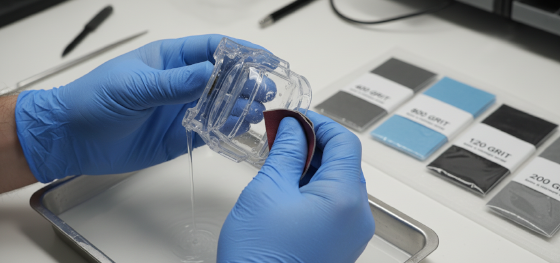
The road to clarity is paved with abrasive paper. Many shops attempt to jump directly to a buffing wheel, but this only creates a "shiny haze"—a surface that reflects light but is still distorted by the tool marks beneath the gloss. Successful stampare in 3d trasparente finishing is an exercise in technical patience. JUCHENG technicians move through a rigorous, documented ladder of wet-sanding stages. We start with 400 grit to remove the primary layer lines, then move systematically through 600, 800, 1200, and finally 2000 grit.
Each step must completely erase the scratch pattern of the previous one. We use water as a constant lubricant to prevent the resin from clogging the paper and generating frictional heat, which can "smear" the plastic. By the time a part reaches the 2000-grit stage, it should have a smooth, satin-like translucency. This mechanical leveling is the most labor-intensive part of the process, but it is the only way to ensure that the final polishing stage results in a distortion-free view. For our medical and aerospace clients, this precision is mandatory; a distorted view through a transparent manifold could hide a critical air bubble or a crack in a fluid line. We treat the sanding phase as a study in surface topography, preparing the part for the final leap into transparency.
Alchimia chimica: La lucidatura a vapore e i suoi limiti

When a part features intricate internal channels or deep, unreachable bores, mechanical sanding is a physical impossibility. This is where chemical vapor polishing provides a technical workaround. By exposing certain transparent polymers to a solvent vapor—typically a specialized blend suited for the specific resin chemistry—we can achieve a non-contact leveling of the surface. The vapor condensed on the surface causes the top few microns of the plastic to melt and flow into the microscopic valleys of the tool marks.
However, JUCHENG engineers provide a critical warning: chemical polishing is not a universal cure. It can introduce internal stresses that lead to "crazing"—microscopic cracks—if the part is later exposed to alcohol or temperature shifts. Furthermore, vapor polishing can slightly round off sharp edges, which might be a problem for parts requiring precise mechanical interlocks. At Jucheng Precision, we often use a hybrid approach: mechanical buffing for the primary exterior surfaces to maintain dimensional truth, and vapor polishing for the internal "hidden" geometries. This ensures your stampare in 3d trasparente project maintains its sharp industrial lines while achieving the internal clarity needed for functional fluid or light passage. We bridge the gap between aesthetics and stability by selecting the finishing method that respects the geometry of your design.
Trappola della traslucenza: La fisica dei filamenti FDM trasparenti

We must address a frequent point of confusion for our clients: "Can I use FDM to stampare in 3d trasparente parts?" Filaments like Clear PETG or Polycarbonate are marketed as "transparent," but in reality, they exist in a "Translucency Trap." Because FDM works by extruding a round bead of plastic, there are always microscopic triangular air gaps between the rows and layers. These millions of air pockets act as light-scattering prisms. No matter how much you sand the outside of an FDM part, the interior will remain foggy because the light is being destroyed by the internal structure.
FDM is an excellent tool for light *diffusion*. If your goal is a lampshade or an indicator cover where you want the light to be soft and spread out, clear PETG is a cost-effective choice. But if your goal is visibility—seeing through a lens or guiding a laser beam—FDM is the wrong tool. At Jucheng Precision, we are honest about these physical limits. We steer clients who need true vision toward our industrial SLA lines. By understanding that "clear material" does not equal "clear part," we help you avoid the frustration of spending a budget on a technology that is physically incapable of reaching your optical goals. We match the physics of the process to the mission of your part.
Validazione fotometrica: Prototipazione per illuminazione automobilistica

The most demanding proving ground for stampare in 3d trasparente components is the automotive lighting lab. Before a headlight design moves to a million-dollar production mold, the prototype must undergo "Photometric Testing." This involves measuring the exact beam pattern and luminous intensity to ensure it meets road safety regulations. If the prototype lens has even a 5% deviation in transparency or a slight internal cloudiness, the light bench data will be useless.
JUCHENG specializes in these high-fidelity prototypes. We utilize ultra-clear Somos resins and 5-axis finishing to create lenses that are indistinguishable from production polycarbonate. We understand that in the automotive sector, transparency is a safety parameter, not a decorative one. Our light pipes and lens prototypes allow designers to verify their "Light Signature" in real-time, accelerating the development of the next generation of LED systems. By providing parts that are optically true to the production design, we ensure that your R&D data is a reliable roadmap for final assembly. We don't just print light; we control its path.
Standard integrato JUCHENG: Preservare l'anima ottica

The final hallmark of a professional manufacturing partner is the ability to prove the clarity. Transparency is a measurable metric, and Jucheng Precision has invested in the metrology needed to validate it. Our quality control team utilizes light transmission meters to ensure that your stampare in 3d trasparente parts meet the required percentage of efficiency—typically 88% to 92% for high-end resins. We also perform "UV Ageing" simulations for our outdoor clients to verify that the clear parts won't turn yellow after a month in the sun.
We understand that a transparent part is a fragile asset. After the final polish, our parts are handled only with lint-free silk gloves and are immediately protected with anti-static films and vacuum packaging to prevent even a single microscopic scratch during transit. Whether you are building an innovative heart-pump chamber or a high-performance light guide, JUCHENG provides the technical rigor and the finishing expertise to bring your vision into the light. We don't just cut and print; we engineer the light path that defines your product's quality. Contact Jucheng Precision today for a technical DFM review and see how our transparent 3D protocols can clarify and elevate your next breakthrough.

