

Il tuo prototipo è approvato. Funziona. Ha un bell'aspetto. Ora arriva la prossima grande domanda. Come ne produci un migliaio? O diecimila? O di più?

Creare un singolo pezzo perfetto è una sfida. Ricreare quella perfezione migliaia di volte con incredibile velocità e coerenza è un'altra sfida completamente diversa. Questo è il ponte che devi attraversare dal prototipo alla produzione.
Per creare parti in plastica di alta qualità su larga scala, un processo si distingue sopra tutti gli altri. È lo standard di riferimento della produzione. È il motore della produzione di massa moderna. Quel processo è Stampaggio a iniezione.
Questa guida servirà come introduzione completa a questa potente tecnologia. Esploreremo il processo, i materiali, le regole di progettazione e i costi. È la tua mappa stradale per navigare con successo il percorso verso la produzione scalabile.
Analisi del Processo di Stampaggio a Iniezione
Un Mondo di Materiali per Stampaggio a Iniezione
Progettare per il Successo (DFM)
Esplorazione delle Tecniche Avanzate
Decodifica della Struttura dei Costi
Perfezionare l'Aspetto Finale: Finiture Superficiali
Garantire la Qualità, Evitare Difetti
Alimentare le Principali Industrie del Mondo
Analisi del Processo di Stampaggio a Iniezione
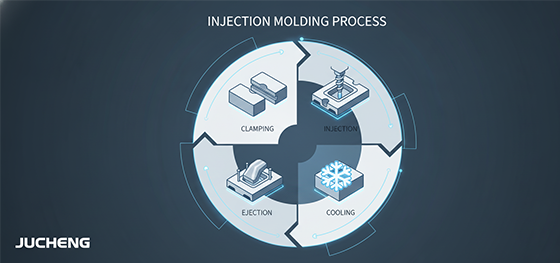
Il Processo di stampaggio a iniezione is a high-speed cycle of creation. It is a highly controlled and repeatable dance of pressure, heat, and motion. The cycle includes mold closing, filling and packing, cooling, and ejection.
It begins with Clamping. The machine holds the mold closed against the pressure generated during filling and packing. Required clamp force depends on the projected area and cavity pressure, rather than a fixed tonnage range for every part.
Next is Injection and Packing. Plastic pellets are melted in the barrel and injected into the mold cavity. Filling time depends on the part, material, and process settings. Packing or holding pressure then feeds additional material into the cavity to compensate for cooling shrinkage while the gate remains open.
Cooling continues while the mold remains closed until the part is sufficiently solid for ejection. The material shrinks as it cools, so the final dimensions are not an exact copy of the cavity dimensions. Cooling is often the longest portion of the cycle.
Infine, l'Espulsione. Lo stampo si apre e un sistema di perni espulsori spinge fuori il pezzo ormai solido. Il pezzo cade in un contenitore di raccolta e il ciclo ricomincia immediatamente.
Un Mondo di Materiali per Stampaggio a Iniezione
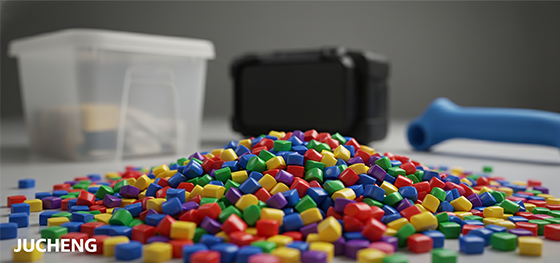
Un'incredibile varietà di termoplastica Materiali per stampaggio a iniezione possono essere utilizzati. Scegliere quello giusto è una decisione di progettazione critica.
Le plastiche commodity sono i cavalli di battaglia. Materiali come il Polipropilene (PP) e il Polietilene (PE) sono a bassissimo costo e vengono utilizzati per beni di consumo quotidiani, imballaggi e giocattoli.
Le plastiche tecniche offrono un salto di prestazioni. ABS, Policarbonato (PC) e Nylon (PA) forniscono un ottimo equilibrio tra resistenza, resistenza agli urti e costo. Sono la spina dorsale di parti automobilistiche, involucri elettronici e beni durevoli.
High-performance thermoplastics such as PEEK and PEI (ULTEM) can be considered for demanding applications, but their heat and chemical resistance are not interchangeable. Evaluate the specific grade against the operating temperature, load, chemicals, and exposure conditions. Aerospace or medical use requires assessment of the selected grade and finished part for the intended application, not just the polymer name.
Thermoplastic elastomers (TPEs), including thermoplastic polyurethane (TPU), cover a range of hardness and performance characteristics. Selected grades can be used for grips, seals, and overmolded parts; suitability depends on the specific formulation, operating temperature, fluid exposure, and mechanical requirements. For overmolding, substrate compatibility and bond performance also need evaluation. At JUCHENG, we stock over 50 common resins and can help you select the perfect material.
Progettare per il Successo (DFM)
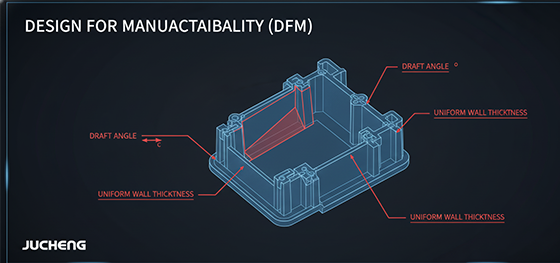
Non puoi semplicemente prendere un progetto realizzato per la stampa 3D e iniettarlo. Un pezzo deve essere specificamente progettato per il processo di stampaggio. Questo si chiama Progettazione per la Produzione, o DFM.
Corretto Progettazione per stampaggio a iniezione is a deep topic. But two rules are the most important. First, maintain a uniform wall thickness. Thick sections cool slower than thin sections, which can cause ugly sink marks and warping. Second, assess draft relative to the intended pull direction, taking the material, surface texture, and feature depth into account. Draft helps surfaces release from the mold. Intentional undercuts, such as snap-fit features, need an appropriate tooling and release strategy rather than a blanket draft rule.
Comprendere il DFM è fondamentale per il successo. In JUCHENG, la nostra revisione DFM gratuita è una parte fondamentale del nostro servizio. I nostri ingegneri analizzano il tuo progetto e forniscono feedback esperti per prevenire problemi prima che si verifichino.
Esplorazione delle Tecniche Avanzate

Lo stampaggio moderno è in grado di realizzare una complessità incredibile. Il dibattito tra sovrastampaggio vs stampaggio con inserto mostra due tecniche potenti.
Insert molding places a preformed component into the mold before plastic injection. For a threaded metal insert, plastic surrounds the external body to retain it while the internal thread remains accessible for a screw. Molded-in inserts are one option; heat or ultrasonic installation into thermoplastics and other post-mold methods may also be suitable. Choose the insert and installation method for the plastic, joint loads, and assembly requirements.
Overmolding adds a molded material over a substrate. In pick-and-place molding, previously molded substrate parts are placed into a separate overmold tool. Two-shot molding instead forms and overmolds the substrate in an integrated sequence, using approaches such as transfer, rotation, or core-back tooling. A soft TPE grip over a rigid substrate is one application, not the only material combination. Material compatibility and processing conditions must be evaluated for the intended bond.
Decodifica della Struttura dei Costi
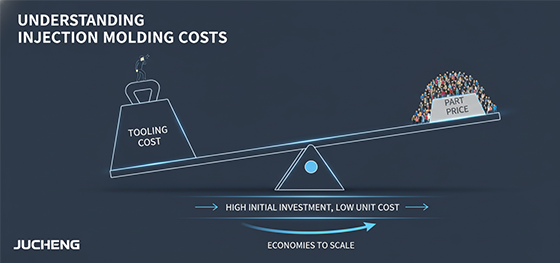
Comprendere il costo dello stampaggio a iniezione è fondamentale per pianificare il tuo progetto. È una storia di due numeri: il costo dello stampo e il prezzo del pezzo.
Tooling is an upfront project cost. Injection molds may use aluminum or steel; tooling cost depends on the part size and complexity, mold material, cavity count, and required finish.
Per-part cost depends on material consumption, machine time, cycle time, and the number of parts produced per cycle. Increasing production quantity spreads the upfront tooling cost across more parts, but does not guarantee a particular unit price or make molding the lowest-cost option for every project. Compare total project costs at the required quantity. For smaller volumes, JUCHENG offers low-volume tooling options that lower your upfront investment.
Perfezionare l'Aspetto Finale: Finiture Superficiali
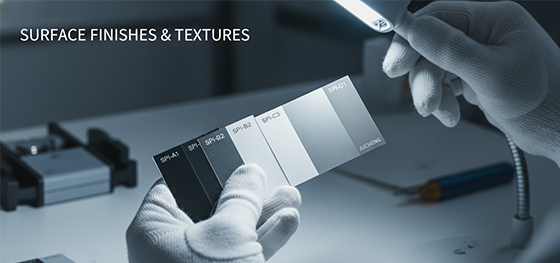
The mold surface influences the molded finish, but the selected resin and additives can affect how the texture appears on the part. This means we can achieve a huge variety of finiture superficiali per stampaggio a iniezione trattando lo stampo in acciaio stesso.
The industry uses SPI (Society of the Plastics Industry) standards to define these finishes. SPI-A1 specifies a diamond-polished mold finish associated with high gloss, while B-grade finishes use abrasive paper. C and D finishes use different methods: SPI-C1 uses a 600-grit stone, whereas SPI-D1 uses dry blasting. The molded appearance should be checked with the selected material rather than assumed from the finish designation alone.
We can also create complex patterns. VDI 3400 provides a reference for specifying EDM surface-texture grades; it is not the machining operation itself. Electrical discharge machining (EDM), also called spark erosion, can produce the mold texture. Other custom textures, like a leather grain, can also be chemically etched into the mold. This allows you to create beautiful, finished parts directly from the machine.
Garantire la Qualità, Evitare Difetti

Un processo veloce è inutile senza qualità. Un produttore professionale ha un sistema robusto per prevenire difetti di stampaggio a iniezione.
Defects such as sink marks and warping can result from interacting part-design, material, mold, and process factors. DFM can identify risks early, but proposed changes still need evaluation through molding trials and part inspection.
Flash and short shots also require assessment of the part geometry, mold design and condition, material, and process settings. Our experienced engineers use advanced tools like Moldflow simulation to predict how the plastic will flow. Simulation helps identify flow risks and compare design options; its predictions depend on the input data and modeling assumptions and must be checked against molding trials. During production, we use a data-driven "scientific molding" approach. Monitoring pressure, temperature, and time can help detect process variation, but monitoring alone does not establish that every part meets its requirements. Process validation and the applicable part inspections and acceptance criteria remain necessary. Finally, our QA department uses CMMs and other tools to verify that the final parts meet every one of your specifications.
Alimentare le Principali Industrie del Mondo

Il I settori di applicazione dello stampaggio a iniezione sono virtualmente infiniti. Se un prodotto è fatto di plastica e prodotto in grandi volumi, è probabile che sia stato stampato a iniezione.
Nell'industria automobilistica, produciamo pezzi che devono soddisfare il rigoroso standard di qualità IATF 16949. Nel campo medico, operiamo secondo la ISO 13485 per creare componenti per dispositivi da materiali biocompatibili. Per l'elettronica di consumo, eccelliamo nella produzione di involucri a parete sottile e belli che definiscono i prodotti moderni.
Possedere queste certificazioni chiave non è solo una formalità. È la prova che abbiamo i processi, la tracciabilità e la mentalità di qualità per servire le industrie più esigenti del mondo. È la tua garanzia che siamo un partner di cui ti puoi fidare.
Scegliere di investire nello stampaggio a iniezione è un passo importante. È il passo che porta il tuo prodotto da un prototipo a un prodotto reale e scalabile. In JUCHENG, siamo specializzati nell'aiutare le aziende a fare questa transizione, specialmente per la produzione a basso volume. Siamo il tuo partner esperto nel percorso verso il successo sul mercato.